The rain had stopped pretending to be gentle. It came down in hard, metallic drops that flattened the late-autumn leaves into a slick, bruised carpet. Miriam sank into it anyway, knees soaking through, palms pressed to her face as if she could hold her grief inside her skull. Her shoulders convulsed. Every breath rasped like she was inhaling splinters.
Jonah stood beside her, not kneeling, not fully standing—hovering in that helpless in-between. His jaw was locked so tight the tendons in his neck stood out. He stared at the stone as though staring long enough might undo it, might make it a mistake someone would apologize for.
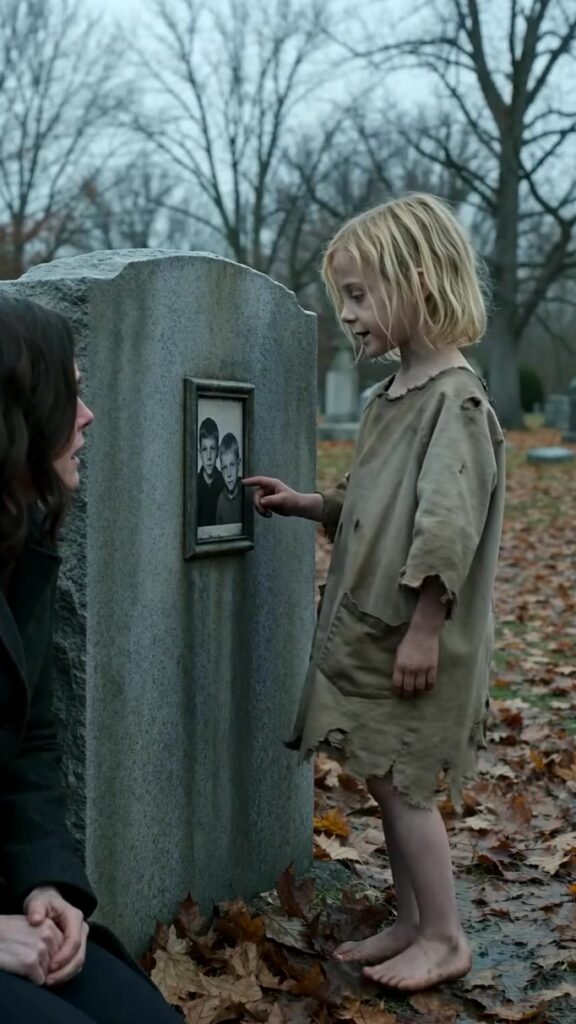
The headstone was gray and new, a sharp slash against the wet earth. Inset into it was a photograph sealed under glass. Two boys looked out from another season of life, cheeks flushed, eyes bright with the kind of trust that seemed obscene now. Eli and Noah. Their names carved beneath, dates too short, a dash like a wound between.
Miriam tried to speak, but her throat collapsed around the words. Jonah’s hand hovered over her shoulder and then fell, useless. Somewhere in the cemetery, wind tugged at the bare branches and made them clatter like teeth.
That was when the voice came—small, unhurried, more certain than anything in the storm.
“They’re not alone.”
Miriam lifted her head. Rain had pasted hair across her cheeks; her eyes felt flayed. Across the narrow strip of grass that separated their plot from the next, a little girl stood as if she’d been placed there. She couldn’t have been older than six or seven. She was barefoot on the freezing ground, toes reddened, ankles smeared with mud. A thin smock hung from her shoulders in torn folds, as if it had been slept in for days. Her hair was pale enough to look almost white in the dim light, and it moved in the wind like it belonged to some other climate.
She pointed—one dirty finger extended, steady—at the photograph of the boys.
Jonah’s breath snagged. He had the irrational urge to step in front of the stone, to block the child’s gaze, as if her seeing could change what was already carved.
“What did you say?” he asked. His voice came out lower than he intended.
The girl didn’t shift under his attention. Her eyes were too calm, not glassy with innocence, but polished with something older. “They’re with me,” she said, as if it were a simple fact, like the rain being cold.
Miriam’s confusion rose like nausea. “With you?” she whispered. “Who are you? Where’s your mother?”
The child’s chin tipped toward the eastern fence line beyond the cemetery, toward the city that blurred under rain. “They told me the place. East Side Home.”
The words landed like stones in Miriam’s chest. The East Side Home wasn’t a place people mentioned out loud. A private orphanage closed years ago after investigations, after whispers of records lost and files burned. Jonah had only ever driven past it once, the boarded windows staring back like blind eyes.
“That’s… that’s not possible,” Jonah said, though he didn’t believe his own protest. Something in the way the girl said it made possibility irrelevant.
She slipped a hand into her pocket and drew out a toy: a little soldier no taller than Jonah’s thumb, its paint worn away so that the shape was mostly mud-brown. Still, the silhouette was unmistakable—helmet, raised arm, the tiny stamped base. The boy’s favorite. Noah carried it everywhere until Jonah, trying to be careful, tried to keep it safe. The last time he’d seen it was the day the casket closed. Miriam had insisted it go with him, because she couldn’t bear the thought of Noah waking somewhere without it.
Miriam made a sound that might have been a cry, might have been the body’s involuntary refusal to accept what the eyes were witnessing. “No,” she breathed. “No, that was—”
The girl held the soldier out as if offering a lost glove. “He said it gets cold,” she murmured. “And that you put it near his hand so he wouldn’t be scared.”
Jonah’s stomach rolled. He had been the one who’d placed it, fingers trembling, whispering an apology into the satin. Nobody else had been close enough to see. The funeral director had politely looked away.
“Where did you get that?” Jonah demanded. His voice cracked, rage scraping at the edges of terror. “Did someone give you that? Did you… did you take it?”
The girl’s gaze slid past him to the stone, to the picture under glass. “I didn’t take it,” she said. “They did.”
Miriam pushed herself upright on shaking hands, wet sleeves dragging through leaves. “Who is ‘they’?” Her eyes searched the empty grounds as if expecting two small figures to step out from behind the maple trees. “Sweetheart, please. Tell us who you are.”
The child’s mouth trembled, not with fear, but with effort, as if she were holding back a tide. “My name was Lark,” she said. “They called me that at the Home. I didn’t have shoes then either.”
Jonah’s throat tightened. “Was,” he repeated, the word tasting wrong. “What do you mean, was?”
Lark lowered the soldier and stared at her own bare feet. Rain ran down her shins in rivulets. “I’m not supposed to be here long,” she said. “The ground tries to keep you when you come back.”
Miriam’s hands flew to her mouth. The cemetery seemed suddenly too small, the air too thin. “Come back from where?”
Lark looked up again. Her eyes, pale and reflective, held Jonah with a strange kind of pity. “From the rooms under the Home,” she said softly. “The ones they bricked up after the fire. The ones with the names on the wall.”
Jonah felt his knees weaken. He caught himself on the stone, palm smearing rain across Eli’s engraved name. “What names?” he rasped.
Lark’s finger lifted again, not to the photograph this time, but to Jonah and Miriam. “Your names,” she said. “And theirs.”
Miriam shook her head violently, denial thrown like a shield. “No. We… we had them. We carried them home. We—”
Lark’s voice dropped, and the wind seemed to lean in to hear it. “One of them asked me to tell you,” she said. “He said… he said you were chosen. That’s what the papers said. Chosen is nicer than stolen.”
The word stole the color from Jonah’s face. His mind flashed, unbidden, to the adoption agency office: the smiling counselor, the reassuring tone, the way certain questions had been gently redirected. He had wanted to believe so badly that the universe was finally handing them mercy that he hadn’t noticed the shadows behind the paperwork.
Miriam’s breath came in frantic bursts. “They’re ours,” she insisted, the statement breaking as soon as it left her mouth. “They’re ours.”
Lark didn’t argue. She only extended the soldier again, palm up, as if returning a piece of truth too heavy for a child to carry. “They loved you,” she said. “That part is true. They wanted you to know it before…”
“Before what?” Jonah said.
Behind Lark, the cemetery gate groaned on its hinges, though no one touched it. The sound made Jonah flinch. Lark’s eyes flicked toward it. Something like fear finally crossed her face—not fear of Jonah, but of time.
“Before the Home calls you back,” she whispered. “It doesn’t like its secrets buried.”
Miriam stepped forward, muddy hands outstretched. “Wait—please. Help us. Tell us what happened to them. Tell us what happened to you.”
Lark’s expression softened in a way that hurt more than any horror. “They’re not hurting now,” she said. “Not like the ones in the walls.”
The rain began to thin, as if the sky were running out of cruelty. A hush settled. Jonah blinked, and for a heartbeat he thought he saw two small silhouettes standing behind Lark—two boys, hair plastered to their foreheads, looking not afraid but urgent. He blinked again and they were gone, leaving only the trembling air.
Lark’s hand closed around the toy soldier. “I can’t stay,” she said. “But you can go. You can find the room.”
Jonah swallowed hard. “How?”
Lark turned her palm upward. In the center of her muddy hand was a key, old and iron-dark, its teeth jagged with rust. Jonah hadn’t seen where it came from. It simply existed, heavy with implication.
“They hid it in the drain by the laundry stairs,” Lark said. “The East Side Home still has the stairs.” She took Jonah’s hand—her fingers were cold as the headstone—and pressed the key into his palm. The metal burned like ice.
Miriam reached for Lark’s shoulder, desperate to anchor her, but her hand met only wet air. Lark had stepped back. Or faded. Jonah couldn’t tell which. The leaves behind her shivered as if something small had passed through them.
Then there was only the empty strip of grass, rain-slick and vacant, and the distant city humming like nothing had changed.
Jonah stood motionless, staring at the key in his hand until the shape imprinted itself onto his skin. Miriam clutched the headstone as if it were the only solid thing left in the world.
On the photograph, Eli and Noah’s eyes seemed to hold a new warning, a message Jonah had never known to look for: not goodbye—go.
And across the grave, where the girl had been, a single barefoot print filled slowly with rainwater, then overflowed, and vanished into the soaked earth.