The scream came from nowhere and everywhere at once—thin, raw, and tearing through the midday lull like metal on stone.
“Help me—please—IT HURTS!!”
The street had been a slow river of errands: grocery bags, coffee cups, sun-bleached flyers taped to a lamppost. The sound stopped it cold. Heads turned. A dog stopped barking. A bus hissed at the curb and exhaled passengers who froze mid-step, eyes searching for the source, as if the cry might be a trick of heat.
At the edge of the small parking lot, a black SUV sat idling in the sun without moving. Not idling, really—silent, windows darkened, doors locked. The air above the hood shimmered. A faint chemical smell floated on the breeze, hot plastic and something sweet turning sour.
The scream came again, muffled now, trapped behind glass.
Not one person moved closer. They did what people did: they formed a ring at a safe distance. They looked at each other with eyebrows raised, silently asking for permission to act and silently agreeing not to be first. Hands drifted to pockets. Phones appeared, lenses pointed like tiny weapons.
Caleb Mercer had been walking back from the hardware store with a roll of painter’s tape and a sack of screws he didn’t need. He had the kind of day you forget the moment it ends—until the scream welded it into his memory forever.
He pushed through the ring without thinking. The SUV’s paint was slick and immaculate, the kind of black that swallowed reflections. The windows were tinted, but when he pressed his face close he could make out a small shape in the back seat: a child, maybe six or seven, slumped sideways as if gravity had doubled. A pale forehead shone with sweat. Tiny hands beat weakly at the door handle. The child’s mouth opened and closed, each cry scraping against the glass and coming out broken.
Caleb tried the rear door. Locked. He tried the front. Locked. He rapped on the window. The child’s eyes fluttered up—wide, glassy, unfocused. Caleb saw the tremor in the kid’s lips. He saw the way their chest rose too fast.
“Hey,” Caleb said, too quietly, then louder, “Hey! It’s okay. Look at me. I’m here.”
Someone behind him called, “Did you call 911?” Another voice answered, “I’m on hold.” A third said, “Maybe the parent is nearby.” No one else touched the car.
Caleb circled the SUV. The sun hammered down. The asphalt smelled like scorched rubber. The vehicle’s metal radiated heat in waves, and he imagined the inside like an oven that had been preheating for an hour.
“We can’t wait,” he said to the ring of faces. No one replied, but a few phones rose higher, framing him, already turning him into a story.
He scanned the ground and found a jagged chunk of landscaping stone near a curb. He lifted it; it was heavier than it looked, gritty against his palm.
He hesitated for half a breath. Somewhere in his head, rules and consequences lined up in neat rows: property damage, lawsuits, the way people on the internet loved a villain more than a hero. Then the child’s knuckles thudded again, too weak, and the scream dissolved into a whimper that sounded like someone trying to swallow pain.
Caleb raised the rock and struck the rear window.
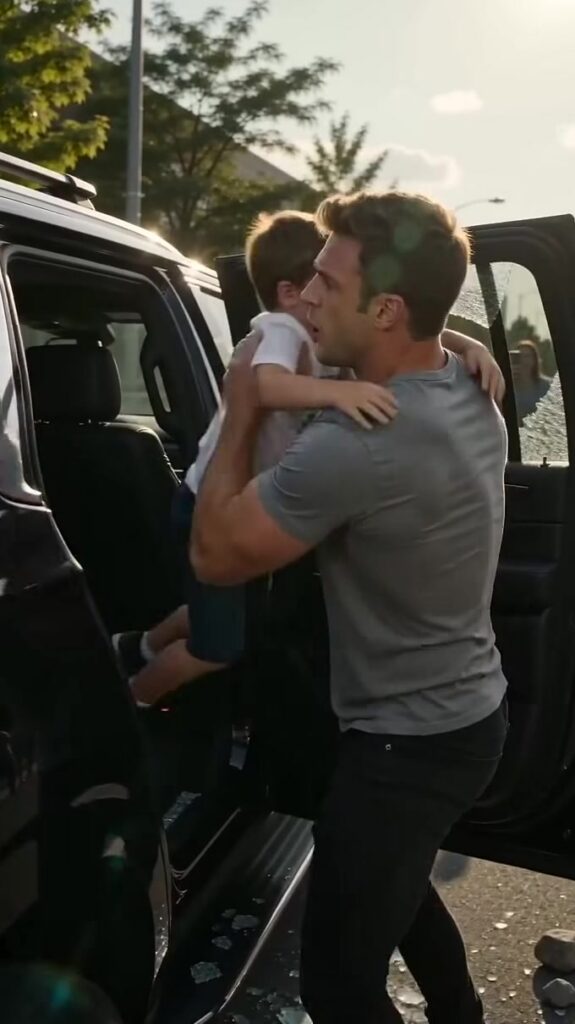
The first blow cracked the glass into a spiderweb. The second collapsed it outward with a sound like a gunshot. Glittering shards burst onto the pavement, raining over his arms and shoulders. A chorus of gasps rose from the crowd. The car alarm exploded into life—an endless, furious wail that made the scene feel more urgent and more unreal.
Caleb tore away the remaining glass with his sleeve, ignoring the sting, and reached in. Heat rushed out like breath from an open furnace. The child’s skin was hot to the touch, almost feverish. Caleb fumbled with the seat belt, fingers clumsy in panic. It finally clicked free. He scooped the child up, bracing their head against his shoulder, and backed away from the window.
The kid clung to him with a strength born of terror, fingers knotting in his shirt. Their hair was damp. Their eyelids fluttered, fighting to stay open.
“You’re okay,” Caleb said, though he didn’t know if it was true. “Stay with me. Keep your eyes open. What’s your name?”
The child’s lips moved. No sound. Then, faintly: “M…Mara.”
“Mara,” Caleb repeated. He looked around. “Water! Does anyone have water?”
A woman in a sunhat stepped forward, then stopped as if an invisible line cut across the asphalt. She held out a bottle at arm’s length, as though afraid to get too close to the broken glass, the alarm, the responsibility. Caleb took it, poured some into his palm, and dabbed it against Mara’s cheeks and lips.
For a single fragile moment, the world rearranged itself around him. The ring of people wasn’t a wall anymore; it was an audience. Their faces softened. Someone murmured, “Thank God.” Someone else whispered, “He saved her.” He felt the strange weight of being watched and approved of, and it was dizzying.
Then a voice cut cleanly through the car alarm, sharper than the siren, colder than the glass.
“What do you think you’re doing?”
The crowd parted the way water parts around a stone.
An elegant woman stepped into the space as though she belonged there. She wore a cream blouse that looked too expensive for the dusty parking lot and sunglasses that hid her eyes completely. Her hair was pulled back with perfect restraint. Not a strand was out of place. She did not look at the shattered window. She did not look at the child trembling in Caleb’s arms. She looked only at Caleb, assessing him the way someone might assess a stain on a tablecloth.
“Ma’am,” Caleb said, still crouched, arm around Mara’s back. “Your kid was locked in the car. She—she was overheating. I—”
“That is not your decision,” the woman replied, each word precise. Her mouth barely moved. “And that is not your child.”
The sentence dropped into the air like a weight. A hush fell over the ring of witnesses, and in the brief gap between the car alarm’s pulses, Caleb could hear the blood thudding in his own ears.
He stood slowly, keeping Mara pressed to his shoulder. “Are you her mother?” he asked.
The woman’s chin lifted a fraction. “I am the person responsible for her.”
“Responsible?” Caleb echoed, incredulous. “She was—she was—” He looked down at Mara’s flushed face. Her eyes were fixed on the woman now, wide with something beyond fear. Recognition, yes. And dread.
The woman stepped closer, heels clicking on the asphalt. Her hand extended, palm open, a gesture practiced to look gentle. “Come here,” she said softly, as if coaxing a skittish animal. “Mara. Don’t embarrass yourself.”
Mara’s grip tightened violently. The child’s nails dug into Caleb’s collarbone through the fabric.
“Don’t,” Mara breathed, the word barely audible but full of panic. Then, louder, desperate, spilling out like the earlier scream: “Don’t let her take me.”
Every phone in the circle held steady, recording the shift in the story. Caleb felt it—the moment the heroic narrative cracked like the window had, revealing something jagged underneath. A rescue was simple. This was not.
He swallowed, forcing his voice not to shake. “Why does she think you’ll hurt her?”
The woman smiled, and it was perfectly composed, the kind of smile meant for boardrooms and cameras. “Children are dramatic,” she said. “They say things. Especially when strangers put ideas in their heads.”
“I didn’t put anything—” Caleb began, but Mara’s small body stiffened as the woman came within arm’s reach.
Caleb shifted his stance, turning slightly so his back was between Mara and the woman. It wasn’t a grand gesture. It was instinct. He could feel the crowd’s attention pivoting, waiting to decide what he was now: savior, criminal, meddler, kidnapper.
From somewhere beyond the circle came the distant rise of sirens—police, ambulance, he couldn’t tell. Relief should have followed. Instead, dread crawled up Caleb’s spine. Sirens meant authority, paperwork, explanations. And in the world he lived in, authority often listened to whoever looked most composed.
The woman’s sunglasses tipped, just slightly, as if she were studying him through a crack. “Hand her over,” she said. “You’ve done enough damage.”
“She needed help,” Caleb said. “She still does.”
Mara pressed her mouth to Caleb’s shirt and whispered something he felt more than heard, a trembling confession: “She said if I told, no one would believe me.”
Caleb’s chest tightened. He looked around at the ring of faces—strangers with phones, strangers with opinions, strangers who had stood still when a child screamed. He wondered how many of them would believe Mara. He wondered how many would believe the woman in cream.
And he understood, with a clarity that made him cold, that smashing a window had been the easy part.
The sirens grew louder. The woman’s outstretched hand didn’t waver. Mara shook in Caleb’s arms like a leaf caught in a storm.
Caleb took a slow step back, glass crunching under his shoe, and held on tighter.
“Then we’ll make them believe you,” he murmured to Mara, though he had no idea how. He lifted his gaze to the woman’s hidden eyes. “Not today,” he said, voice low, and felt the entire street hold its breath.
The car alarm screamed. The crowd recorded. The sirens closed in.
And the woman in cream waited, perfectly unbothered, as if she had all the time in the world.