The chandelier above the ballroom trembled as if it could sense the hunger in the air. A hundred people stood shoulder to shoulder beneath it, scented with cologne and ambition, their laughter ringing too loud, too practiced. They’d come for spectacle: a charity gala that had drifted into a dare, because the man hosting it could never resist turning generosity into theater.
He waited beside the table with his hands spread like a magician about to reveal a rabbit. In a charcoal suit that looked poured onto him, Grant Halden smiled at the crowd as if they were shareholders he’d just impressed. On the polished oak table sat the safe—an old thing, squat and heavy, its face scarred by use and time, its dial dulled to a pewter sheen. It didn’t match the room. It didn’t match anything in Halden’s life, which was the point.
“Ten thousand,” Halden said, lifting his glass in a toast that wasn’t to anyone in particular. “To whoever opens it. Right now. No drilling. No cutting. No calling a friend. Just your hands and your wits.”
The laughter came on cue, with that brittle excitement people wear when they expect failure from someone else. Phones rose instantly, rectangles of light aiming at the safe as if it were a caged animal. Someone shouted, “Get a locksmith!” Another voice offered a joke about dynamite. Halden basked in it, enjoying the idea that he owned the moment as completely as he owned the building.
Then a boy stepped out from the cluster near the doors, as quiet as a crease in the air.
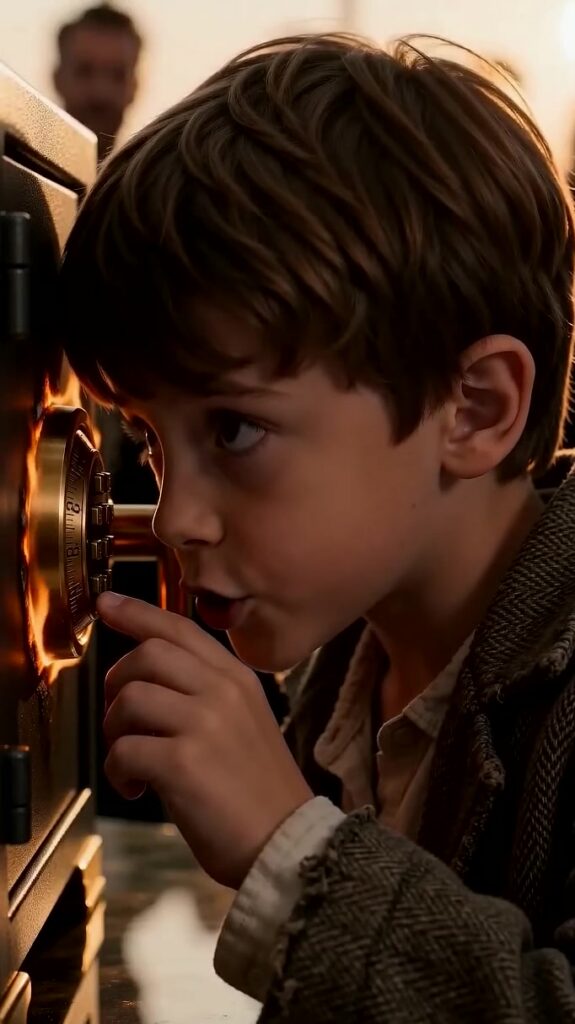
He couldn’t have been more than eight. His jacket was brown tweed, worn at the elbows, the sort of garment that belonged in an old photograph rather than among sequined gowns. He didn’t carry a phone. His hands hung at his sides, small and still. The crowd noticed him the way people notice a wrong note in a song: not with kindness, but with curiosity.
Halden’s smile widened. “Well,” he said, amused. “Are we being brave tonight?”
The boy didn’t answer. He walked straight to the table and stood before the safe. Up close, the metal seemed colder, older—its surface mottled with faint scratches as if someone had once tried to erase what it contained.
A woman near the front chuckled. “This is cruel,” she whispered, but she didn’t lower her camera.
The boy raised one hand and rested his fingers on the dial. He didn’t yank. He didn’t strain. He turned it slowly, as if he were setting a clock. A few people laughed again, expecting him to spin it randomly for the entertainment value.
But the boy’s wrist moved with a quiet intention—left, then right, then left again, the rhythm of someone who knew where the numbers lived. He stopped once, leaned closer, and pressed his ear near the cold metal. His face was expressionless, yet everything about him seemed to listen harder than the room itself.
The laughter thinned.
Halden shifted his weight. “Now that’s adorable,” he said, and the word sounded wrong against the boy’s stillness. “Go on then. Impress us.”
The boy didn’t look up. His voice, when it came, was barely above the hush of a turning dial. “Are you sure?”
For a moment, the question seemed too serious for a child, too weighted with something that didn’t belong at a gala. Halden gave a short chuckle that landed awkwardly. “Open it,” he said, as if daring the universe to contradict him.
Again the dial turned. The boy paused at intervals that made sense only to him, listening for minute shifts—microscopic changes in tension, the faintest tremor in metal. He moved as though the safe were speaking and he was the only one fluent enough to hear.
Click.
The sound was small, but it cut through the ballroom. The phones wavered. Someone’s laughter died mid-breath.
Halden’s grin held, but his eyes sharpened. He leaned forward, and for the first time he looked less like a host and more like a man guarding a ledger. “Who taught you that?” he asked, and the question came out too quickly, too honest.
The boy’s fingers stayed on the dial. He kept his eyes on the safe. “My father built this one,” he said, and there was no pride in it—only a cold certainty that made the air feel thin.
A ripple passed through the crowd, a shared shiver disguised as murmuring. A few guests glanced at each other as if trying to remember a name they’d heard once and filed away as unimportant. Halden’s face tightened around his mouth, the way a man looks when a door he thought locked creaks in its frame.
“That’s…” Halden began. The word didn’t finish. He swallowed, and the movement was visible even from the back of the room.
The boy turned the dial again. Slower now. Reverent. As if he understood not just the mechanism, but the consequence of waking it.
Click.
Click.
Then a final sound—louder, metallic, not the crisp tick of a pin but the deep release of a bolt surrendering. It echoed from the safe and seemed to bounce off the chandelier, returning to everyone as a warning.
The safe door shifted. Just a fraction at first, a dark seam widening into a sliver. A breath of cold mist leaked out, rolling over the table’s glossy surface. Under the warm lights it looked pale, almost luminous, like fog over graveyard grass. People recoiled without meaning to, heels scraping, bracelets clinking.
Halden stepped forward, all charm stripped away. “Stop,” he said, but it was too late to pretend the dare had been a joke. His hand hovered near the safe as if he might slam it shut with sheer will. He was close enough now that the mist touched his knuckles, and he flinched.
The boy did not flinch.
He pulled the door open another inch. The hinges protested with a low groan. The cold thickened, spilling out in slow curls that wrapped around the boy’s sleeves. His jacket, threadbare as it was, didn’t seem to absorb it. The mist behaved like something alive—searching, tasting the air, slipping toward the crowd as though it recognized them.
Inside the safe, something glinted. Not gold. Not cash. The flash was wrong—like polished glass catching light from a source no one could see. A murmur rose, half fear and half fascination. Cameras zoomed in, their mechanical whirs loud in the sudden hush.
Halden’s voice dropped. “What do you want?” he asked, not to the crowd and not to the boy’s hands, but to the boy himself. It was the voice of a man bargaining with a memory.
The boy finally looked up. His eyes were steady, too steady. “You offered ten thousand,” he said. “But you can keep it.”
He opened the safe wider. The mist poured out like winter breaking a dam.
For the briefest moment, the crowd saw what lay within: a stack of yellowed papers wrapped in twine; a brass pocket watch stopped at an exact time; and beneath them, a small velvet box that seemed to pulse with darkness at its edges. The papers bore a familiar handwriting—blue ink in neat, engineer’s loops—plans, signatures, and something that looked disturbingly like a confession.
Halden’s face drained of color. “Close it,” he whispered, but the plea came too late to be heard by anyone but himself.
The boy’s fingers touched the velvet box. The mist surged, and the lights above flickered, a collective blink from the room. Phones continued filming, catching the tremor in Halden’s hands, the widening of his eyes, the slow collapse of a man’s certainty.
“My father built this safe,” the boy said again, softer now, as if speaking to the thing inside rather than the people around them. “And he built it to keep something from you.”
He lifted the box, and the cold deepened into a silence so complete it felt like pressure. The crowd leaned in despite themselves. Somewhere in the back, a glass slipped from someone’s fingers and shattered, but no one turned.
Halden’s lips moved without sound, his gaze fixed on the boy’s hands. The dare had become a trial. The gala had become a courtroom. And the safe—once a prop—stood open like a mouth that had finally decided to speak.
The boy looked at Halden, and in that look was the weight of an inheritance no child should carry. “You asked for someone to open it,” he said. “So I did.”
Then the mist rolled outward, and the first scream came not from the boy, but from the man who had thought ten thousand dollars could buy any ending he wanted.
And in the glare of a hundred recording screens, the truth began to climb out of the safe, one cold breath at a time.