My dad… had this tattoo.
It wasn’t one of those messy, half-faded mistakes you saw on drifters at gas stations. It was deliberate. A black circle no bigger than a coin, cut by three thin lines like claw marks. When I was little, I used to trace it with my fingertip while he pretended not to notice, his forearm warm under the kitchen light.
“It’s a compass,” he told me once, voice quiet like he didn’t want the walls to hear. “Not for directions. For people.”
Then his eyes changed, and he added, “If I ever vanish, you show it to the right person. The wrong person will pretend it means nothing.”
He never said who the right person was. He never said who the wrong one might be. He only kissed my hair, like it might be the last time, and told me to remember.
Three months later, the sheriff found his truck off County Road 9, doors open, keys gone, the seat soaked with rain and something darker. The official story moved fast, like it was being pushed downhill. Missing. Presumed dead. No suspects. A few polite questions for show. A few pitying looks.
And then, because adults can’t stand a mystery that doesn’t tidy itself, the story hardened into a rumor: my dad ran.
Everyone thought I was lying when I said he wouldn’t. People smiled with their mouths only. Teachers patted my shoulder with hands that wanted me to stop talking. Even my mom—who used to stand like a wall beside him—stared at the sink as if it held the answer.
But I knew my dad. He had rules. He had promises. He had that tattoo.
The day I decided to go to the garage, I was ten years old and so tired of being dismissed that fear felt like something belonging to somebody else. I waited until my mom fell asleep on the couch, the late news murmuring under the lamp, and I slipped my hand into the jar on top of the fridge where she kept spare change. Not much. Enough for the bus and a soda and maybe a phone call if I found a payphone that still worked.
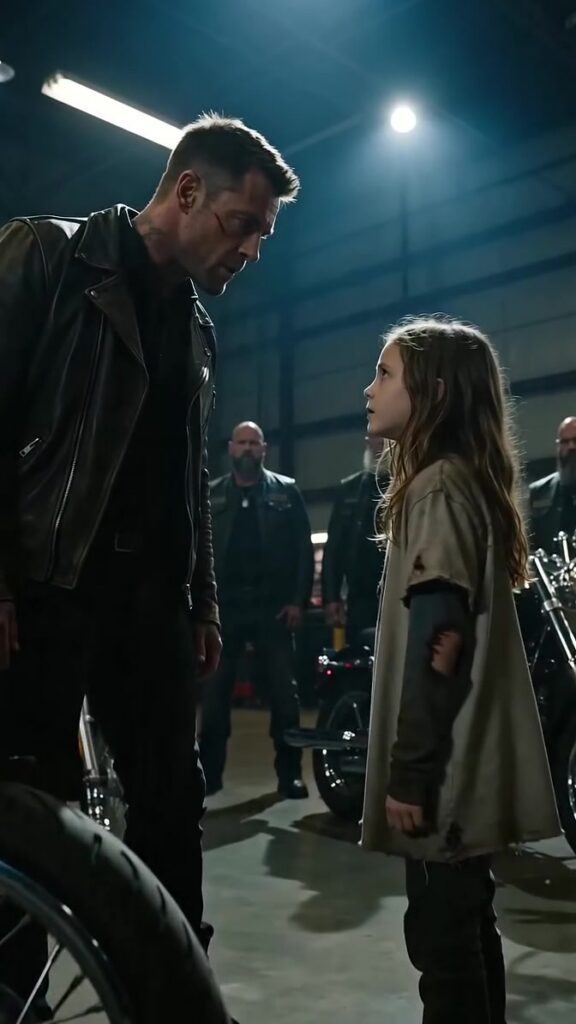
I rode to the edge of town where the roads got worse and the buildings leaned from age. The garage sat behind a chain-link fence like it had something to hide. A sign hung crooked: IRON VULTURES—REPAIRS. Beneath it, someone had painted over a symbol in thick gray strokes, but I could still see the curve of a circle beneath the paint.
Inside the fence, motorcycles lined up like animals at a trough. Men moved among them, leather and metal, tattoos crawling up necks and knuckles. The air smelled of oil and burnt rubber and old smoke. Conversations slowed as I walked through the open bay door.
No fear. No hesitation. I didn’t even look around to find a friendly face because my dad had never taught me to be polite to predators.
I looked straight at Marcus.
He sat on a stool near the back, half in shadow, holding a rag like he’d been wiping something clean for a long time. His hair was clipped short, his jaw rough, and his eyes were the color of wet pavement. The other men gave him space the way dogs give space to a bigger dog.
One of them stepped forward, broad-shouldered, irritated. “Kid, you lost?”
I kept my eyes on Marcus. “No.”
Marcus didn’t move. He just watched me like I was an insect he hadn’t decided to crush.
“You can’t be in here,” the broad man said, trying again. His voice was meant to scare me. It didn’t.
I took another step until I could see the small scar above Marcus’s left eyebrow, pale against his skin. My dad had described it once, offhand, like it was a landmark. “Marcus has a nick there,” he’d said, pointing at his own face. “He thinks it makes him look mean. He doesn’t need help.”
So I knew it was him.
I lifted my chin. “He told me… what you did to him.”
The sentence landed like a tool dropped on concrete. The garage went quiet. Even the radio in the office seemed to fade, though it was still playing, thin and distant.
Somebody’s boot shifted. A chain clinked. A man coughed and stopped halfway through, like the sound was forbidden.
Marcus leaned forward slowly, elbows on his knees, the rag dangling from his fingers. Calm. Cold. Almost curious. “That’s impossible,” he said.
He let the words hang in the air, as if daring anyone to challenge them.
Then he added, softer, like a confession and a threat at once: “I buried him.”
My heartbeat did a strange thing then—it steadied. Like a metronome snapping into time. Because he’d said the part he wasn’t supposed to say.
The broad-shouldered biker’s head turned sharply toward Marcus. Another man’s hand went to the waistband of his jeans. A third, older man with gray in his beard stared at the floor as if it might open and swallow him before he had to pick a side.
Marcus realized, a fraction too late, that the room had changed. People weren’t looking at me anymore. They were looking at him.
“Kid,” Marcus said, and for the first time there was a thin crack in the calm. “Who sent you?”
“No one,” I answered. “I came because you’re the wrong person.”
He blinked. A small movement. But I saw it: surprise, like he wasn’t used to being named correctly.
I reached into my backpack and pulled out my dad’s old photo. It was worn at the edges, folded and unfolded so many times it looked tired. He stood beside a motorcycle, arm slung around another man whose face had been scratched out in pen. Mom had done that, I thought bitterly, as if erasing someone’s face could erase what happened.
I flipped the photo over. My dad’s handwriting ran in a tight slant: IF YOU’RE READING THIS, HE’S LIED TO YOU TOO. LOOK FOR THE COMPASS.
Marcus’s eyes flicked to it, and something sharpened behind them. “Cute,” he muttered. “You think you know—”
“I know the tattoo,” I said.
That made the room breathe in. I saw it in the way shoulders lifted, in the way a man near the workbench took his hands out of his pockets as if ready to catch something that might fall.
The older biker with gray in his beard—someone called him Finch, I heard it murmured—swallowed hard. “Marcus,” Finch said carefully, “what tattoo?”
Marcus didn’t answer. His gaze stayed locked on me. “Show me,” he said, voice tight now, the calm replaced by a dangerous focus.
“I can’t,” I said. “It’s not on me.”
“Then where is it?”
I felt the weight of the moment, the invisible line I’d stepped over by coming here. My dad had said the compass was for people. I understood now: it pointed to the ones who would either protect you or destroy you, depending on what they feared more.
Marcus stood, slow and controlled, like a blade sliding from a sheath. “Little girl,” he said, and his voice dropped to something almost gentle. “If you’re lying, you don’t get to walk out.”
“I’m not lying,” I said, and I hated that my voice trembled just a little. Not from fear of him. From anger at how many adults had looked at me and decided the truth was too inconvenient to listen to.
Finch took a step closer to Marcus. “What did you do?” he asked, and there was something pleading in it, like he wanted Marcus to deny it so badly he could taste it.
Marcus’s jaw flexed. “I did what I had to,” he snapped.
Another biker—taller, with a tattooed throat—shook his head slowly. “We didn’t sign up for that,” he said, voice low. “We’re not… that.”
The garage felt like it might split in half. The men weren’t a single wall anymore; they were cracks, fault lines, shifting loyalties. Marcus looked around, and for the first time he seemed to understand he wasn’t alone with a child. He was surrounded by witnesses.
He turned back to me, eyes hard. “Tell him,” he said, nodding at Finch. “Tell them all. What did he ‘tell you’?”
I could have repeated the things I’d pieced together—the late-night arguments, the way my dad checked the locks twice, the way he jumped when a motorcycle passed our house. But words were slippery. Words were easy to dismiss. Adults had been doing it to me for months.
So I chose the thing my dad had left that couldn’t be talked away.
“But she smiled… and reached into her pocket…”
I did.
My fingers closed around something small and cold. Metal, worn smooth at the edges. I brought it out slowly, letting every man in the garage see it catch the light.
It was a severed strip of leather, narrow as a wristband, with a black circle stamped into it—cut by three thin lines like claw marks.
The compass.
Marcus’s face drained of color. His mouth opened slightly, then shut. For the first time, he looked afraid—not of me, but of what the symbol meant in the hands of a child who shouldn’t have had it.
Finch stared at the band like it was a ghost. “Where did you get that?” he whispered.
I met Marcus’s eyes and let the silence stretch until it hurt. “He said,” I told them, voice steady now, “that if you ever saw it again… it meant he wasn’t the one who got lost.”
Marcus took a step toward me, hand out like he meant to snatch it away. The men around him shifted, and this time the movement wasn’t to make room for Marcus. It was to block him.
Somewhere deep in the garage, a motorcycle alarm chirped once—an accidental sound that felt like a warning.
I held the compass up between us like a verdict. “If you buried him,” I said softly, “then you know exactly why he gave me this.”
Marcus’s eyes flicked toward the back door, calculating exits. Finch’s hands curled into fists. The broad-shouldered biker who’d tried to chase me out earlier stared at Marcus with a dawning disgust, like he’d just realized what kind of man he’d been calling brother.
And in the center of it all, I stood there, ten years old, gripping my father’s last message, watching a room full of dangerous men finally understand that the most dangerous one had been standing among them the whole time.
Outside, thunder rolled in the distance, low and relentless—like something buried that was starting to push back up through the dirt.