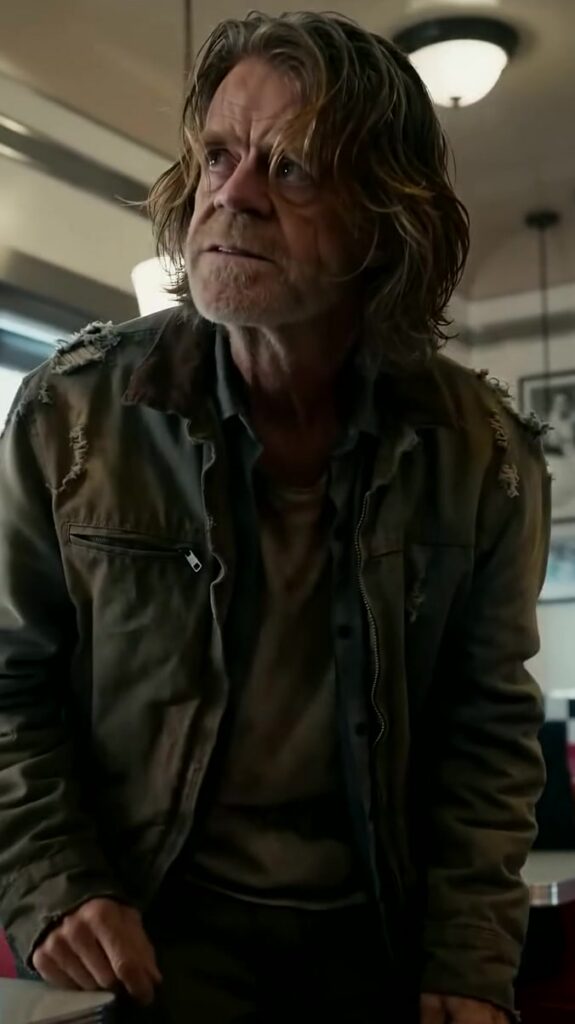
The waitress saw him sitting alone in the corner booth the moment she pushed through the swinging doors with a pot of coffee in one hand and a pad of tickets in the other. It wasn’t just that he was alone—plenty of people ate alone in Lark’s Diner when the rain came down like it meant to erase the whole city. It was the way he tried to make himself smaller than the vinyl seat, shoulders drawn inward beneath a dirty jacket that had once been black. The collar was frayed, the seams tired. His hair stuck out in uneven, damp tufts. And his hands—God, his hands—trembled each time he lifted the chipped mug of water she’d left without asking. Not from cold. From hunger.
Every table around him felt like a small conspiracy. Customers leaned in to speak only when his eyes were down, and when he glanced up they looked away as if they’d been caught doing something shameful. One couple left early, their half-eaten fries pushed to the side. A businessman in a suit pulled his briefcase tighter against his knee, as if poverty was contagious. The neon sign in the window blinked OPEN, OPEN, OPEN, while the air itself seemed to whisper CLOSED around the man in the corner.
Mara had learned what silence could do. She’d grown up in a house where you didn’t ask for seconds and you didn’t talk about the bruises. She’d learned how to make herself useful and invisible. At twenty-six, she waited tables because it paid enough to keep the lights on in her studio and send a little to her mother, and because she could read a room as easily as a menu. She knew when someone wanted refills and when someone wanted forgiveness. This man, she thought, wanted to disappear before anyone could tell him he wasn’t welcome.
She wiped her palms on her apron and walked to the kitchen. The grill hissed. The cook, Benny, flipped patties with a bored rhythm. “Benny,” Mara said low, “you got anything we can spare?”
He glanced past her shoulder toward the dining room. “The manager’ll chew your head off.”
“He can chew mine,” she said. “I don’t think that man’s eaten today.”
Benny’s mouth tightened. He wasn’t sentimental, but he’d once slept in his car between shifts, and that memory lived behind his eyes like a bruise. He slid a hot dog onto a bun, added a smear of mustard, then hesitated. “If Royce sees—”
“Then I’ll pay,” Mara lied, because her wallet held three crumpled bills and a photograph of her father she kept for reasons she couldn’t name.
She carried the plate out as if it belonged there, as if it had always been destined for that booth. The man looked up when the shadow fell across his table. His eyes were the kind of gray that had forgotten the sky. His beard had grown in rough patches. He watched the plate lower with the wary stillness of an animal that expects a hand to turn into a fist.
“Here you go, sir,” Mara said softly, forcing warmth into her voice like coaxing a flame from damp matches. “I hope you enjoy it.”
For a moment he only stared. Then his gaze lifted to her face and held there, as though searching for the trick, the hook, the price she’d demand afterward. Something shifted—his throat bobbed, his eyelids fluttered. “You… you don’t have to,” he whispered, and the words sounded unused, like a language he’d forgotten.
“I want to,” she said.
He took the hot dog with hands that shook hard enough to rattle the paper liner. His fingers were long and clean beneath the grime, nails trimmed as if habit refused to die. He bowed his head not in thanks, not exactly, but in relief so raw it hurt to witness.
And then, as if kindness had rung a bell in the back of the diner, the manager stormed out from behind the counter.
Royce Delaney moved like a man auditioning for authority. His hair was slicked back. His tie was too tight. He walked with the rigid, angry precision of someone who believed the world owed him obedience. “What the hell is this?” he barked, voice slicing through the clatter of plates.
Mara’s stomach dropped. “I—he hasn’t ordered yet,” she began.
Royce didn’t listen. He leaned over the booth, face twisted, and in one sharp motion slapped the plate off the table.
Ceramic shattered on the tile. The hot dog bounced once, rolled, and stopped near Mara’s shoe. Mustard streaked the floor like a stain that couldn’t be scrubbed out. The diner fell silent so completely the rain against the windows sounded like applause.
“This trash doesn’t deserve to eat,” Royce said, loud enough to make sure everyone heard. He looked around, daring anyone to disagree. “We serve paying customers.”
Mara froze. Heat rose behind her eyes, the kind that meant tears were coming and she hated herself for it. She stared at the broken plate, at the food on the floor, and felt something old and familiar: the humiliation of being told you were worth less than other people.
The man in the booth stared down at the mess. For a long moment, he didn’t move. When he did, it was slow, deliberate, like a switch being flipped.
He pushed back from the table and stood.
At first it was only his height that startled Mara. He was taller than he’d seemed hunched in the corner, his frame lean but strong beneath the battered jacket. Then it was his posture. His shoulders rolled back. His spine straightened. His hands, still dusty, stopped shaking as if hunger had been dismissed by command. His tired eyes sharpened into something clear and cold.
Royce scoffed. “Sit down before I call the cops.”
The man looked at him, not with anger, but with a quiet, lethal certainty that made the hairs on Mara’s arms rise. “Don’t,” he said. His voice was calm, educated, almost gentle. “Don’t do that.”
Royce’s jaw worked. “Who do you think you are?”
The man’s gaze traveled across the diner: the counter, the framed photos on the wall, the faded newspaper clipping near the register about the diner’s grand opening. His eyes lingered on the old black-and-white picture of a younger man cutting a ribbon in front of the same neon sign. The face in the photo was leaner, but the eyes were unmistakable.
He returned his attention to Royce. “I’m the one whose name is on the deed,” he said, and each word fell like a heavy coin onto a table. “I’m the owner.”
Royce’s face drained so fast it seemed the color had been yanked out by a hand. His mouth opened and closed. “No. That’s—Mr. Larkin—he—”
“He died,” the man finished softly. “My father. The diner passed to me. You never met me because I wasn’t here. I was… elsewhere.” A shadow crossed his face—something like a memory of locked doors and long nights. “But I’ve been watching my business from a distance. Reports. Numbers. Complaints.” He nodded toward the broken plate. “And now I’m watching with my own eyes.”
Someone behind the counter let out a strangled breath. Benny stared as if the grill had started speaking.
Royce tried to recover. “Sir, I didn’t recognize you. If I had known—”
“That,” the owner said, “is the point.” He stepped closer. The dirty jacket hung on him like a disguise that had served its purpose. “You didn’t recognize me, so you treated me the way you treat people you think can’t do anything to you.”
Royce’s lips trembled. “I was protecting the diner.”
“You were protecting your ego,” the owner replied. He glanced at Mara, and the gentleness returned to his face like sunlight breaking through a storm cloud. “You tried to feed someone because you saw a person. That matters.”
Mara swallowed hard. “I’m sorry,” she whispered, though she wasn’t sure what she was apologizing for—the plate, the trouble, the fact that kindness had turned into spectacle.
The owner looked at Royce again. “You’re fired,” he said simply. No theatrics. No shouting. Just a sentence that ended a job and, maybe, a pattern of cruelty.
Royce’s eyes flashed with panic. “You can’t—”
“I can,” the owner said. “And I am.”
Royce took one step back, then another, as if the floor had tilted beneath him. He looked around for allies and found only lowered gazes and stiff shoulders. He turned and walked toward the office door like a man marching to his own funeral.
The owner crouched, ignoring the shards, and picked up the fallen hot dog with a paper towel. He set it on a clean plate Benny hurried out with shaking hands. “Another one,” the owner told Benny. “And fries. And coffee. Put it on my account.”
Benny nodded so hard his cap nearly fell off.
The owner stood, then turned to Mara. “And you—” he began, and Mara’s heart lurched. She braced for reprimand, for the familiar lesson that kindness was a liability.
He paused, as if choosing words with care. “You’re not in trouble,” he said. “But I want you to sit with me for a minute when your shift allows. I want to hear what you’ve seen here. What you’ve put up with. What you think this place could be.” His eyes held hers. “My father built a diner where people could eat without being judged. I lost my way for a long time. I don’t want this place to lose its way too.”
Mara’s breath left her in a shaky exhale. Around them, the diner began to move again—chairs scraping, silverware clinking, whispers turning into murmurs. A woman at the window dabbed her eyes. The businessman in the suit stared at his untouched pie as if it had suddenly turned bitter.
Mara nodded, throat tight. “Yes,” she managed.
The owner returned to the booth, not as a man hiding in a corner, but as someone reclaiming a seat. He took the new hot dog when it arrived, lifted it with steady hands, and for the first time since Mara had seen him, he looked like he belonged.
Outside, the rain kept falling, relentless and cold. Inside, the neon sign continued to blink OPEN. And this time, for the first time all evening, it felt true.