The ballroom glittered as if it had been stitched from constellations and crystal. Chandeliers hovered overhead like captive suns, scattering their light across linen-draped tables and the smooth shoulders of people who had mastered the art of looking unbothered. At the center of it all stood Lenora Marlowe—upright as a cane-backed chair, composed as a portrait—wearing a sapphire gown that made her silver hair appear almost blue. She cradled a champagne flute the way a pianist holds a note: delicate, controlled, practiced.
It was her annual gala, the sort of evening where money pretended to be charity and secrets pretended to be history. Photographers waited for the right angle. Donors waited for the right handshake. Lenora smiled at them all with the same polished politeness, the kind that suggested she had never raised her voice in her life, and that if she ever did, a building might collapse.
On stage, a string quartet played something old and romantic. The melody drifted through the crowd like perfume. Lenora turned her head as a waiter passed with a tray of gleaming oysters. She murmured a greeting to a councilman’s wife, nodded at a banker who owed her favors, and watched the evening unfold with the distant satisfaction of a woman who had arranged every candle and every guest placement to form a picture only she could see.
Then something shifted. It was not the music; the quartet continued, bows moving in fluid arcs. It was not the light, which still broke into diamonds on the polished floor. It was a small movement of air, a ripple of black-and-white fabric passing behind Lenora’s shoulder. A young waitress—slim, quick, careful not to intrude—threaded between guests with a tray balanced at her fingertips.
Lenora’s gaze followed her without meaning to, the way a compass needle finds north. The girl’s uniform was immaculate, the kind worn in places that charged for silence. Her hair was pinned neatly, but a few strands escaped, catching the chandelier’s glow. And at her throat, just above the high collar, hung a necklace: a delicate flower of diamonds, petals arranged with cruel perfection, flashing as she moved.
Time did not stop so much as thin. The room’s sound receded as if someone had opened a door and all the noise spilled out into the night. Lenora’s fingers tightened around the stem of her glass.
That necklace did not belong in the world. It belonged in a safe that had been sealed. It belonged in ash.
For a moment she saw, superimposed over the ballroom, a different room—low ceilings, smoke curling along them like a living thing. She smelled something that wasn’t there: burning varnish and sweet, scorched fabric. A child’s cry. The crack of a beam giving way. The flash of orange through a doorway.
Lenora’s breath caught, and the flute slid in her hand as if it had become slick. Her polite smile faltered. Color drained from her face so fast it seemed someone had wiped it away.
The glass fell.
It struck the marble with a sharp, obscene sound and shattered into a spray of glittering fragments. Bubbles hissed and died. The quartet, startled by the noise, faltered. The next note never came. Silence collapsed over the guests.
Heads turned. Conversations snapped shut. Somewhere, a camera shutter clicked once, late.
Lenora did not look at the spill or the shards. She moved—too quickly for her age, too urgently for someone known for poise. She cut through the frozen crowd toward the waitress, her gown whispering like a wave.
The young woman saw her coming and stiffened. Her eyes widened, darting to the broken glass behind Lenora, then to the faces watching. She tried to step back, but the crowd was dense and suddenly curious.
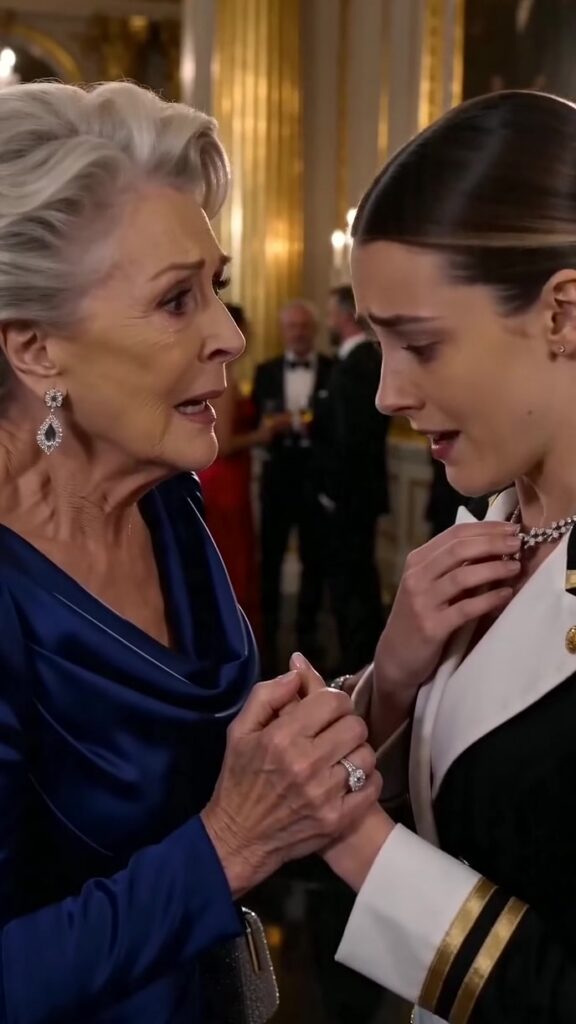
Lenora reached her and seized her hands. The waitress’s fingers were cold, damp with shock.
Lenora leaned in close enough that only the girl could hear the tremor in her voice. “Where did you get that necklace?” she whispered, each word shaking as if it had been wrenched free from somewhere deep.
The waitress’s throat bobbed. “I—I didn’t steal it,” she said quickly, panic flushing her cheeks. “I’ve had it since I was a child. It was given to me. I don’t know—please—”
Lenora’s eyes locked on the diamonds. They threw light onto her skin like tiny blades. Her fingers slid upward, almost reverent, and brushed the flower pendant. The girl flinched but did not pull away, trapped between fear and the strange gravity of Lenora’s attention.
“Turn it,” Lenora murmured.
With trembling hands, the waitress lifted the pendant and flipped it over. The back was worn smooth from years of touch. In the metal, faint but legible, were two engraved letters.
R.M.
Lenora’s lips parted. A sound escaped her—not a word, not quite a sob, but something raw that did not belong in a ballroom. Her eyes filled so abruptly that the tears seemed to appear already formed, ready to fall.
“Rosemary,” Lenora breathed, as though saying the name might summon the person attached to it.
The waitress froze, the way animals do when they sense danger but cannot see it. Her gaze searched Lenora’s face, the crowd behind her, the watching staff, the doorway where security hovered uncertainly.
“My foster mother…” the waitress said, voice cracking. “She used to call me that. Rosemary. But my name is Mira. She said it was just—just a nickname.”
Lenora’s hands tightened on Mira’s. Her knuckles went white. “No,” she whispered, and the word carried a grief older than the girl. “It wasn’t a nickname.”
The room had begun to stir again. People leaned in. Someone murmured Lenora’s name with an edge of scandal. A man with a drink paused mid-sip, eyes bright with the hunger of witnessing something real.
Lenora stared at Mira’s face as if measuring it against a memory. High cheekbones. A small scar at the edge of the eyebrow. The shape of the mouth—soft, determined. Details that could have been anyone’s until they were not.
“How old were you when you got it?” Lenora asked, too softly. “The necklace.”
Mira swallowed. “I don’t remember before the home. They said I was around four. I had this in my fist when they found me. They thought it was costume jewelry until they realized—”
Lenora’s eyes flicked shut. Four. Smoke. A child pulled from a burning house. A little hand clenched around something bright. A flower made of diamonds, meant to mark ownership, meant to be a promise.
Lenora opened her eyes again, and in them, a terrible recognition took root.
“You were there,” she whispered. “That night.”
“What night?” Mira’s voice rose, thin with confusion. “I don’t know what you’re talking about. I’m just working. Please let go—”
Lenora did not release her. If she let go, Mira might disappear back into the world, swallowed by uniforms and anonymity, and Lenora could not endure that again—not after so many years of silence built like a wall around the past.
A heavy hand clamped onto Lenora’s arm.
The grip was not gentle. It was the kind of grasp that assumed compliance as its birthright.
Lenora turned. A tall man stood beside her, silver hair combed flawlessly back, tuxedo fitted like armor. His face was handsome in a severe way, the sort of man who could smile without warmth and call it charm. Victor Halden—benefactor, trustee, and the man who had helped Lenora rebuild after the tragedy that had made her name whisper-worthy long before it became philanthropic.
His eyes darted from Lenora’s tear-streaked face to the necklace at Mira’s throat. Something tightened at the corners of his mouth. It was not surprise. It was calculation.
“Lenora,” he said, voice low, carrying a warning masked as concern. “You’re causing a scene.”
Lenora’s chest rose and fell sharply. “Victor,” she whispered, and there was terror in her tone now, as if she had finally understood what had been standing in shadow all these years.
Mira looked between them, breath coming too fast. “Who are you?” she demanded, but neither answered her.
Victor’s fingers dug into Lenora’s arm, steering her backward a fraction. His smile aimed itself at the watching guests, polished and false. Then he leaned close enough that his words slid into Lenora’s ear like ice.
“Let her go,” he murmured, too softly for anyone else to hear. “You don’t want to pull on this thread.”
Lenora’s eyes stayed on Mira—on the necklace, on the engraved initials, on the young woman’s face that held a child’s lost name like a ghost behind the eyes. “She’s alive,” Lenora breathed, disbelief and joy and horror twisting together.
Victor’s expression did not change, but his voice dropped into something colder than the marble beneath their feet.
“She was never supposed to survive the fire.”