The rain came down so hard it made everything look crueler. It turned the world to metal and stone—faces sharpened, shadows deepened, and every mistake seemed permanent. Even the black iron gate in front of Kellan Dorsey’s house looked like a set of ribs, trembling in the wind as if the property itself were trying to breathe.
Mara Dorsey stood on the slick path with water running off the brim of her hat, though she’d stopped wearing hats years ago. She’d put this one on out of habit, the same way she’d wrapped her gray coat tight, as if cloth could stop a prophecy. Her hands clutched the hem of her dress under the coat, fingers white with effort. She’d come with a pie in a tin and the small, stubborn hope that a mother could arrive at a door and still be wanted.
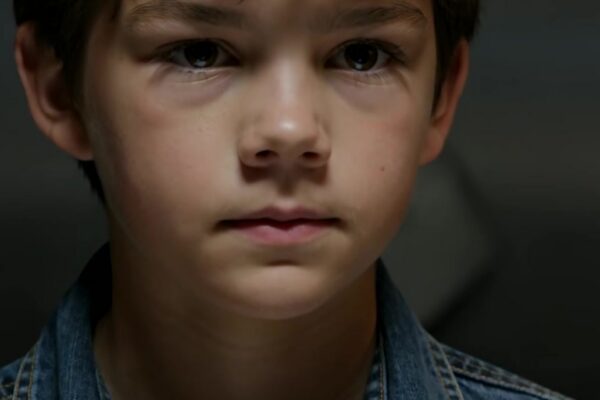
Kellan opened the door as though he’d been waiting for the knock. His hair was damp already, and the porch light behind him etched him in pale gold. He was broad now, shoulders learned from lifting and working and surviving. But his eyes—his eyes held the same quick hurt as the boy who used to run home with skinned knees, demanding a kiss and a bandage. He did not offer either. He did not step forward to shelter her. He shoved a burlap sack into her arms so abruptly her boots slid, and for a heartbeat she thought the rain would take her down.
“Take it,” he said, voice clipped to the bone. “And go.”
Mara tightened her grip around the sack. The fabric was rough and wet, and it felt heavier than grain. The dismissal, the lack of warmth, stung more sharply than the cold. Behind him, half in shadow, a young woman leaned against the inside wall—Lysa, the wife Mara had met only twice. Her arms were folded, expression smooth and unreadable. She watched Mara as one watches a stranger who might carry contagion. Kellan’s gaze flicked toward Lysa, then away from Mara, as if looking at his mother too long would spill something dangerous onto the porch.
Mara forced her mouth into the shape of acceptance. She nodded because nodding was what kept peace, what kept doors open, what kept sons from becoming strangers forever. She turned and walked back down the path, hugging the sack to her chest, rain soaking through her sleeves and dripping from her chin. She did not look back. She did not cry. Not until the gate’s rattle faded behind her and she was alone with the small rented room she called home.
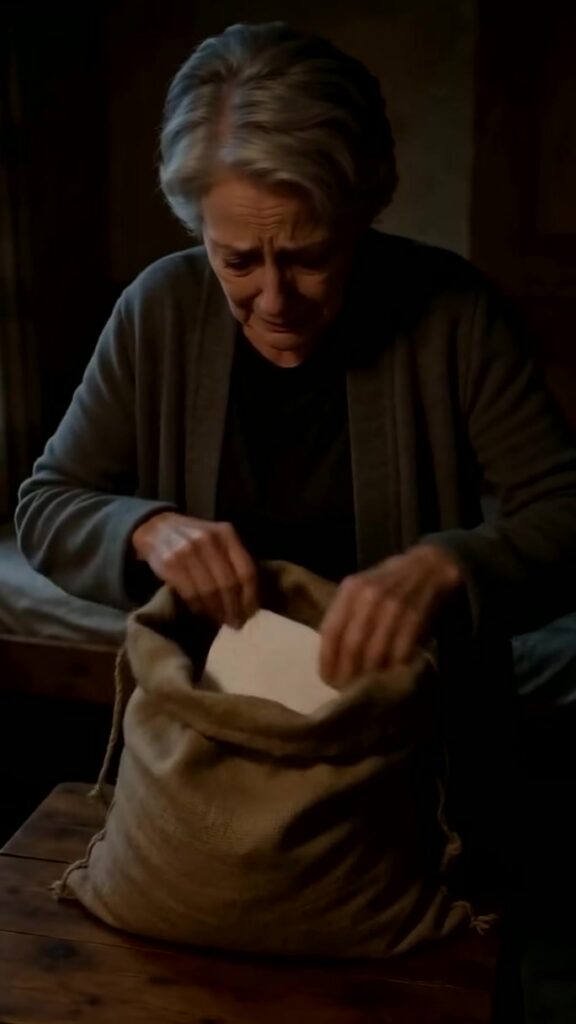
Inside, the air smelled of boiled tea and old wood. The window was a watery mirror, streaked by the storm. Mara set the sack on the table with care, hands trembling from more than the cold. It would be rice, she told herself. He’d always been practical, even in anger. A son could push away affection and still remember hunger.
She loosened the knot. No grain shifted. No soft cascade, no dusty scent. Instead, her fingers met paper. Mara froze, then reached in as though she feared being bitten. She drew out a white envelope, its surface clean and bright against the brown burlap. On the front, in Kellan’s unmistakable handwriting, was one word: Mom.
The room tilted. The rain’s tapping on the glass suddenly sounded like hurried footsteps. Mara slid a thumb under the flap and opened it. A thick stack of bills lay inside—too many, far too many for a man who’d once asked her if they could afford milk. Beneath the money was a folded sheet of paper. Her hands shook so badly the paper crackled like dry leaves.
She read the first line and felt her breath fracture.
I’m sorry, Mom.
Her eyes blurred, and she pressed her knuckles to her mouth to keep the sound in. She read on, each sentence a rope thrown across a widening gulf.
I couldn’t talk in front of her. She listens to everything. She counts every kindness like it’s a debt.
Don’t come back here after today. Don’t ask where the money came from. Just take it and leave town before dark.
Mara’s chest tightened, not with gratitude but with dread. The money wasn’t a gift; it was a lifeline. She swallowed and forced herself to keep reading.
I tried to get out clean. I tried to do it the right way. But she has friends, and they’re not the kind you can tell no. If I run, she’ll go to you first to make me come back. If I stay, she’ll keep taking pieces of me until there’s nothing left but the part that knows how to obey.
Mara’s tears fell onto the paper, darkening ink and making the words bleed at the edges. She brushed them away with the side of her hand, frantic, as if smearing the sentences could change what they meant.
If you love me, you’ll disappear.
Her vision tunneled. There was one final line, pressed hard into the page, as though he’d been writing with shaking hands.
By the time you read this, I’ll either be gone… or she’ll know.
Mara’s head snapped up toward the window. Through the rain-blurred glass, the world outside was a watercolor of gray and black. She pushed the curtain aside with trembling fingers and leaned close until her breath fogged the pane.
Down the street, beyond the slick shine of pavement, she could just make out the silhouette of the iron gate at Kellan’s house. And there—standing by it, drenched, still as a grave marker—was her son.
He wasn’t watching the road. He wasn’t watching for her. He stared at the ground like a man waiting for a sentence to be read. Then he lifted a shaking hand and wiped his face, as if offended by the presence of his own tears.
A second figure stepped onto the porch behind him. Lysa moved with the calm of someone who believed the storm belonged to her. She walked into the rain without flinching, the water beading on her hair like pearls. In her hand was something dark and straight, held close to her thigh—too deliberate to be an umbrella, too small to be a tool.
Mara’s stomach dropped. She couldn’t hear anything through the glass and the thunder, but she saw the way Kellan’s shoulders tensed. She saw his head turn, slow, reluctant, like a man facing a blade. Lysa lifted the object slightly. Even through distance and rain, the shape was unmistakable.
Mara staggered back from the window as if the sight had struck her. The money on the table seemed suddenly obscene, a pile of paper meant to purchase her silence. Her mind raced through years of small humiliations, her son’s tight smiles, his rare visits where he’d looked over her shoulder as if expecting an intruder. She had blamed marriage, work, pride. She had never imagined fear.
She grabbed her coat, then stopped—hands hovering over the envelope—because the note’s warning burned like a brand: Don’t come back. If you love me, disappear.
But love, Mara realized, was not always obedient. Sometimes it was reckless. Sometimes it was a mother standing up from a table in a dim room, wet with rain and regret, and choosing the more dangerous kind of devotion.
She shoved the money into her bag without counting it, folded the note, and tucked it close to her heart. Then she hurried to the door, the storm’s roar swelling as she pulled it open. The rain slapped her face, cold and punishing, and for an instant everything outside did look crueler—the streetlights, the puddles, the distant gate like a jaw of iron.
Mara stepped into the downpour anyway. She did not know what she would say when she reached him. She did not know how to disarm a woman who carried control like a weapon. She only knew this: if Kellan was going to vanish, he would not vanish alone into the dark. And if Lysa thought fear could keep a mother away, she had never understood what a mother was.
The rain hid Mara’s tears as she ran, and in its merciless shimmer, she became something harder than grief—something that did not ask permission to protect what it loved.