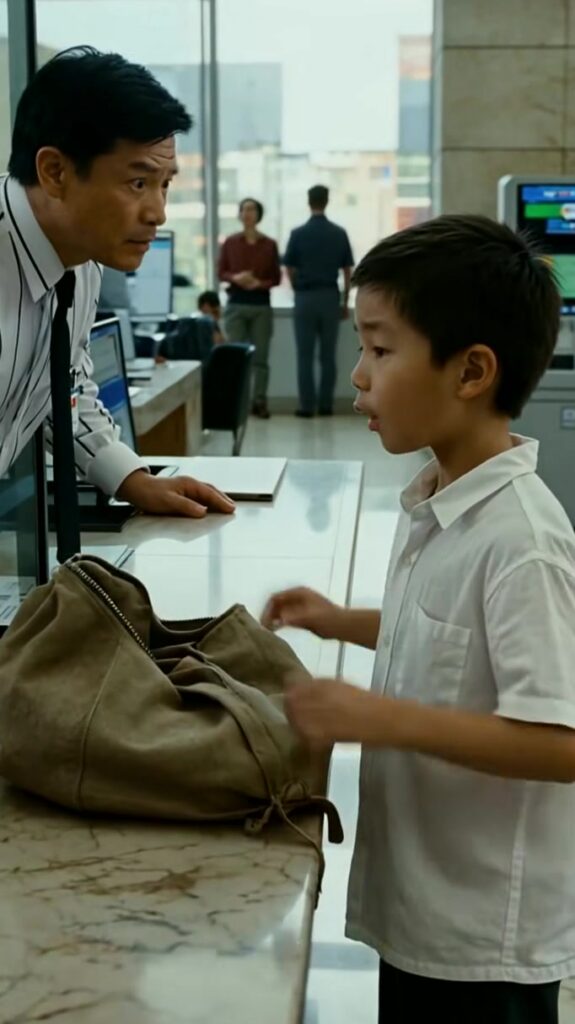
The bank was the kind of place that tried to convince you money was a natural element, like air or light. White marble floors stretched clean as frozen water. Pale daylight poured through tall windows and softened everything it touched—leather chairs, brushed steel railings, the sharp lines of glass offices where suits moved like shadows behind frosted panels. Even the security guards seemed curated, their uniforms pressed, their shoes unscuffed, their gazes polite and distant.
People waited with the mild patience of people who had never truly waited for anything. A woman in a cream coat scrolled through her phone with two fingers, the way one handled something delicate. A man with a watch that caught and threw light sipped coffee from a cup the bank offered as if it were a favor. The low murmur of transactional life floated above the counters—account numbers, signatures, dates, calm voices. Quiet wealth everywhere, in the smoothness of motion and the absence of hurry.
Behind Counter Three, Lila Hart adjusted the angle of her pen so it pointed neatly toward her customer. She had been hired for her calm face and her steady hands; the bank liked steadiness, liked predictability. She liked it too. Predictability paid rent. Predictability made the world feel less like a cliff edge.
Then the sound came.
A single, rude slam against polished stone—heavy, wet, wrong. It struck the air with the finality of a gavel.
A dirty old bag lay on the counter, smeared with grime and darkened at the seams as if it had been dragged through places the bank pretended did not exist. The marble under it looked offended.
Instant silence swallowed the room. The woman’s scrolling stopped mid-swipe. The coffee cup paused midway to lips. Even the soft hum of the air vents seemed suddenly loud, like breathing in a room full of people trying not to breathe.
All eyes turned toward Counter Three.
A boy stood there, small enough that the counter reached almost to his chest. His hair was uncombed, his jacket too thin for the season. Something about him did not fit the way a stain doesn’t fit silk. But it wasn’t his clothes that held the bank captive—it was his face. No fear. No apology. His eyes were calm in a way that felt older than him, like still water that hid depth and cold.
Lila, shocked out of her practiced neutrality, heard her own voice sharpen. “Hey! What is wrong with you?” It came out louder than she intended, and it echoed strangely in the polished hall.
The boy didn’t blink. He didn’t flinch under the weight of a room staring him down. He simply set his hands on the edge of the counter as if he owned it, as if he had every right to be here.
“I want to open an account,” he said. His voice was even, unhurried, almost gentle.
A beat of silence stretched. In that pause, Lila became aware of the security guards beginning to move—one subtle step, then another. The manager, Mr. Kenning, rose behind his glass partition, his smile assembling itself like armor.
Lila swallowed. Training took over. “Do you… have identification?” she asked, trying to make the sentence land in the world she understood. “And what’s in the bag?”
“Deposit,” the boy replied. “For the account.”
Mr. Kenning arrived at her shoulder, smelling faintly of citrus and certainty. “Young man,” he said, voice polished smooth, “this is a private institution. We can help you, but you can’t disrupt our clients. Where are your parents?”
The boy’s eyes slid to Kenning, and something in them cooled further. “My parents are not required for this deposit.”
One guard reached the counter’s end, careful not to make sudden movements that might ignite whatever this was. The bank was full of fragile composure, and everyone sensed it could shatter into panic with the wrong tone.
Lila looked down at the bag. The canvas was old military surplus, the kind with thick straps and faded stenciling. Mud clung to the bottom like a second skin. Yet it sat on the marble with odd deliberateness, like a statement.
“May I open it?” Lila asked. Her fingers hovered above the zipper.
“Yes,” the boy said. “But don’t spill it.”
That was the first thing he’d said that felt like a warning.
Lila hooked one finger into the zipper and pulled. The sound of teeth separating was loud in the stillness. She opened the bag and expected—she didn’t know what she expected. Trash. Clothes. Something stolen. Something that would justify calling the police and restoring the world.
Instead she saw neatly bundled stacks wrapped in rubber bands, arranged like bricks. They were not pristine; they carried the faint smell of smoke and damp paper, the scent of time spent hidden. But the bills were real. Not a handful. Not a few. An amount that made her breath catch in her throat.
Every instinct screamed that it was counterfeit. Every instinct also knew, with a sick clarity, that it wasn’t. The ink had the right weight. The paper had that faint, stubborn texture that money had when it had lived too long in someone else’s fear.
Lila’s gaze snapped back to the boy. His calm did not change. If anything, it deepened, as if he was watching the bank reveal itself to him rather than the other way around.
Behind her, Kenning’s polished composure cracked at the edges. “Where did you get this?” he demanded, the question sharp enough to cut.
The boy’s eyes flicked, briefly, to the security cameras mounted in their quiet corners. “It was left,” he said. “And it was meant to be found.”
Lila felt the room tilt. All around them, clients leaned forward as if drawn by gravity, as if money itself could pull their bodies toward it. The guards looked at Kenning. Kenning looked at the bag, at the boy, at the bank full of witnesses, and his mind worked as fast as a machine.
“We’ll need to file—” Kenning began.
“No,” the boy said, softly, and the word stopped Kenning like a hand on his chest. “Open the account.” He set a small object on the counter, beside the filthy bag: a simple key, tarnished, attached to a thin metal tag stamped with a number. “Put it under my name.”
“And your name is?” Lila heard herself ask. Her voice sounded far away, like it belonged to another teller in another life.
The boy looked at her for the first time as if she mattered, as if her answer would alter something. “Elias,” he said. “Elias Vane.”
The name moved through the room without anyone saying it aloud. Lila watched Kenning’s face change—just a fraction, just enough. Recognition, or fear, or both. It was the expression of a man who had opened a door in his mind that he had kept locked for years.
Lila’s fingers rested on the edge of the open bag, on the old canvas, on the dirty seam. She realized she was trembling, though she could not say whether it was from the money or from the boy’s impossible steadiness.
“Elias,” she repeated, and the bank’s marble cold seeped through her fingertips. “How old are you?”
“Old enough,” he said. Then, with that same calm, he added, “Old enough to know what happens when people hide things behind clean floors.”
Kenning’s smile tried to return and couldn’t find its way back into place. The guards didn’t move closer now; they stood as if waiting for a signal they didn’t want to receive. Clients began to reach for their phones, not to scroll but to record, to capture the moment when ordinary life in a luxury bank fractured and showed the darkness beneath its daylight.
Lila looked again at the bundles. The deposit was too big for a boy, too carefully arranged to be a child’s accident. It was a message, a weight set on a counter to make an entire room feel the impact.
“Why here?” she whispered, though she didn’t know if she wanted the answer.
Elias watched her with eyes that refused to blink. “Because this is where the truth was stored,” he said. “And today, it’s being moved.”
In the silence that followed, the bank felt less like a sanctuary and more like a stage, and every polished surface seemed to reflect not wealth but waiting—waiting for something long buried to finally rise.”