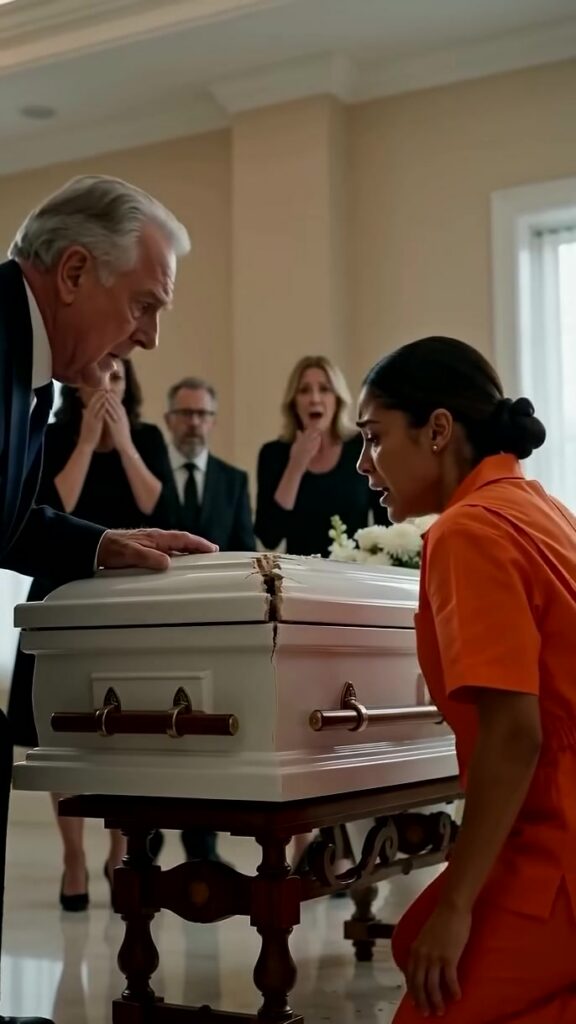
Nobody was looking at the maid when it happened. They were watching the gleam of the white coffin like it was the only honest thing in the room, the one object that did not pretend to be merciful. Flowers stood in disciplined ranks around it, white on white, perfume masking the sharper scents of varnish and old money. The mourners crowded beneath the chandelier’s tired crystals, their faces arranged into the same careful expression: sadness without questions.
Rosa moved along the wall with a cloth in her hand, because that was what she did—erase fingerprints, smooth smudges, keep the place clean enough to host grief. Her uniform was a bold orange that looked almost scandalous in a parlor devoted to black. She had been told to stay invisible, and she had learned the craft well. When the widow’s friends arrived, they passed her like she was a potted plant. When the priest lifted his hands, his sleeves billowed like wings, and no one noticed the maid wiping the condensation from a water pitcher, listening to the room the way some people listened to prayers.
Edgar Vale stood nearest the coffin, straight-backed and severe, his jaw locked as if grief were a thing that could be clenched into submission. He did not weep. He did not sway. When condolences reached him, he accepted them with the precision of a man signing papers. Vivian had been his wife for twelve years, and in those twelve years the city had learned to treat the Vales’ private life as a sealed vault. Now the vault sat open, and everyone wanted to look inside.
Rosa tried not to look at the coffin. She had seen Vivian the day before—Vivian alive, with her hair pinned up and her lipstick smeared as if she’d wiped her mouth hard after a difficult conversation. Vivian had pressed something into Rosa’s palm in the kitchen: a small silver key, warm from her skin. “If anything happens,” she had said, smiling too brightly, “don’t give it to anyone who asks.” Then she’d added, very quietly, “Especially not someone who says they speak for God.” Rosa had laughed because she didn’t know what else to do.
That morning, the paramedics had come and gone. There had been a statement about an aneurysm, about suddenness, about the cruelty of chance. Rosa had watched Edgar’s face as the sheet was pulled up, and she’d thought she saw relief flicker beneath his practiced sorrow. She told herself she was imagining it. She told herself she was only a maid; she didn’t know anything about the ways the rich survived their own tragedies.
During the viewing, while the priest murmured his rehearsed comfort, Rosa went into the side corridor to replace wilted arrangements. That was where she heard it: not a voice, not a word, but a frantic, irregular sound like nails raking a thin wall. It stopped and started, like someone was trying to learn the rhythm of silence. Rosa froze with a bundle of lilies in her arms. She waited for another noise. It came again—three quick taps, then a dragging scrape, then a breath that did not belong in a building dedicated to the dead.
She dropped the lilies. Their stems snapped like bones. Before she understood what she was doing, she was in the maintenance closet, both hands wrapped around the haft of the splitting axe the caretaker used for kindling in winter. Her heart pounded against her ribs, too large for her body. She stepped back into the parlor just as the priest leaned closer to the coffin to begin the final blessing.
The sound of the axe striking wood was so sudden it felt like lightning inside a house. The coffin lid splintered; lacquer and pale dust burst into the air. Screams ricocheted off the walls. People stumbled backward, chairs tipped, someone’s pearls spilled across the floor like spilled teeth. Edgar turned with fury on his face, but Rosa was already yanking the axe free, her arms shaking, her eyes fixed on the crack she’d made.
“She isn’t gone,” Rosa said, her voice shredding on the last word. “I heard her.”
Edgar’s hands clenched at his sides. His grief finally moved, but it was not the kind the room expected. It looked like rage trying to swallow fear. “You’ve ruined this,” he hissed, then softened his tone as if kindness could reassert control. “Rosa. Put it down.”
Behind him, the priest’s face remained composed, but his eyes had narrowed, not in sorrow—calculating, like a man watching a door he thought was locked suddenly swing open. Rosa didn’t lower the axe. She stepped closer, pressed her ear near the split, ignoring the varnish that flaked into her hair. The room’s breathing thinned into a hush. Somewhere, a phone began recording.
From inside the coffin came a dull thud, then another—uneven, desperate, unmistakably human. Edgar’s mask shattered. He lunged to the coffin, fingers digging into the damaged lid. His expensive ring snagged on a splinter; he tore anyway. The lid gave, the seam widening until cold air rolled out like the sigh of a cellar.
Vivian’s eyes snapped open in the narrow darkness. Her pupils were wide, her lips bluish, her chest working hard as if each breath had to be stolen. She clawed at Edgar’s wrist with startling strength, nails biting skin. Edgar made a broken sound that might have been her name. Vivian didn’t look at him. She stared past his shoulder, directly at the priest, and rasped, “Don’t let him—”
The priest stepped forward too quickly, his hands already reaching, his voice smooth with urgency. “She’s delirious. She needs—”
Rosa moved before anyone else could think. She swung the axe, not to strike flesh, but to bury the blade in the polished floor between the priest’s shoes. The crack echoed. The priest stopped. For the first time, his composure slipped; annoyance flashed like a knife.
“Back,” Rosa said. Her throat burned. “No one touches her.”
Edgar blinked at her as if seeing the maid for the first time in his life. “What are you doing?” he demanded, but his voice shook. Vivian’s fingers tightened on him, then trembled. She was fighting something invisible—sleep, poison, panic. “She gave me this,” Rosa said, and pulled the silver key from her pocket. “She said not to hand it to anyone who asks. Especially someone who claims God as a witness.”
The priest’s smile returned, thin and wrong. “This is hysteria. Give me the key.”
Rosa didn’t. She turned to Edgar, forcing him to listen. “There’s a safe in the study,” she said, remembering the way Vivian had once complained about how Edgar hid documents behind a painting. “The key fits.”
Edgar hesitated. He looked at the mourners watching as if they were at a theater, then at his wife gasping in the coffin. He swallowed hard. “Bring her into the back room,” he ordered, voice hoarse. “Now.”
The priest stepped forward again, anger sharpening his features. “Mr. Vale, I must insist—”
Edgar’s head snapped up. “You don’t insist anything in my house,” he said, and the authority in his tone surprised even him. Two of the men from Edgar’s security detail—men who had been hired to keep outsiders away from the family name—moved between the priest and the coffin. The priest’s eyes flicked to the doors, to the recording phones, to the maid gripping an axe like she had been born holding it.
In the chaos of carrying Vivian out, in the frantic calls for an ambulance, in the trembling prayers whispered by people who no longer knew what they had witnessed, nobody noticed the priest slip toward the side corridor. Nobody—except Rosa. She watched him disappear, her stomach turning cold. For the first time that day, she understood the real shape of the danger: death had not come as an accident. It had come as a plan interrupted.
Rosa pulled the axe free from the floor and followed, silent as the invisible servant she’d been trained to be. At the end of the corridor the priest had paused by the maintenance closet, his hand on the handle, as if searching for something to finish what had started. Rosa’s reflection wavered in a framed mirror beside him—small, orange, trembling, and suddenly undeniable.
“You should have kept cleaning,” the priest said without turning.
Rosa tightened her grip. “You should have kept praying,” she answered, and stepped into the narrow space between him and the door, because the world had finally looked at her—and she was not going back to being unseen.
Behind them, the parlor roared with confusion and sirens. In front of them, a man wearing holiness like a costume weighed his options. And somewhere, in a back room, Vivian Vale fought her way back to breath, holding on to life by the thin edge of a maid’s refusal to stay quiet.