The city below the rooftop looked like it had been poured into place. Towers caught the last sun and held it, each pane of glass a polished coin. The restaurant sat on top of it all, floating above traffic and heat and hunger, a terrace of limestone and polished teak where every surface had been wiped of fingerprints. Golden hour made the crystal glasses on the tables throw little prismatic flecks onto white linen. Soft jazz drifted from a trio near the bar—piano, upright bass, brushed snare—music engineered to suggest feeling without demanding any. The guests spoke in low, confident tones, laughter trimmed down to something tasteful.
Waiters moved as if pulled by invisible threads, placing plates that looked more like art than food. A bottle of wine was presented like an offering, its label turned outward, its cork extracted with a hush. At the center table sat a group that drew glances even here: people with the kind of ease that comes from never needing to calculate. One man in particular held court without raising his voice. He wore his wealth like a second skin—watch catching the sun, cufflinks glinting, hair combed back as if the air itself would never dare to tousle it. He smiled with his mouth, not his eyes.
Everything felt controlled. Expensive. Untouchable. The restaurant’s edge was lined with glass, and beyond it the city fell away in a velvet drop, as if all troubles had been pressed down into the streets and sealed there. Up here, even the wind seemed trained to behave. A hostess with a sleek tablet managed the flow of guests like a conductor. A photographer drifted between tables, looking for candid luxury for the restaurant’s page.
Then something in the controlled rhythm slipped.
At first it was only the sound of the service door—an unplanned click that didn’t belong in the music. A waiter half-turned, confusion briefly breaking his practiced expression. The hostess lifted her gaze, a polite smile already forming—then stalling. A child stepped into the terrace as if she had walked through a crack in the sky.
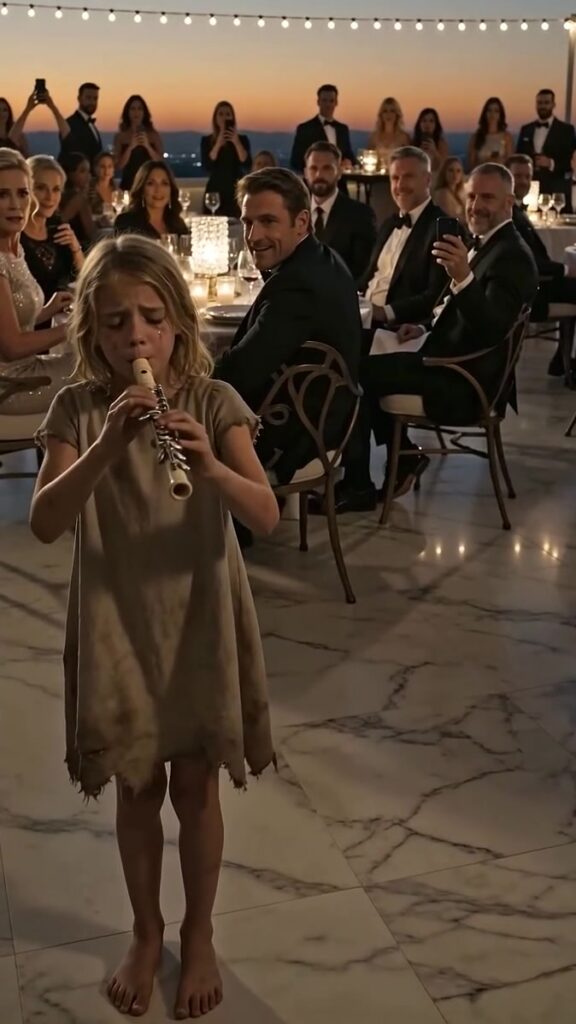
She was small, seven or eight perhaps, hair tangled into a dull knot and clinging to her forehead with sweat. Her clothes were not just old; they were tired—frayed at the seams, stained in places that looked like the city’s dust had become part of the fabric. She was barefoot. One foot had a fresh scrape across the arch. In her hands she clutched a flute that had lost its shine, the metal dulled and dented, a strip of tape holding one joint together as if the instrument itself had been wounded and bandaged back into usefulness. Her eyes were wide with exhaustion, the kind that comes from days not ending, from nights offering no real rest.
Her voice tore through the jazz like a blade.
“Please!” she screamed, and the word bounced off crystal and stone. “Please… I just need money for food… please!”
Silence arrived so fast it felt physical. The pianist’s hands hovered above the keys. The brush on the snare stopped mid-sweep. A laugh at the bar died in someone’s throat. Forks paused. A few guests turned slowly, as if moving too quickly would make the moment more real. In that hush, the city sounds far below seemed louder—sirens, horns, the distant bark of a dog—but even those felt like they belonged to another world.
Phones began to rise. Not all at once, but like a tide—first one screen, then three, then a half-circle of glass rectangles capturing the scene. Some guests watched through their cameras rather than their eyes, as if a recording could act as a shield. A woman at the next table pinched her mouth as if tasting something bitter. Another smirked, amused by the interruption, by the idea of disorder daring to enter their curated evening.
The hostess took one step forward, then stopped. A security guard near the elevator tightened his jaw, waiting for a signal.
At the main table, the wealthy man leaned back in his chair with the indulgent air of someone discovering unexpected entertainment. He surveyed the girl the way one might examine a stray animal that wandered into a gallery. His friends watched him to see how they should react. He reached for his glass, swirled the wine, and held it up to the light like a judge considering evidence.
“If you want money,” he said, voice smooth, carrying without effort, “impress us.”
A soft ripple of laughter moved around him—carefully contained, like the jazz. Someone made a short, disbelieving chuckle as if to say, can you believe this? Another guest murmured something about “content,” and a friend nudged them, grinning. The moment took on the shape of a spectacle, a sudden performance staged by accident and cruelty.
The girl’s shoulders trembled. For an instant she looked smaller, as if the silence and the watching eyes were pressing her into the floor. She stared at her feet, at the stone tiles clean enough to reflect her dirt. Her fingers tightened around the flute until her knuckles paled. She swallowed, and the movement in her throat looked painful, like forcing down something sharp.
She took a step back toward the service door. Her gaze flicked to it, to the gap she had come through. There was a brief, almost unbearable pause where it seemed she would flee—where all the bravery that had carried her up elevators and stairs and past barriers would crumble into shame. Some guests anticipated it and relaxed, already bored, already ready to return to their plates and their curated stories.
Then she lifted the flute.
Not with the bright confidence of a trained performer, but with a careful, trembling insistence. She held it like a lifeline. Her fingers found the keys by memory. The worn metal caught the last sun and glowed faintly, a small tarnished moon in her hands. She drew in a breath that made her ribs show under her shirt, and for a heartbeat her eyes closed, as if she had to leave the rooftop to find the sound.
Across the terrace, the wealthy man’s mouth curved, amused and expectant. Phones steadied. The security guard’s hand hovered near his earpiece. The trio watched, uncertain whether to reclaim their music or surrender it.
The girl’s lips touched the mouthpiece.
And before the first note could be heard—before anyone could decide whether to mock, to pity, to intervene—the world seemed to hold itself in suspense, suspended between cruelty and grace, between a dare and a prayer.
Cut to black.