The jewelry store was too quiet.
Not the quiet of velvet chairs and careful footsteps, not the hushed reverence people pretended to have when they were about to spend too much money. This was a colder quiet, as if the air itself had been polished and sealed behind glass. It tasted faintly of disinfectant and expensive perfume, of metal warmed by white lights that never blinked.
Diamonds lay in their trays like frozen stars. Gold bracelets curled like sleeping snakes. Everything was arranged to make you believe the world was orderly—measured in carats, set in prongs, accounted for in neat little tags that no one seemed to read.
The customers drifted with an unhurried certainty, faces calm, hands loose, eyes selecting. They moved like people who had never done arithmetic at a checkout counter, like people whose money had always arrived before the worry did.
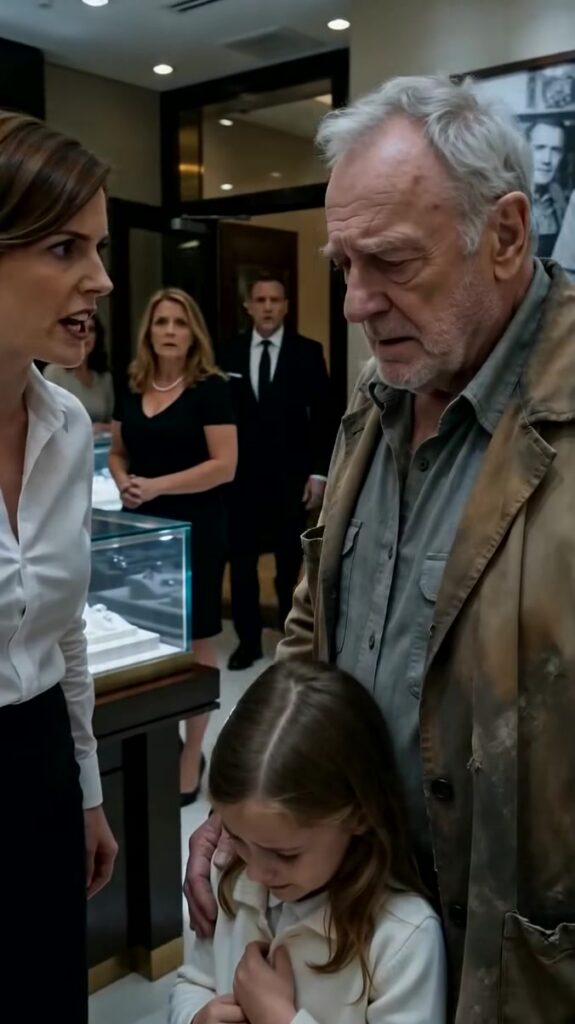
At the far end of the main cases, an old man and a little girl stood out in a way no security camera needed to zoom in to notice. His coat was worn at the elbows. Her boots were scuffed, the kind that still held playground dirt in their seams. He kept his hands in his pockets as if afraid they might touch something by accident.
The girl leaned toward the glass, nose nearly brushing the polished surface. Her breath clouded it for a moment before the store’s steady climate erased the proof that she was alive and warm.
“Grandpa,” she whispered, voice small enough to be swallowed by the carpet, “if I ever become rich… I’ll come back for this one.”
She was looking at a heart-shaped pendant tucked in a corner of velvet. It wasn’t the largest stone in the case. It wasn’t meant to impress with size. It had a modest diamond nested in the center, framed by a thin ring of rose gold, delicate as a promise.
The old man’s face softened. The light caught the silver in his hair and the tired lines around his eyes. He smiled like someone rehearsing a happier life.
But something in that smile didn’t belong to joy.
It was the kind of expression you learn when you’ve had to smile through things that cut: a trained curve of the mouth held together by grit. The muscles moved, but the heart behind them stayed braced, as if expecting to be struck.
He opened his lips, perhaps to tell her that riches were not the only way to earn something beautiful, perhaps to promise her that she’d have it anyway. His hand rose halfway, hovering near her shoulder, and hesitated—like touch itself required permission.
Then—
BANG.
A sharp knock on the glass case, the sound exploding in the polished quiet like a gunshot without the smoke. Heads turned in a smooth, synchronized wave. Someone in a suit paused mid-step, as if the floor had suddenly shifted.
The saleswoman had rapped her knuckles against the glass. She wore a black dress that made her look like a shadow given shape, and a necklace that sat at her throat like a collar. Her smile was practiced, but the way her eyes narrowed made it clear she had decided, instantly and completely, what the old man and the child were worth.
“Don’t stand there dreaming over things you’ll never touch,” she said, voice bright enough to be cruel. She didn’t lower it. She wanted it to carry.
The little girl flinched so hard her shoulder bumped the case. Her hands went to her grandfather’s coat, clutching the fabric as if it were a lifeline. She slipped behind him, hiding her face in the folds of worn wool.
The old man’s jaw tightened. He drew in a breath that seemed too heavy for his chest. “Please,” he said, and the word came out quiet, almost respectful. “She’s just a child.”
It should have been enough. A normal person would have softened. A normal person would have realized there was no danger in a child’s longing.
The saleswoman didn’t soften.
“Then teach her her place before bringing her in here,” she replied, as if the store were not a store at all but a private club, and the little girl had wandered in from the street.
The silence that followed was thick and wrong. It pressed against the old man’s temples. The wealthy customers pretended to examine earrings or watches, their attention carefully angled away, but not their ears. No one spoke. No one intervened. It was easier to let cruelty happen when it wasn’t aimed at you.
The little girl’s grip on his sleeve tightened. Her head bowed. Her eyes fixed on the floor, studying the pattern of the carpet like it held a hidden door she could crawl through to disappear.
And the old man—
He said nothing.
He swallowed whatever rose in his throat: rage, shame, an apology he did not owe. His shoulders rounded a fraction, as if his body had learned to make itself smaller when a room decided it was unwelcome.
He reached, slowly, to cover the girl’s hands on his coat, not to pull them away, but to warm them, to tell her without words that she was safe. Yet even that gesture looked cautious, like he feared it might be misinterpreted as theft.
“Come on, Lila,” he murmured, using her name as a shield. “Let’s go.”
He turned them toward the door.
And then another voice cut through the stillness—low, sharp, and full of something that did not belong in that room of curated calm.
“Do you even know who founded this store?”
It came from behind the saleswoman.
The manager had stepped out from an office door that opened without a sound. He was a tall man with close-cropped hair and an immaculate suit that fit like armor. For a heartbeat, he looked past the customers, past the display cases, past the saleswoman’s stiff posture—straight at the old man.
The manager’s face drained of color.
His eyes widened the way people’s eyes widen when they see someone they thought was a myth step into daylight. His lips parted as if to speak, then closed again, as though the air had been punched from him. His gaze flicked to the old man’s hands—hands that were calloused, steady, and faintly stained at the knuckles, as if they had once worked with tools and metal and fire.
“It can’t be…” the manager whispered, but it was not disbelief. It was recognition that hurt.
The saleswoman blinked, annoyed by the interruption. “Sir, I’m handling—”
“Stop,” the manager said, and the word landed with authority so sudden it made her stiffen. “Right now.”
He didn’t look at her. He kept looking at the old man like his world had shifted off its axis. Then, slowly, as if his body were being moved by an unseen hand, he turned toward the wall behind the main counter.
A black-and-white photograph hung there, framed in gold. Most customers glanced at it only long enough to feel that sense of history the store sold alongside its diamonds. In the photo, a younger man stood in a workshop, sleeves rolled up, holding a small piece of jewelry toward the camera. He wasn’t smiling for the photographer. He looked exhausted. Determined. Alive.
The manager’s finger lifted and pointed, trembling.
“That’s him,” he said, voice breaking on the last word.
In the quiet, all eyes followed his gesture to the photograph.
Then back to the old man by the door, with the little girl hiding behind his coat.
The saleswoman turned, finally, and her expression shifted—confusion first, then the slow creep of fear as she looked from the photograph to the man she had just humiliated.
The old man’s smile returned, but this time it wasn’t rehearsed. It was weary, layered with old memories. His eyes glistened like glass under the harsh lights, and for the first time he looked directly at the room that had tried to shrink him.
He did not raise his voice. He did not demand respect. He simply stood there, as if he had been standing in that exact spot for decades, waiting for someone to remember.
The manager took a step forward, then another, his polished shoes suddenly too loud on the carpet. “Sir,” he said, the title shaking, “you founded Marrow & Finch. My grandfather told me stories. He said you vanished after the fire.”
The old man’s hand tightened around Lila’s small fingers. “I didn’t vanish,” he replied softly. “I burned.”
The words hung in the air like smoke that no amount of cleaning could erase.
Behind him, the store’s door reflected a faint outline of the street outside—ordinary, loud, alive. Inside, the white lights continued to shine on the diamonds as if nothing had changed.
But everything had.
Because in that cold, perfect quiet, the store finally had to listen to the man whose hands had built it—and to the child who still believed she could come back for a heart-shaped promise.
The manager’s gaze flicked to the pendant in the case. His throat worked as if he were swallowing more than words. “Lila,” he said gently, crouching until he was eye-level with her hiding place, “would you like to see it closer?”
She peeked out, eyes wide with caution and hope.
Her grandfather did not answer for her. He just stood, steady and silent, holding her hand as the room waited—at last—for what he would do next.