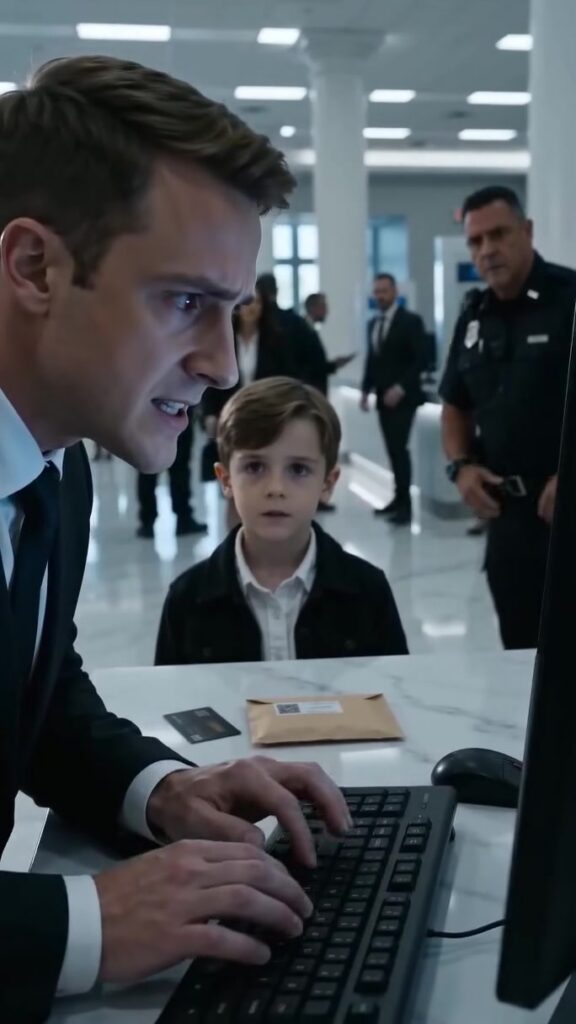
The bank was built to look like it served the city. Marble steps worn by a century of shoes, bronze doors polished by hands that wanted to be seen, a clock in the lobby that never lost a second. But the men and women who worked behind those doors knew the truth: the bank didn’t belong to people.
It belonged to what people hid.
At nine fifty-eight on a gray Tuesday, the lobby hummed with the usual choreography—customers clutching folders, security guards scanning faces, tellers smiling in practiced angles. In the back, where the vault’s air was colder and the cameras had a blind seam nobody admitted existed, a file cabinet sat locked not to protect money, but to protect names.
Julian Kade, teller station three, had learned to count fear as accurately as bills. He’d watched it sweat through collars and shake in signatures. His job was to take deposits, move numbers, and never ask why someone’s hands trembled when they said their own name.
When the front doors opened and a child walked in alone, Julian didn’t feel fear. He felt irritation. Kids were chaos, unpredictable and loud, and chaos didn’t belong in places like this.
The boy was small—seven, maybe—wearing a neat coat that didn’t match the weather. His hair was combed too carefully, as if someone had trained him to be presentable in rooms that punished sloppiness. He didn’t stop to gawk at the chandeliers or the armed guard by the metal detector. He walked straight toward Julian’s counter as if the path had been drawn for him.
Julian kept his eyes on his screen. “Hey,” he said, not unkindly but with the flat authority of someone who wanted a problem to vanish. “You’re in the wrong place, kid. Where’s your—”
The boy stepped closer. Slow. Measured. Not shy, not defiant—simply certain. He set a brown envelope on the counter with both hands, aligning its edge with the wood grain as if he respected lines more than people.
Then he placed a card beside it.
It was black, worn at the corners, the kind of matte plastic that swallowed light. No logo. No name. Just an embedded strip that looked older than any card had a right to be.
Julian finally looked at him. The boy’s eyes were steady, dark with the blank seriousness of someone who had chosen not to be a child.
Julian gave a small laugh, because laughter was the easiest way to make something ridiculous. “Is this a joke?” he asked. “Where’d you get that, magic shop?”
The boy didn’t blink. “Check it.”
It wasn’t a request. It was an instruction delivered with the calm of someone reading a rule that couldn’t be argued with.
Julian’s smile thinned. He glanced at the security guard, expecting the guard to move in and escort the kid back outside. But the guard was busy with a man arguing about a cashier’s check. Nobody was paying attention yet.
Julian took the black card between two fingers and swiped it through the reader. The machine chirped, then hesitated, as if confused by what it had been asked to recognize.
A prompt appeared on Julian’s screen. Not the bank’s usual blue interface, but a stark gray window with a single line of text: ENTER ACCOUNT DESIGNATION.
Julian’s stomach tightened. He typed “UNKNOWN” because he didn’t have anything else to type.
The screen flashed.
Then it populated with a profile page that should not have existed. An account number with too many digits. A status tag that read ARCHIVED—DO NOT ACCESS. A red banner above it, pulsing like a heartbeat: SYSTEM INTEGRITY WARNING.
Julian’s breath caught. He typed again, faster, searching for the database path, the permissions, the audit trail. His fingers made the familiar dance of a man trying to prove he was in control.
His face drained as he found it: a line in the account history marked PURGED BY ORDER OF BOARD. No timestamp. No signature. Just an instruction, as if the system itself had been told to forget.
“No,” Julian whispered, and the word sounded like it had been pulled from him. “No, this was wiped.”
The lobby noise seemed to thin, as if someone had lowered the volume on the entire room. Even the fluorescent lights felt quieter.
A guard approached, his boots sounding too loud in the new hush. “Problem?” he asked, leaning toward the counter.
Julian didn’t answer. He couldn’t. His eyes were fixed on the screen’s reflection, where his own face looked like a stranger’s—mouth slightly open, pupils wide with a fear he hadn’t learned how to hide.
From the corner of his vision, he saw movement: a woman in a black coat, hair pinned back, the kind of person who never stood in line. Julian knew her without knowing her name. She was the bank’s shadow—compliance, security, the part of the institution that didn’t sign holiday cards.
She leaned in, read the red warning, and recoiled as if the screen had burned her.
“Shut it down,” she said, voice low, sharp as a blade. She didn’t look at Julian. She looked at the boy.
Julian’s hands shook as he reached for the terminal’s power button. The button did nothing. The cursor moved on its own, opening windows Julian hadn’t touched. The red banner spread downward like ink, bleeding into every field, every number.
At the top of the screen, a line appeared: ACCESS CONFIRMED. WITNESS LOG ACTIVE.
People had started to notice. Heads turned. A man near the brochure rack paused mid-step. A teller at station one stopped counting and stared, sensing the shift without understanding it. Secrets had a way of changing the air.
Julian swallowed hard. “This account… it shouldn’t be here,” he said, more to himself than to anyone else. “Someone ordered it gone.”
The boy finally spoke again, voice small but cold, as if warmth had been removed for safety. “And yet it’s not gone.”
Julian looked at him, truly looked. Not at his coat, not at his size—at the stillness that didn’t belong in a child. “Who sent you?” Julian asked, because the bank only understood orders.
The boy leaned forward, close enough that Julian could see the faint scar on his chin, like a comma in a sentence that hadn’t ended. “No one,” the boy said. Then, after a beat heavy enough to press down on Julian’s lungs: “I came myself.”
The woman in black’s hand hovered near her earpiece. The guard shifted his stance, unsure whether to treat the child as a threat or a victim. Julian’s screen displayed a family profile photo that loaded slowly, line by line, as if the system was resurrecting the image from a grave: a man, a woman, and two children smiling in bright sunlight that didn’t exist anymore.
Beneath the picture was a name, and beneath the name, a note filed in a section Julian had never seen: SETTLEMENT HELD PENDING SILENCE.
Julian’s tongue felt thick. “That account belongs to a dead family,” he said, and the word dead tasted like metal. “They… there was a fire. Years ago.”
The boy didn’t flinch. His gaze didn’t move to the photo. It stayed on Julian, as if Julian were the one on trial. “Say their name,” the boy whispered.
Julian’s lips trembled. He knew the name. Everyone in this building knew it the way they knew the emergency exits—by training and by dread. The bank had taught them to avoid it, to treat it as a cracked tile you stepped over without looking down.
The red warning on the screen flickered, then stabilized into a new message: DISCLOSURE EVENT IMMINENT.
Julian glanced at the woman in black. For the first time, her composure broke. There was fear in her eyes, old and practiced, the fear of someone who had survived by never letting the wrong word through her teeth.
“Don’t,” she mouthed, barely moving her lips.
The guard’s hand drifted toward his holster, but his posture wasn’t protection. It was panic wearing a uniform.
Julian’s throat worked. The bank had rules for everything—withdrawal limits, identity checks, fraud alerts. It had no rule for a child asking for the dead to be named aloud in the place where they had been erased.
The boy’s voice softened, almost gentle, and that gentleness was worse than the command. “If you say it,” he said, “they can’t keep it anymore.”
Julian opened his mouth. The name rose in him like a confession. He could feel it pressing against his teeth, the shape of it, the weight. Around them, the lobby held its breath. Even the clock seemed to pause between ticks.
On the screen, the witness log began counting: 1… 2… 3… as if recording the number of people who would carry what came next.
Julian’s lips formed the first letter.
And somewhere deep in the building, behind walls made to muffle sound, something clicked—an old lock deciding whether it would hold one more time.
The boy didn’t blink.
The bank, which had always belonged to secrets, leaned in to listen.