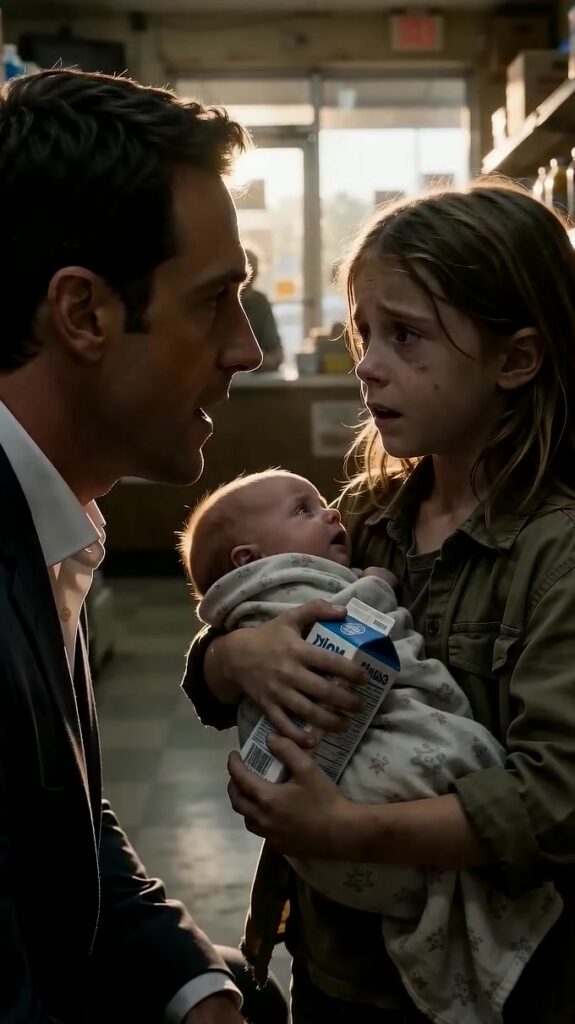
The bell over the door gave a tired jingle when she slipped into the corner store, as if even it had learned not to make a fuss about desperate people. Outside, the night clung to the pavement in a wet, black sheet. Inside, the lights were too bright—yellow and steady, like a promise someone else could afford.
Lena kept her back straight the way her mother used to teach her, a posture meant to fool the world into thinking you were unbreakable. Her arms ached from the baby. Milo’s small head rested under her chin, his breath fluttering in hiccupy puffs that sounded like he’d been crying in his sleep and couldn’t quite stop. Every few minutes his mouth would twist, the pre-cry shape, and she’d tighten her hold, as if pressure could keep sound from escaping.
Her brother, Finn, was at home on the couch with a fever and a bowl of plain rice that had gone cold hours ago. He’d pretended he wasn’t hungry. Lena had pretended she believed him. The truth was that hunger had become a regular guest, one of those relatives who never left and always asked for more.
She moved through the aisles carefully, passing shelves stacked with chips and candy and glossy magazines featuring people whose problems could be solved by changing a haircut. The milk case was in the back, breathing a thin frost into the air. When she opened the glass door, the cold hit her fingers and she shivered. She chose the cheapest carton—store brand, dented at the corner—and held it to her chest.
The carton wasn’t heavy. It was just… loud. It seemed to announce her to the whole store: a girl with a baby, hair pulled into a messy knot, shoes too thin for the season, carrying something she shouldn’t have without the right paper in her pocket.
At the register sat an old clerk with skin like folded paper and eyes that had seen every kind of story. He watched her without moving, one hand resting beside a little dish of pennies labeled TAKE ONE, LEAVE ONE. Lena waited for him to look away, to turn his head toward the lottery tickets or the dusty fan. He didn’t.
She tried to swallow, but her throat felt sealed. “I can pay later,” she said, and hated how small her voice was. “I just… my family needs it. My brother’s sick.” The baby shifted and made a thin sound. Lena rocked him, fast and frantic. “I’ll work. I’ll do anything. I’m not—” She stopped before the word thief could leave her mouth and make itself true.
The clerk’s gaze didn’t soften. It wasn’t cruel either. It was the look of someone who’d learned that pity could empty you quicker than poverty. His lips parted as if to say something, then he shut them again. Silence filled the space between Lena and the register like spilled oil.
Then the bell jingled once more, and someone entered with the quiet assurance of a person who belonged wherever he stood. Lena didn’t look at first. She kept staring at the rows of gum and mints, willing her hands to stop shaking. But she felt him near—felt the air change, the way it did when a storm rolled in without warning.
“That’s an interesting thing to hold like a shield,” a man’s voice said.
Lena’s eyes lifted. He wore a dark suit that probably cost more than everything in her apartment, including the couch with the broken spring. His hair was neat, his shoes polished. He didn’t glance at the candy or the cigarette rack. He looked only at her and the baby and the carton of milk pressed too tightly to her ribs.
He stepped closer—not aggressive, not gentle. Just inevitable. The clerk made no sound. The store seemed to stop humming. Even the fluorescent lights felt quieter.
Lena angled her body, instinctively placing herself between the man and Milo. “I’m paying,” she lied, though her empty pockets might as well have been transparent.
“I know,” the man said. “In one way or another.”
He crouched until his face was level with hers, which was worse than looming. It made the moment intimate, like a confession. Up close, Lena saw faint lines at the corners of his eyes, the kind that came from deciding hard things. His gaze flicked to Milo’s cheeks, raw from crying. Then back to Lena.
“What if I offered you more than milk?” he asked.
The question was ridiculous, and yet it landed with weight. More than milk meant more than a night of quiet. It meant more than a filled stomach. It meant more than she had been allowed to want since the day her mother didn’t come home from work and the landlord changed the locks three days later.
Lena tightened her grip on the carton, fingers whitening. “I don’t have anything to give,” she said.
“You have time,” he replied. “And you have a choice.”
Milo stirred, his face wrinkling. A cry rose like a siren warming up. Lena bounced him harder, whispering his name, begging him with her breath. The baby’s mouth opened—then he stopped, distracted by the movement. The quiet that followed felt like the last plank of wood over deep water.
The man reached into his inner pocket.
Lena stepped back so quickly she bumped the counter display of lollipops. Plastic-wrapped spheres rattled against each other. Her heart raced so hard she thought it might bruise her from inside. Every story she’d ever heard about men in suits flashed through her mind: social workers, debt collectors, police, people who spoke in calm voices while tearing your life apart.
“Don’t,” she said, though she didn’t know what she was asking him not to do.
He withdrew his hand slowly, the gesture careful, as if moving too fast might shatter something. “I’m not going to hurt you,” he said.
In his palm lay a small object that was not money.
It was a hospital bracelet—thin, white plastic with the faded gray of a name printed on it, worn down by time and water and grief. The kind of thing you were supposed to throw away. The kind of thing you couldn’t.
Lena’s breath caught. The store tilted, as if the floor had forgotten how to stay level. She knew that bracelet. She had kept hers for years, tucked in a shoebox with a lock of hair and a photo of her mother smiling before the world turned sharp. Lena had traced the letters until they blurred: MARA RIVAS. The date. The ward number.
The bracelet in the man’s hand carried the same name.
“Where did you get that?” Lena whispered. Her voice sounded like it belonged to someone else.
The man’s eyes didn’t flinch. “I was there the night she came in,” he said. “And I was there when she didn’t leave.”
Lena shook her head once, hard, as if she could dislodge the memory. “No.” She swallowed and tasted metal. “No, you’re lying. She—she died.”
“That’s what they told you,” he said gently, and that gentleness was what made her stomach twist. “Because it was easier. Because it was cleaner.”
Milo whimpered again, and the sound cracked something open in Lena’s chest. The bracelet in the man’s palm looked too small to hold so much weight. Her hands, still around the milk carton, suddenly felt ridiculous—like she’d been bargaining with pennies while someone had been holding the deed to her entire life.
“Why are you showing me this?” she asked, and the words came out scraped raw.
“Because your mother didn’t disappear,” the man said. “She was taken. And the people who took her are the same people who are watching families like yours collapse quietly so no one notices.”
Lena stared at him, waiting for the part where he demanded something awful. “What do you want?” she managed.
He glanced at the milk in her hands, at Milo’s damp eyelashes, at the exhaustion that had made a home in Lena’s face. “I want you to stop trying to survive in the cracks,” he said. “I can get your brother a doctor tonight. I can get formula and heat and a place that locks from the inside.”
Her heart lurched with a hope so fierce it hurt. She hated it immediately, because hope had fooled her before.
“And in return?” Lena asked.
The man’s expression tightened, not with cruelty, but with the strain of saying something that would change everything. “In return,” he said, “you come with me. Not as a charity case. As someone who’s going to help me find where they keep the people they don’t want found.”
The clerk behind the register cleared his throat softly for the first time, a small reminder that the world still existed. He slid a coin from the penny dish, rolling it between his fingers as if deciding whether to intervene, whether it would matter.
Lena looked down at Milo. He stared back with wide, unknowing eyes. The baby didn’t care about conspiracies or missing women or men in suits. He only cared that someone held him and that the night didn’t hurt too much.
Lena’s fingers loosened around the milk carton. The plastic crinkled in surrender. She could walk out. She could go home with a stolen carton and the old familiar fear, and pretend the bracelet hadn’t existed.
Or she could step into something darker and sharper than hunger, something that might finally have a name.
“If you’re lying,” she said, her voice steadying into something new, “I’ll make you regret it.”
The man nodded once, like he’d expected nothing less. He placed the bracelet on the counter beside the milk, a small white circle of truth. “Good,” he said. “Then we understand each other.”
Lena reached for the bracelet with the hand that wasn’t holding her child. It was lighter than it should have been. It always had been. But when her fingers closed around it, she felt, for the first time in years, the weight of a direction.
Behind her, the warm store lights kept shining, golden and indifferent, as she stepped away from the register without the milk—and toward a night that would not be quiet, but might finally be hers.