The birthday dinner looked flawless. That was the point of it: a room polished to a shine so bright it could blind the truth itself. Warm chandelier light poured down in honeyed sheets, catching the edges of crystal stemware and turning every toast into a little flare of fire. Candles stood in ranks along the length of the table, their flames wavering as if even the air was holding its breath.
Outside the mansion windows, the city was a distant smear of light and weather, far away enough to feel unreal. Inside, everything was carefully real—silk napkins folded into swans, orchids arranged with surgical precision, a cake tall as a child and whiter than any honest memory. The guests leaned into laughter like it was a shared investment. Jewelry winked. Watches glinted. Wealth wrapped the room in the comforting lie that history could be rearranged if the furniture was expensive enough.
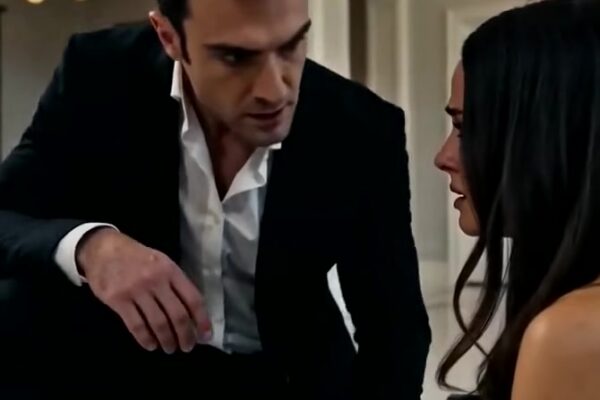
At the center sat Victor Hale, turning sixty with the ease of a man who had always been allowed to turn any age he wished into a celebration. His young wife, Elena, sat at his right hand in a dress the color of dark wine. She smiled at the guests and at Victor in a practiced rhythm, the kind of smile that didn’t reach the eyes but always reached the cameras.
“To Victor,” someone said, raising a glass. “To the years behind us—”
A small box hit the table.
Not thrown. Not slid. Dropped—clean, deliberate. The sound was sharper than it should have been, a wooden knock that echoed against the silver and porcelain like a gavel. Forks rattled. A laugh died mid-breath. Someone’s crystal clinked once, then stopped.
Heads turned in a wave. The nearest guests looked first for a prank, then for a servant to blame. But the movement came from the far end of the table, where the marble floor gleamed so perfectly it reflected the candlelight like still water.
A boy stood there.
He was too small for the grandeur around him, too thin for the winter outside, too dirty for the spotless white walls. His clothes hung in torn layers as if they had been passed through too many hands that never had enough. He was barefoot on the marble, his toes curled as though the cold might crack him. His hands trembled so hard that even without moving, he seemed to vibrate, and yet he had carried the box all the way into this room without dropping it.
Victor rose slowly, chair scraping back with a controlled, irritated sound. His face shifted in stages—the fleeting amusement of a man seeing an interruption, then annoyance at being forced to acknowledge it, then the cold that had built empires and broken people. The room waited for him like a courtroom waits for the judge.
“Who brought him in here?” Victor asked.
No one answered. Servants hovered near the doors, frozen between obedience and panic. Security stood too far away to intervene without being noticed, and in this house being noticed was its own kind of failure.
The boy swallowed hard. His throat worked like it was trying to push a stone down. He stared at Victor with eyes too old for his face, then flicked a glance to the cake as if it might be safer to look at sugar than at a man with power.
“My mom told me to give you this today,” he said, voice small but steady enough to reach the far end of the table.
Elena’s smile faltered for the first time all evening. Her fingers tightened around her wineglass. Victor stared at the box as if it had grown teeth.
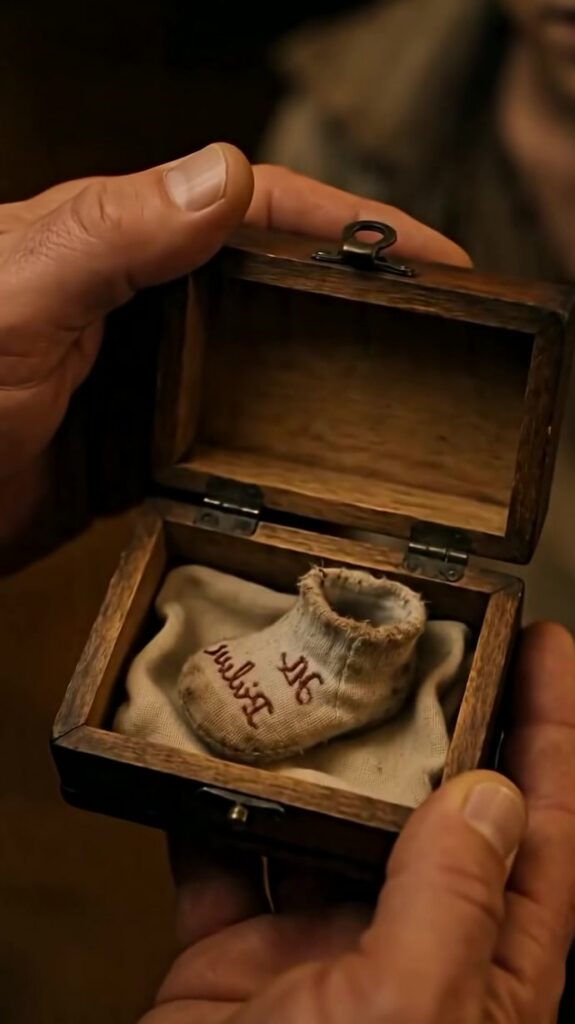
He picked it up. His hands, ringed and manicured, looked wrong holding something so plain. He opened the lid with the caution of someone handling an animal trap.
Inside lay a single baby shoe.
It was tiny, softened by age, the leather scuffed in a way that spoke of being loved and worn and then saved. It had been cleaned at some point, carefully, reverently, the way people clean relics. On the inside, along the sole where no one would see unless they looked, faded thread formed two stitched initials: V.H.
Victor’s breath stopped as though someone had reached into him and twisted a valve. Color drained from his face in a slow, sick tide. The confident mask he wore in boardrooms and headlines slipped, revealing something raw beneath it—something frightened.
“I buried this,” he said, not to the boy, not to the room, but to whatever shadow had followed him into the light. His lips trembled around the words as if they were poison.
Elena leaned closer, her voice a whisper meant only for him. “Victor… what is that?”
He didn’t answer. His gaze snapped back to the child, sharp enough to cut. “Where did you get it?”
The boy’s shoulders rose and fell once, a breath he couldn’t afford to spend. “My mom kept it under her bed,” he said.
There was a sense then—subtle, almost superstitious—that the room had lost oxygen. Even the candles seemed to burn smaller. No one moved. No one reached for a phone, as if documenting this would make it permanent.
Victor’s fingers tightened around the box. His voice dropped lower. Tighter. “Who is your mother?”
The boy blinked fast, trying to keep tears from spilling. When he spoke, his voice was barely above a whisper, but it landed like a verdict.
“She said you buried the shoe,” he said. “But not the baby.”
Victor’s grip loosened as if his hands had gone numb. The tiny shoe tipped in the box, then settled. A sound left Victor—half gasp, half laugh that couldn’t find humor. He stared at the boy the way a man stares at a locked door suddenly opened from the other side.
Elena’s chair creaked as she pushed it back, the motion instinctive. She looked from the shoe to Victor’s face, confusion turning into something darker. Fear doesn’t always announce itself; sometimes it simply rearranges a person’s posture, pulls their shoulders up, shortens their breath.
“That’s not possible,” she said, and the denial in her voice was thin as tissue. “Victor, tell me this is some—some sick joke.”
Victor didn’t look at her. His eyes were fixed on the boy’s bare feet, on the dirt under the nails, on the bruises blooming along his shins like old storms. He seemed to be seeing, for the first time, what the candles and chandeliers could not disguise: that poverty leaves marks wealth cannot polish away.
“What did she tell you?” Victor asked, and in his tone there was a new note, not anger but something like dread. “Why now?”
The boy licked his lips. His hands fluttered at his sides as if looking for something to hold. “She said… she said today was the day you’d be surrounded,” he answered. “She said you’d think you were safe because everyone was watching you be happy.”
Victor’s gaze flicked over the table, over the guests frozen with wide eyes, over the cake with its perfect white frosting. He swallowed, and the movement looked painful.
“Where is she?” he demanded.
The boy’s expression pinched, and for a second he looked very young. “She can’t come,” he said. “She can’t walk good anymore.” He hesitated, then added, as if repeating a sentence he had been told to memorize: “She said you took something from her that never grew back.”
Elena made a soft sound—something between a sob and a strangled breath. She stared at Victor as if she had never seen him before. The man who had bought her diamonds and promised her a future suddenly looked like a stranger wearing his face.
Victor’s mouth opened, then closed. His eyes shone with a wetness he would have despised in anyone else. His hands trembled now, matching the boy’s. He set the box down slowly, as if it might explode, and the action felt like surrender.
Across the table, someone finally found their voice, a brittle attempt at control. “Victor, should we call—”
“No,” Victor snapped, the word cutting through the room. He looked at the boy again. “Your name,” he said. “Tell me your name.”
The boy’s chin lifted. He didn’t look proud. He looked determined, the way people look when they’ve been carrying a message too heavy for them and have no choice but to deliver it anyway.
“Jonah,” he said. Then, softer, almost as if he didn’t want to say it but had promised he would: “She said you’d remember.”
Victor’s eyes squeezed shut for a moment. When he opened them, the flawless dinner—the light, the crystal, the roses, the cake—seemed suddenly fragile, like a stage set that could be kicked down with one hard truth.
He looked at Elena, and for the first time all night he seemed to see her not as decoration beside him but as a witness. His voice came out hoarse. “I need… I need a car,” he said, not commanding now, but pleading with the air. “Get my driver.”
Elena stood, trembling. “Where are you going?”
Victor stared at the little shoe as if it were a compass pointing straight into his buried past. “To the only place I never paid off,” he whispered. Then he turned back to the boy, his eyes hollowed by an old secret clawing its way into daylight. “Show me,” he said. “Take me to her.”
The boy didn’t move at first. He watched Victor the way a child watches a storm decide whether it will pass or strike. Then, very slowly, Jonah nodded. The candles continued to flicker, the chandelier continued to glow, and the guests continued to sit in their expensive silence—while the flawless birthday dinner cracked down the middle, and what had been hidden beneath beauty finally began to breathe.