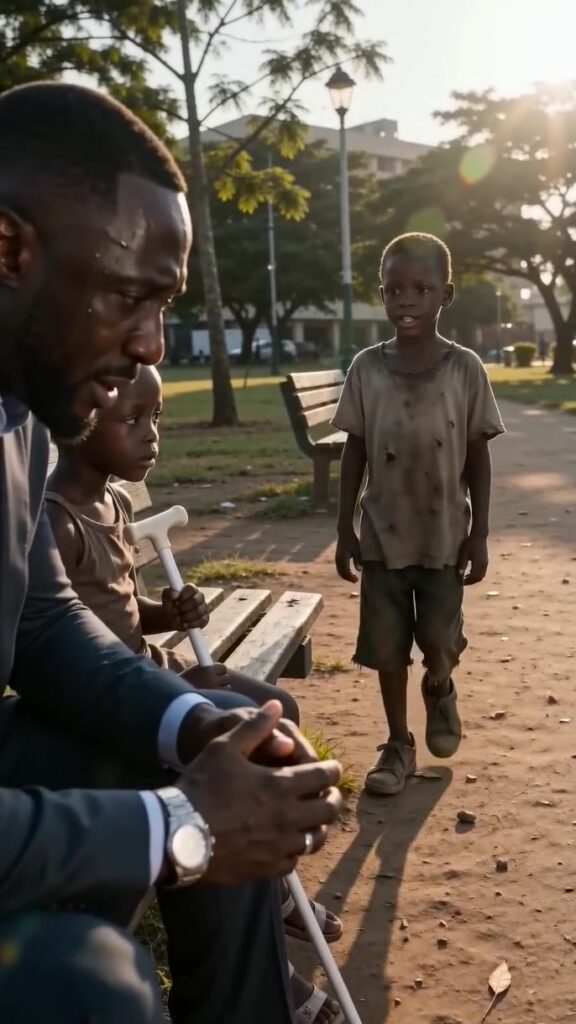
The pavement shimmered like poured glass. Heat rolled off the courthouse steps in visible waves, turning the world into a wavering mirage. Under the thin shade of a sickly palm, Eli Ward sat on the lowest stair with his back straight and his shoulders rigid, as if he could will himself into stone. His shirt clung to him; sweat gathered at his collarbone and slid down his spine. He didn’t wipe it away. His left hand was occupied—trapped, really—inside the tight grasp of his daughter.
Mara’s fingers were small, but they held him with the panic of someone gripping the last solid thing in a world that kept dissolving. Her eyes, clouded and unfocused, stared toward nothing. She had learned the angles of his face by touch, the slope of his cheek, the hinge of his jaw, the way his knuckles stood out. Now she mapped him again and again as if repetition could keep her from disappearing.
“Daddy,” she murmured, voice thinned by the heat. “Is it nighttime already?”
Eli forced his mouth into a smile she couldn’t see. His throat tightened. “No, sweetheart. Just clouds.”
There weren’t any clouds. The sky was a harsh, empty blue that pressed down like a hand. But lying was a habit you picked up when you lived in triage—when you learned to keep a child calm while the world did its slow, brutal harm.
For six months, they’d been in and out of clinics. Specialists with clean shoes and gentle voices. Tests that tasted of metal and antiseptic. The conclusion always landed with the same dull finality: progressive loss, uncertain cause, unlikely reversal. Eli had learned to nod, to ask the right questions, to take pamphlets he would later tear into tiny pieces in his truck. He’d learned to keep his terror quiet so Mara wouldn’t hear it.
Today’s appointment had ended early, not with an answer but with a referral and a polite apology. Eli had walked them out into the punishing noon and sat down as if the heat could weld him to the steps. He had one more name written on a sticky note in his pocket, one more number to call, one more day to pretend he could outwork despair.
He felt Mara’s thumb rub over the scar on his knuckle—an old cut from a busted radiator hose. Her touch was absent-minded, seeking comfort the way a drowning person seeks air.
“What are the clouds doing?” she asked.
“Moving,” he said, because movement was hope.
Then he noticed the boy.
At first Eli thought he was just another kid cutting across the plaza. There were always children around the courthouse—some with parents, some with nowhere else to be. But this one wasn’t moving like he had a destination. He stood near the fountain without touching it. The water flashed in the sun, and the boy didn’t squint. His hair was too neat for the heat, his shirt buttoned to the collar as if he’d dressed for winter. Most unsettling was the stillness of his face. No fidgeting. No restless glance at phones or pigeons or passing cars. Just watching.
Eli shifted instinctively, putting himself between the boy and Mara. “Not today, kid,” he said, keeping his tone flat. “Move along.”
The boy didn’t flinch. He stepped closer, slow and measured, as if he’d rehearsed each footfall. He stopped at the edge of the stair where Eli sat and looked down at him. His eyes were an unsettling gray, like stormwater in a gutter.
When he spoke, his voice cut through the heat with an odd clarity. “Your daughter is not sick.”
Eli felt his chest compress. For a moment the courthouse, the fountain, the shriek of distant traffic all fell away. He heard only the blood in his ears and the faint intake of Mara’s breath.
“What did you say?” Eli’s voice came out rougher than he intended. His hand tightened around Mara’s, not to hurt her, but to anchor himself.
“She isn’t going blind,” the boy said. “Someone is taking her sight.”
The words landed wrong, like a shoe on a stair that isn’t there. Eli stood up too fast, dizziness flashing white behind his eyes. “What are you talking about?” Panic sharpened the edges of every syllable. “Who are you?”
Mara turned her head toward the sound of the boy, her face tilting as if listening could substitute for seeing. “Daddy?” she asked, and the single word carried all her trust.
The boy’s gaze flicked to Mara, and for the first time something like pity moved across his features—brief, controlled, then gone. He leaned slightly closer to Eli, just enough that the fountain’s babble covered the next sentence. He didn’t raise his voice. He didn’t have to.
“Your wife.”
Eli’s spine went cold. The sun might as well have vanished. His mind refused the idea at first, rejected it like a body rejecting poison. Lila’s laugh. Lila’s hands braiding Mara’s hair. Lila sitting up at night searching medical forums until her eyes were red. Lila whispering prayers into Mara’s pillow.
“No,” Eli said automatically. “No. That’s—”
“You’ve been chasing doctors,” the boy continued, calm as a metronome. “You keep hearing the same vague words: degenerative, idiopathic, unlucky. But the pattern doesn’t fit. She sees better on some days and worse on others. The drops don’t help. The scans don’t explain it. Your daughter doesn’t have a disease. She’s being altered.”
Eli’s jaw clenched so hard his teeth ached. “Altered how?”
The boy’s eyes didn’t blink. “Not with the body. With what the body is allowed to receive.”
Eli stared, waiting for the punchline, the con, the demand for money. None came. The boy’s stillness held like a threat.
“That makes no sense,” Eli said, but his voice had lost conviction. A memory surfaced uninvited: Mara rubbing her eyes after drinking her bedtime tea, the way Lila insisted it helped her sleep. Another: Lila always volunteering to handle Mara’s vitamins, snapping, “Let me do it, you forget.” Another: Mara complaining once that her tongue felt “fuzzy,” and Lila laughing too loudly. Eli had noticed then, a flicker of something in Lila’s face—fear, maybe—before she masked it.
“Why are you telling me this?” Eli demanded. His hands shook now openly. He felt Mara’s grip tighten, sensing his distress.
The boy finally blinked, once, slow. “Because if you keep letting it happen, she won’t just lose sight. She’ll lose her ability to notice what’s being done. That’s the point.”
Eli swallowed, throat dry as dust. “Who sent you?”
“No one,” the boy said. “Some things don’t get sent. They arrive.”
Mara tugged at Eli’s hand. “Daddy, are the clouds still moving?” Her voice cracked, not from the heat this time but from the tension she could taste in the air.
Eli turned to her, and the act of facing her felt like turning toward a cliff. He forced himself to breathe. He knelt so his face was close to hers. He wanted to shelter her from the boy’s words, from the sudden fracture in the life he’d believed in. But the fracture was already there, spreading with each heartbeat.
“Yeah,” he lied softly. “They’re moving.”
He stood again and faced the boy. “What do I do?” The question tasted like betrayal, like he was condemning Lila with a stranger’s whisper. Yet beneath that was something darker: relief at having someone to blame, at having a direction for his fear.
The boy’s expression didn’t change, but his eyes seemed to harden. “You stop letting her give Mara anything you don’t prepare yourself,” he said. “You watch your wife like you watch a fire. You don’t confront her until you have proof. And you don’t leave Mara alone.”
Eli’s pulse hammered. “Proof of what?”
The boy’s gaze lifted past Eli, toward the courthouse doors, as if he could see through stone. “People don’t steal sight because they hate eyes,” he said. “They steal it because they don’t want witnesses.”
Before Eli could ask anything else—before he could grab the boy’s sleeve or demand a name—the boy stepped back. He turned away with the same deliberate calm, walking not toward the street but toward the shadow beneath the courthouse arch. The light swallowed him until he reached that line of darkness, and then, in the blink between heat and shade, he was gone.
Eli stood frozen under the burning sun, his daughter’s hand clenched around his, and the world he knew—his marriage, his routines, the comforting story of an illness they were fighting together—collapsed inward like a roof eaten through by termites. Around them, people passed without looking. The fountain kept talking to itself.
Mara lifted her face toward him. “Daddy?” she whispered. “Why did it get quiet?”
Eli looked down at her clouded eyes, at the trust in her upturned mouth. Somewhere in his pocket the sticky note with the next specialist’s name crumpled against his thigh. He had thought the enemy was misfortune. Now the enemy had a familiar voice and slept beside him at night.
He squeezed Mara’s hand carefully, as if she were made of glass. “We’re going home,” he said, and the words sounded like the first line of a war prayer.
Above them the sky remained empty and bright, but Eli could no longer pretend the darkness wasn’t already inside their house.