The parking lot was loud in the ordinary way—rattling carts, idling engines, the beep-beep of a delivery truck reversing as if the whole world had agreed to speak in practical noises only. A thin rain had passed through and left the asphalt dark and gleaming. Sunlight struck the wet surface with the harshness of a spotlight, turning every puddle into a mirror and every oil stain into a bruise. It looked too bright for anything cruel to happen.
That was the trick of places like this. Cruelty didn’t need shadows. It wore fluorescent light and slid between minivans.
The elderly woman came through the automatic doors with a paper grocery bag hugged against her chest. Her coat was the sort that had once been fashionable and now had simply become permanent. She walked with the careful rhythm of someone who had learned not to trust their own knees, pausing at every painted line as though the stripes might shift under her. Her eyes scanned for her car—small, pale blue, parked too far away because the closer spaces were taken by people who moved faster.
She was only a few steps into the lot when the young man intercepted her. He wasn’t a kid, not really—mid-twenties maybe, built with the wiry confidence of someone who never expected consequence. A red hood was up over his head though the rain had stopped. His hands were empty, his expression busy with impatience.
He said something she didn’t hear over the engines and the music leaking from another car. She turned her head, the way people do when they’re trying to be polite and also trying to get away. She shook it once, a small apology. She shifted the bag higher in her arms, as if her groceries could become armor.
The young man stepped closer. His mouth moved again—words sharper this time, shaped like demands. His eyes flicked to her bag and then back to her face, measuring the softness of her, the slowness of her. He made a small, dismissive sound and reached out.
It happened so quickly the moment barely had a beginning. One hand snagged the paper handle. The woman tightened her grip on instinct, and for a heartbeat they were connected by that thin loop of twisted paper—her need pulling one way, his entitlement pulling the other.
The handle tore.
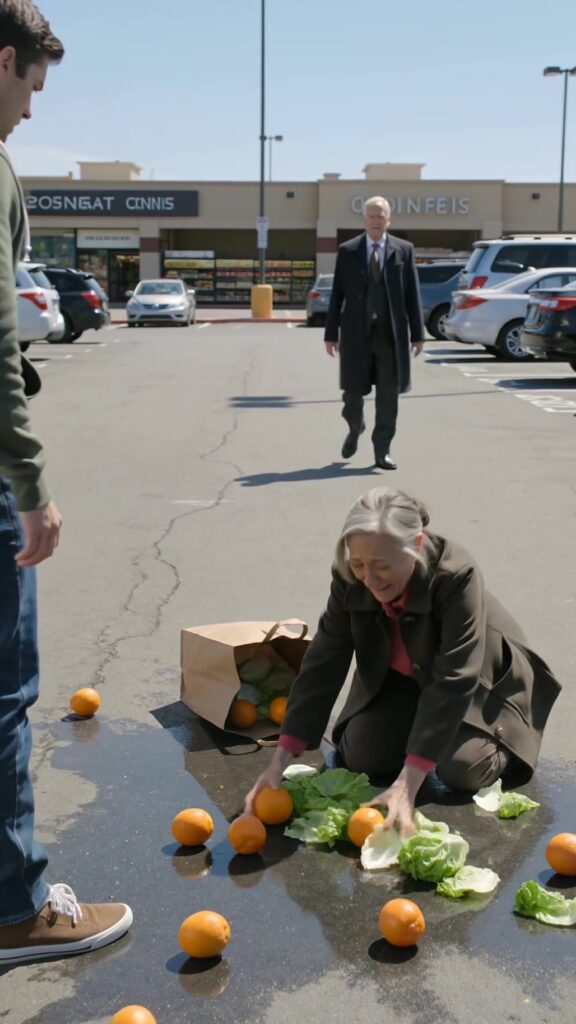
The bag hit the ground with a dull slap that echoed louder than it should have. It burst open on impact like a paper heart splitting. Oranges rolled away in bright, ridiculous arcs. A head of lettuce skidded through a sheet of water and came to rest against a tire. A carton—milk, maybe—split and bled pale liquid into the cracks of the pavement. A loaf of bread slid into a shallow puddle and soaked up the water greedily as if it had been waiting for it.
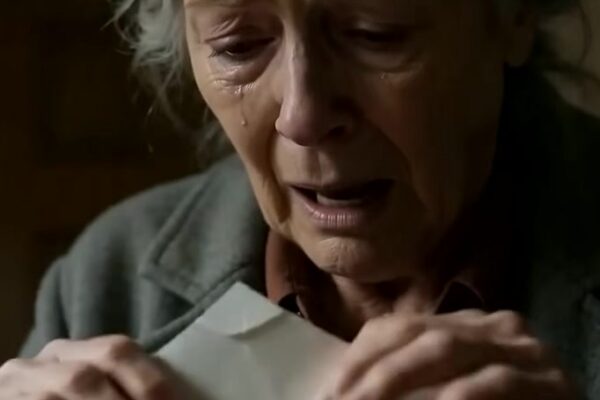
The woman stood frozen beside the mess. Her face collapsed before she even moved, as if her features had been holding together purely out of routine and now couldn’t justify the effort. Her lips parted. The sound that came out was so thin it didn’t seem like it could be heard in a place so loud.
“That was my last money.”
The words trembled. Her voice shook so hard it barely sounded real, like it belonged to someone speaking from another room. Then she dropped to her knees.
Fast. Desperate. Not with anger—there wasn’t room for anger when panic had already flooded in. She began scooping at the groceries with hands that didn’t quite obey her, trying to save what she could as if enough speed might rewind time, might stitch paper back together, might un-crack the carton, might make the moment less humiliating.
“My God,” she whispered, and it wasn’t a prayer so much as an inventory. “That was my last money.”
The young man stood over her, breathing hard. His chest lifted and fell like he’d run a race. His face had the blank arrogance of someone who believed the world was a crowded place where nothing you did mattered because no one would stop you. Around them, cars rolled past slowly. A couple pushing a cart glanced, then looked away, their attention snapping back to their own errands like rubber bands.
The woman’s fingers fumbled for an orange that had rolled under another car. She leaned forward too far, and for a second it looked like she might topple. The young man laughed—one short sound, more exhale than amusement—then he said, loud enough for her to hear, “Should’ve held on tighter.”
That was when someone stepped forward from between two parked SUVs.
An older man in a dark overcoat. Not old-old—late sixties perhaps—but carrying the kind of stillness that made him seem heavier than his body. His hair was gray, combed back, and rainwater clung to the shoulders of his coat in dark beads. He didn’t rush. He didn’t shout. He walked as if the asphalt belonged to him, as if he had walked through worse lots than this and learned to do it without flinching.
Yet as he approached, the space around the three of them tightened, like air drawing in. The ordinary noises of the lot didn’t stop, but they seemed suddenly far away, muffled behind the focus of what was happening here.
He stopped just behind the young man, close enough that the young man noticed without being touched. Then he spoke in a voice that wasn’t loud, but didn’t need to be.
“That’s enough.”
The young man turned, annoyance ready on his face like a practiced expression. It faltered midway, snagging on something he didn’t expect. Uncertainty crept in at the edges.
Because the older man wasn’t looking at him with outrage.
He was looking at him with recognition.
The woman on the ground looked up too, confusion pulling her tears into shape. The older man’s eyes flicked to her briefly—just long enough to register her as a person, not an obstacle—and then returned to the young man.
The young man tried to speak first, as if speed could control the story. “She—”
The older man cut him off with one cold glance, a look so precise it felt like a door closing.
Then he looked down at the spilled groceries. At the kneeling woman with wet knees and trembling hands. At the milk seeping into the grooves of the pavement like time draining away. At the young man’s empty hands.
And he said, very quietly, “You throw food exactly like your father did.”
The sentence landed with a weight that didn’t belong to words alone. The young man’s throat bobbed. He blinked, fast, and the arrogance on his face cracked the way the carton had cracked. For a moment he looked younger, startled, as if someone had spoken his real name in a room where he’d been pretending.
“What did you say?” His voice came out rougher than he intended. He squared his shoulders, trying to rebuild himself. “You don’t know me.”
The older man’s gaze didn’t waver. “I do.”
Behind his calm, something sharper waited, held in check like a blade kept in a sheath out of habit. He reached into the inner pocket of his overcoat and pulled out a small, worn wallet. His hands were steady—too steady, as if steadiness had once been a requirement for survival.
“Get away from her,” he said, and there was no anger in it. Only certainty. “Now.”
The young man hesitated, eyes flicking to the woman, to the older man, to the nearest bystanders who had begun to slow, their attention finally tethered. Consequence had arrived. It wasn’t wearing a uniform or holding a weapon. It was wearing a dark coat and looking at him like a ghost knew his face.
“You don’t know my father,” the young man insisted, but the words weren’t for the older man. They were for himself.
The older man exhaled through his nose. “I worked with him,” he said. “And I watched him turn mean when he thought no one important was looking. I watched him break things that couldn’t be replaced and call it nothing.” He nodded toward the mess. “This is the same kind of nothing.”
The woman made a small sound, half sob, half apology, and began reaching for the bread, as though the conversation over her head didn’t matter as much as salvaging what she could. The older man crouched down beside her, careful with his knees, and began picking up oranges one by one, placing them gently into what remained of the bag.
“Ma’am,” he said softly, as if speaking could undo the bruise of being seen like this. “Let me.”
Her hands paused, then resumed slower, ashamed of how they shook. “It’s ruined,” she whispered. “I shouldn’t have— I shouldn’t have bought the milk. I thought I could make it last.”
The older man didn’t answer that. He didn’t let her turn thrift into guilt. He simply kept gathering.
Standing above them, the young man’s breathing grew louder. The lot hadn’t changed, not really—cars still rolled, carts still rattled, sunlight still struck the wet asphalt hard enough to make everything too bright. But the moment had changed shape. It no longer belonged to him.
The older man stood, holding the torn bag as if it were something valuable. He reached into his wallet again and pulled out a folded bill. Then another. He held them out to the woman.
She recoiled as if the money were heat. “No,” she said quickly. “I can’t—”
“You can,” he replied, and the words were gentle but final. “Because you shouldn’t have to learn what it feels like to beg on your knees for groceries.”
Her eyes brimmed again, but this time the tears carried something else—relief, and the shock of being treated like she mattered. She accepted the bills with both hands, as if receiving something sacred.
The young man took a step backward. His eyes darted toward the lanes of traffic, toward an escape route, toward the possibility of disappearing into the ordinary noise again. But the older man’s attention snapped back to him, and the steadiness sharpened.
“You’re going to pick up what’s left,” he said. “You’re going to put it in her car. And you’re going to apologize.”
“Or what?” the young man blurted, trying to find his old shape. “You’ll—what? Hit me? Call the cops?”
The older man’s mouth tightened. “No,” he said. “I’ll do something worse. I’ll remember you. I’ll say your name out loud in rooms you don’t know exist. And I’ll make sure the people who taught your father to get away with it learn what he raised.”
The young man’s face drained. For the first time, he looked past the older man and seemed to see the invisible network that held some lives up and let others drop. His bravado wavered, not because he’d suddenly grown kind, but because fear had finally found a crack to enter.
Slowly, awkwardly, he bent down and picked up the lettuce. His fingers hesitated over the soaked bread. He lifted it anyway, as if disgusted to have to touch the consequences of his own impulse.
He didn’t say he was sorry at first. The apology had to travel a long distance through whatever pride had been poured into him.
When it arrived, it was barely a whisper. “I… I didn’t mean—”
The woman looked at him with eyes that were tired beyond this one insult. “You did,” she said, not cruelly, just truthfully. “You did mean it.”
The older man guided her toward her pale blue car, carrying the salvaged bag like an offering. The young man followed, arms full of damp groceries, moving carefully now, as if he could sense the thinness of the line he’d crossed.
At the trunk, the older man helped the woman sit for a moment on the edge of her bumper. He checked her hands for scrapes, as if he’d done this for people before. Then he closed the trunk gently and turned to the young man one last time.
“You can walk away from being your father,” he said. “But you can’t walk away from being someone.”
The young man stared at the wet ground. The sunlight reflected up into his face, too bright, unforgiving. He swallowed, and for a heartbeat it looked like he might say something real. But he only nodded once, stiffly, and backed away into the noise of the lot.
When he was gone, the parking lot returned to its ordinary loudness. Carts clattered. Cars rolled. A gull cried from the light pole as if nothing important had happened.
The woman gripped the folded bills like they were a lifeline. “Why did you help me?” she asked, voice still trembling, but steadier now. “You didn’t have to.”
The older man watched the place where the young man had disappeared, his expression unreadable. “Because I’ve watched that kind of throwing before,” he said. “And I’ve spent most of my life regretting what I didn’t stop.”
He adjusted his coat collar against a breeze that smelled like rain and exhaust. Then he gave her a small nod—an acknowledgement, not a farewell—and walked back between the parked cars, swallowed by the bright glare and the ordinary sounds, leaving behind a patch of asphalt where cruelty had tried to pass unnoticed and, for once, had been seen.