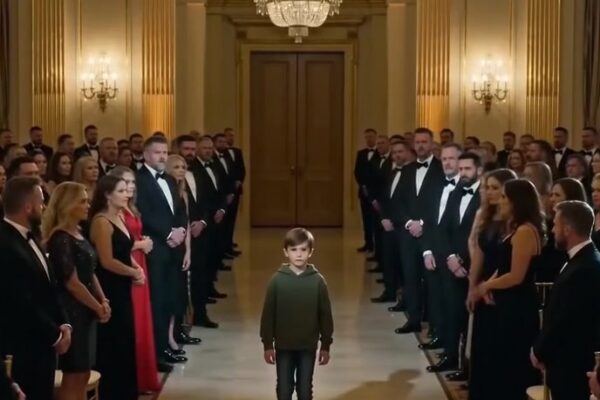
The rooftop engagement party looked like it had been assembled by people who believed perfection could be rented by the hour. White roses were clipped to the glass railings with invisible ties. A string quartet played near the bar, their bows moving like gentle metronomes against the thrum of the city. The champagne tower caught the late sun and threw it back at the guests in tiny shards of gold.
Isla Hart stood near the edge, where the skyline opened like a promise. Her dress was not a full wedding gown—this was an engagement celebration, after all—but it was white and sleek and expensive enough to turn strangers into admirers. Around her, people lifted phones to memorialize happiness. Her fiancé, Rowan Vale, had the kind of smile that made donors write checks and rivals forget why they were angry.
Rowan reached into a velvet box and lifted a bracelet, diamonds set like frost. “For you,” he said, loud enough for the nearest cluster to hear. Applause rose on cue, as if someone had directed it.
Isla offered her wrist, laughing, flushed with the spectacle of being adored. The bracelet hovered a breath away from her skin.
Then something rough and urgent cut through the music.
A child’s voice—ragged with cold and panic—shouted from the elevators, and a small figure darted across the polished stone. People turned, thinking it was a prank, a stunt for social media. But the girl’s bare ankles and torn sweater didn’t belong to any performance. She moved like an animal that had been chased, weaving between gowns and suits with a desperation that made the air tighten.
Security reacted late. Two men in black stepped forward, hands reaching, but the girl slipped past them with a sick kind of skill—as if she’d learned where to run to avoid being caught.
Before anyone could stop her, she grabbed Isla’s wrist.
The diamonds flashed and shook. Isla stumbled. A gasp rippled through the crowd; someone dropped a flute and it shattered, the sound sharp as a slap. Champagne cascaded down the tower in glittering streams, the party’s careful symmetry collapsing in seconds.
“Get her off me!” Isla cried, instinct and fear rising together. Her first thought was of stains, of cameras, of humiliation. Her second thought—arriving like a shadow—was that the girl’s fingers were too thin, her grip too fierce to be mere mischief.
The child held on tighter, trembling so hard her elbow knocked Isla’s bracelet box. Her eyes were enormous, too old for her face, and wild with urgency.
“Don’t marry him!” the girl blurted, the words breaking like glass from her mouth.
The quartet faltered. The city’s wind seemed to pause. All at once, the rooftop was a room full of statues.
Rowan’s smile froze, then tried to rearrange itself into something gentle. “Sweetheart,” he said, voice still smooth, “you’re confused. Let go. We’ll help you.”
But Isla couldn’t look away from the girl’s face. There was dirt smudged on her cheek, and beneath it, a faint bruise yellowing at the edge of her jaw. She was terrified, yes—but not of Isla.
“What are you talking about?” Isla demanded, though her voice had dropped. She felt everyone listening, waiting for her to make the moment normal again.
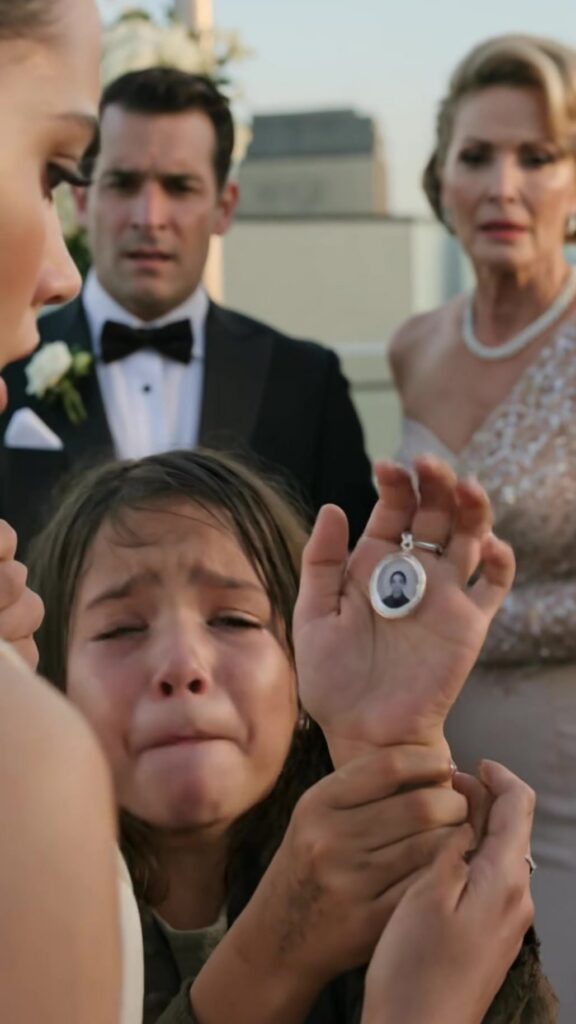
The girl swallowed hard, then opened her dirty fist as if she were revealing a wound.
In her palm lay half of a broken silver locket. The metal was bent, the hinge snapped. Inside, protected by scratched plastic, was a tiny photograph—faded, water-damaged, but unmistakably a woman’s face and the curve of a baby against her shoulder.
At first Isla didn’t understand. She stared at it, her mind sifting for context, for the explanation that would restore order. The locket looked old, cheap, the kind sold at street stalls. It had no place among diamond bracelets and rented roses.
Then the girl’s fingers tightened again around Isla’s wrist and shook it, not violently but insistently, like she was trying to wake her from a dream.
“Look,” the girl whispered, voice cracking.
Isla felt something cold against her collarbone. Her own chain. It was tucked beneath the neckline of her dress, hidden the way she always hid it, because it didn’t match the polished version of herself she presented to the world.
Her hand rose without permission. She drew the chain up, and the silver half-locket she wore came into view.
It was the other half.
The air on the rooftop changed, thickening with the collective inhale of dozens of people. Murmurs started and died as quickly as they formed. A woman near the bar—Rowan’s aunt, Isla thought, the one who had been laughing too loudly all evening—went pale, her lips parting as though she’d seen a ghost slip through the glass railing.
Rowan’s eyes flicked to the locket at Isla’s throat.
Only for a second.
But it was enough.
It wasn’t surprise. It was recognition. And something darker underneath it—calculation, an instinctive measuring of risk.
Isla’s stomach dipped. Her fingers trembled so badly the chain rattled softly against her skin. She held her half-locket out, hovering it inches from the child’s.
The child lifted her half with a reverence that made Isla’s throat tighten. Slowly, carefully, as though the metal could bite, she brought it close.
The two pieces slid into alignment with a soft, final click.
Perfect fit. Perfect scar.
A sound came from the crowd—someone’s strangled whisper, someone else’s sudden sob—then silence swallowed everything.
Isla felt the world tilt. She remembered being six, sitting on the kitchen floor while her mother dug through a drawer with shaking hands. She remembered the sound of a door slamming, the way her mother had pressed this half-locket into her palm as if it were a key.
“If anything ever feels wrong,” her mother had said, voice tight with fear she tried to hide, “you listen to that feeling. You don’t let anyone talk you out of it.”
Isla had asked where the other half was. Her mother had stared out the window for a long time before answering, “Somewhere it shouldn’t be.”
Now it was here, in a stranger child’s fist.
“Where did you get that?” Isla asked, and the question came out broken.
The girl’s eyes filled, tears cutting clean lines through the grime on her face. “My mother,” she whispered. “She gave it to me and said if I ever found him—if I ever saw him smiling like that—I had to run. Even if nobody believed me.”
Rowan took one step forward. “This is ridiculous,” he said, too quickly. “Isla, it’s a coincidence. People find jewelry in thrift stores all the time—”
“No,” the girl said, her voice small but steady now, the kind of steadiness born from having nothing left to lose. She tightened her grip on Isla’s wrist again, as if anchoring herself. “She said he did this before.”
The wind surged, lifting Isla’s veil and snapping it like a flag. Isla’s skin prickled. In that gust, she felt every warning she had ever ignored, every moment she’d laughed at a discomfort to keep the peace. She saw Rowan in fragments—how he hated being contradicted, how he always knew which waiter to charm and which to intimidate, how he’d once told her, smiling, that secrets were just stories without the right ending.
Isla looked at the matched locket halves, then at the photo inside the girl’s. The woman in the picture had Isla’s eyes. The baby’s tiny fist was wrapped around a chain.
Isla’s mouth went dry. She turned, slowly, to Rowan. “Who is she?”
Rowan’s expression didn’t crack, not at first. He spread his hands as though he were calming a room full of investors. “Isla, you’re letting a stranger manipulate you. We can talk privately—”
“Say her name,” Isla demanded. She surprised herself with the sharpness. The guests were no longer a blur; she could see their faces, hungry and frightened, sensing that the party had become a trial.
The girl’s voice slipped between them like a blade. “Her name is Mara,” she said. “My mother. She used to work at the Vale Foundation gala. She said he promised her everything. Then he took everything. Then he made her disappear from the stories.”
Rowan’s jaw tightened. “Enough,” he snapped, the smoothness vanishing for a heartbeat. It was the first time Isla had heard his real voice in public—hard, impatient, accustomed to obedience.
That single syllable did what the matching lockets had begun. It broke the illusion.
Isla stepped back, pulling her wrist free—not from the child, but from Rowan’s reach. The bracelet lay forgotten in its box on the ground, diamonds winking uselessly in the fading sun.
She took the girl’s cold hand in hers, folding both locket halves together between their palms as if sealing a pact. “What’s your name?” Isla asked, her voice lower now, fierce with sudden clarity.
“Lina,” the girl whispered.
“Lina,” Isla repeated, tasting the name like an oath. She turned to the nearest security guard, the one who had hesitated earlier, uncertainty flickering in his eyes now that the room had shifted. “No one touches her,” Isla said. “If anyone tries, I will make sure you never work in this city again.”
Rowan laughed—thin, disbelieving. “Isla, don’t be dramatic.”
Isla looked at him the way you look at a door you once thought was an exit, realizing it had always been locked from the other side. “Dramatic,” she repeated softly. Then she lifted her locket and the girl’s, the two halves mended, and held them up where everyone could see. “This is my mother’s,” she said. “And this is hers. And you know exactly why.”
The rooftop, which had begun as a stage for a fairy tale, became a place of reckoning. Phones rose again, but now not to capture romance—to capture truth. Someone in the crowd stepped back, already deciding how far away they needed to be from the blast radius of the Vale name.
Rowan’s eyes narrowed. The city behind him glowed indifferent and vast.
Isla’s hand tightened around Lina’s. She didn’t know what came next—police, lawyers, headlines, threats whispered at her door. She only knew that a child had run into a world of silk and glass with a broken piece of silver and the courage to shatter a lie.
And in the sudden silence after the click of two matching halves, Isla understood: Lina hadn’t come to ruin her engagement.
She had come to stop Isla from becoming another woman in a fading photograph, trapped behind scratched plastic, waiting for someone brave enough to tell the story out loud.