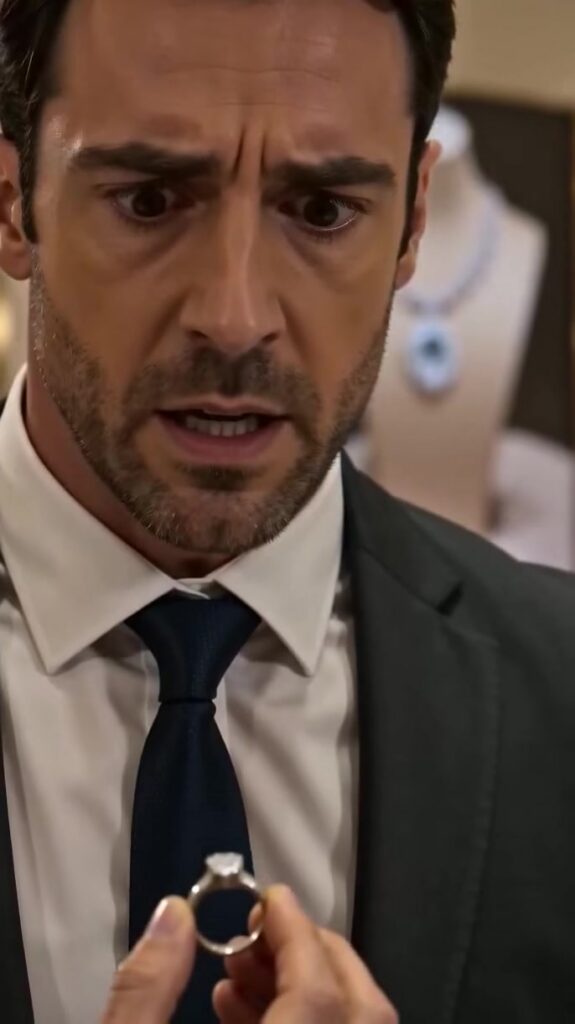
The chandelier above Vautrin & Co. didn’t glitter so much as command. Light poured from it like honey, thick and warm, coating every glass case, every velvet tray, every measured smile. It made the diamonds look alive—cold hearts beating behind flawless facets.
Lena Harlow stood just inside the doorway and felt that light slide over her like judgment. Her shoes were clean but plain. Her coat smelled faintly of rain and bus upholstery. In her left hand she held an old ring box, the kind that had lived too long in a drawer: cracked leatherette, corners rubbed to pale thread, the hinge stiff with age.
She had rehearsed this moment on the ride over, whispering sentences into her scarf, pressing her thumb to the lid as if it could steady her pulse. Ask for the owner. Don’t look at the watches. Don’t let the mirrors convince you you don’t belong. Just give the box to Mr. Vautrin. He will understand.
A sales associate approached with the careful gait of someone trained to keep a safe distance from desperation. “May I help you?” he asked, eyes flicking once to the ring box—then away, as if the wear on it might stain the polished air.
“I need to see the owner,” Lena said. Her voice came out thin. “It’s about a ring.”
“Our appraisals are by appointment,” he replied, already angling his body toward the door.
“It isn’t—” Lena swallowed, her throat tight. “It’s not an appraisal. It’s a return. A… a correction.”
Behind her, laughter trailed across the marble like spilled champagne. A cluster of people gathered near the engagement display—friends, relatives, and the couple itself. The woman at the center was sculpted elegance: cream coat, diamond studs, hair pinned as if the world might unravel if a strand escaped. Lena recognized her from the society columns and from the careful poison of her own late-night searches.
Maris Caldwell.
And beside Maris, tall and broad-shouldered, stood Ethan Rowe, the man whose face had stared out from a framed photograph on Lena’s childhood mantelpiece—except in that photo he was younger and smiling, his arm around a woman whose eyes were now only in Lena’s memory.
Lena’s heart lurched. She had known he would be here. She had chosen today because she could no longer bear not knowing whether he would look at her and see what she saw: her mother’s cheekbones, her mother’s stubborn mouth, the same tremor of fury held under skin.
She took one step toward them, and the world seemed to hold its breath.
Maris turned as if she sensed disruption the way expensive fabric senses a snag. Her eyes landed on Lena’s coat, then her ring box, then her face. A flicker—recognition, or calculation—moved through her expression like a shadow.
“You,” Maris said, too loudly for a jewelry store. Heads turned. The sales associate stiffened.
Lena tried to speak, but the words lodged behind her teeth. She felt suddenly twelve years old again, standing at a foster home doorway with a garbage bag of clothes, trying not to cry.
Maris crossed the room with the confidence of someone accustomed to owning space. Before Lena could step back, Maris seized her wrist.
“Security!” Maris’s voice cracked like a whip. “This girl has been blackmailing my fiancé!”
The store froze in an instant—like a ballroom when the music stops and everyone realizes they’ve been dancing wrong. Somewhere a phone camera clicked on. Another followed. A hush swelled and thickened with the sweet cruelty of curiosity.
“I haven’t—” Lena began, but Maris’s grip tightened until Lena’s fingers went numb around the ring box.
“Show them your little trick,” Maris hissed, leaning close enough that Lena could smell her perfume—something floral and predatory. “Show them how you wave around that old thing and pretend it means something. You don’t get to crawl out of whatever hole you came from and ruin my wedding.”
Ethan’s face had drained of color. He stared at Lena as if she were a ghost he’d hoped the world had forgotten how to summon. His mouth opened slightly, then closed again, the way a man might react to a gun pointed at his past.
Lena’s hand shook. Not because of Maris. Because of Ethan’s eyes. Because she saw, in the pallor and the panic, that he knew. Or feared.
“Let go of me,” Lena whispered. It barely made it into the air between them.
“Open it,” Maris demanded.
All around them, the store’s gold light softened faces into masks. People leaned in. The sales associate hovered like a nervous bird. At the far end of the room, a man in a charcoal suit—silver hair, sharp gaze—had emerged from a back office, drawn by the commotion. Mr. Vautrin himself. Lena’s breath caught with relief and dread.
Maris jerked Lena’s wrist up, forcing the ring box into view. “Go on,” she said. “Let everyone see your evidence. Let them see your lie.”
Lena’s throat burned. She thought of her mother’s hands—always smelling of soap and cheap lavender lotion—cupping Lena’s face when she was small. She thought of a hospital room and a nurse who had hesitated, then slid a battered ring box into Lena’s palm with a look that said, This is all she wanted you to have.
Lena took a breath that felt like swallowing glass.
Then she opened the box.
The hinge creaked softly, an old sound swallowed by the silence. Nestled in faded satin lay a ring that did not belong among Vautrin’s flawless gems: a simple band of yellow gold, worn thin at the bottom, the setting modest. But it carried weight the way bones carry history.
“This,” Lena said, her voice breaking as it finally found its way out, “was buried with my mother.”
Maris’s expression wavered for the first time. Ethan made a sound—half breath, half plea. Several people shifted, the mood pivoting from entertainment to discomfort.
Mr. Vautrin stepped closer, his gaze narrowing on the ring with professional reflex. “May I?” he asked quietly.
Maris opened her mouth, but Ethan spoke first. “No.” The word came out rough, unpolished. He didn’t look at Maris. He looked at the ring as if it were a verdict.
Lena, trembling, held the box out anyway. Mr. Vautrin took it with surprising gentleness. He lifted the ring, turned it under the light, and then stilled. The change in his face was subtle but unmistakable—the way a man reacts when a remembered nightmare walks into daylight.
He rotated the band and found the engraving inside. His thumb traced it once, as if confirming the letters by touch.
“This ring…” Mr. Vautrin murmured, and the room leaned toward him. “This belonged to a bride who vanished the week of her wedding.”
A gasp went through the crowd like a draft. Someone whispered, “That story… my grandmother talked about it.” Another voice: “Wasn’t there a scandal?”
Maris’s eyes flashed. “That’s ridiculous. Rings are rings. People disappear every day. Don’t let her—”
But Ethan’s knees looked as if they might buckle. His jaw trembled with the force of what he was not saying. He reached for the edge of the display case as though it could keep him upright.
Lena felt something shift inside her—not triumph, not satisfaction, but a cold certainty settling into place. For years she’d wondered whether her mother had died carrying a secret or a lie. Now the lie was standing in front of her in a tailored suit, breathing shallowly.
Mr. Vautrin cleared his throat. “The engraving reads, ‘E.R. to C., forever.’” His gaze lifted, pinning Ethan with quiet precision. “I remember polishing this ring for a young man who couldn’t stop smiling.”
Ethan flinched as if struck. Maris’s grip fell away from Lena’s wrist, her fingers loosening in shock and fury.
Lena’s eyes burned, but she refused to look down. She had not come to beg. She had come to end something.
She reached into her coat pocket with her free hand. Paper crackled—folded letters wrapped in a rubber band, edges soft with age. The rubber band snapped as she pulled them out, as if even it could no longer contain what was written.
Maris took a step back. “What is that?” she demanded, voice sharp enough to cut. “Those are—”
“Not yours,” Lena said. Her tears finally slipped free, hot lines down her cheeks that made her skin sting. She held the letters up, a small stack of history that had been kept, hidden, carried from home to home, from suitcase to box, from hospital drawer to Lena’s pocket.
The crowd was no longer whispering; it was waiting.
Lena turned fully toward Ethan, her hands shaking but steady in purpose. The chandelier light painted his fear in unforgiving detail. She could see the man he was now and the boy he had been, and the space between them filled with the ghost of a woman who had once believed him.
“Then tell them,” Lena said, her voice rising just enough to reach every corner of the store, “why my mother kept your letters.”
Ethan stared at the papers as if they were flames. His mouth opened. Nothing came out. Maris’s face hardened into something terrified and furious, a veneer cracking.
Mr. Vautrin didn’t move. The phones kept recording. The diamonds lay silent in their glass prisons, catching light and throwing it back like cold applause.
Lena stood in the center of it all, no longer invisible, holding the ring that had been buried and the words that had refused to stay buried.
And for the first time in her life, the story belonged to her.