The Hawthorne estate was built for people who liked their tragedies tidy—kept behind manicured hedges, dressed in linen, and softened by distant music. That Saturday, the backyard glittered with celebration. A charity luncheon sprawled beneath white tents, crystal glasses catching the sun, laughter rising in practiced crescendos. The guests arrived with checkbooks and condolences, because this was one of those events where sorrow was part of the brand.
At the far edge of the lawn, just beyond the tents and the murmuring crowd, Vivian Hawthorne sat in her wheelchair like an exhibit no one wanted to study too long. A year ago, she had been the girl on horseback and in boats, always the first to race, always the one who dared her friends higher. Then came the fall—officially “an accident” near the stone steps by the lily pond. Officially “unfortunate.” Officially irreversible.
Doctors called her prognosis permanent. Her father, Arthur Hawthorne, called it tragic in public and unacceptable in private. The staff called it heartbreaking, because that was what you called it when you needed to keep your job.
Nobody, however, had a name for the feeling that settled around Vivian like fog: the sense that something about her story had been sealed shut. Not just her body. The memory of that night, too—hazy and full of missing pieces, like a book with several pages torn out.
Beyond the last tent pole, near the toolshed, Mateo stood with the gardeners. He was small for thirteen, his hair dark and uneven as if cut in a hurry. He wore an old shirt that had met more soil than soap. To most of the guests, he was part of the landscape—another functional item on the estate, like the fountain or the hedges.
But Mateo watched Vivian, and Vivian watched everything with the sharpness of someone who had lost movement and gained time. Their eyes met briefly. He looked away first, not because he feared her, but because he feared being seen by the wrong people.
Inside the house, voices rose—Arthur and his lawyer, Arthur and an investor, Arthur and anyone who dared suggest that life could proceed without being controlled down to the last detail. The luncheon was a costume; the real conversation was always about power.
Mateo waited until the argument swallowed the adults entirely. Then he moved.
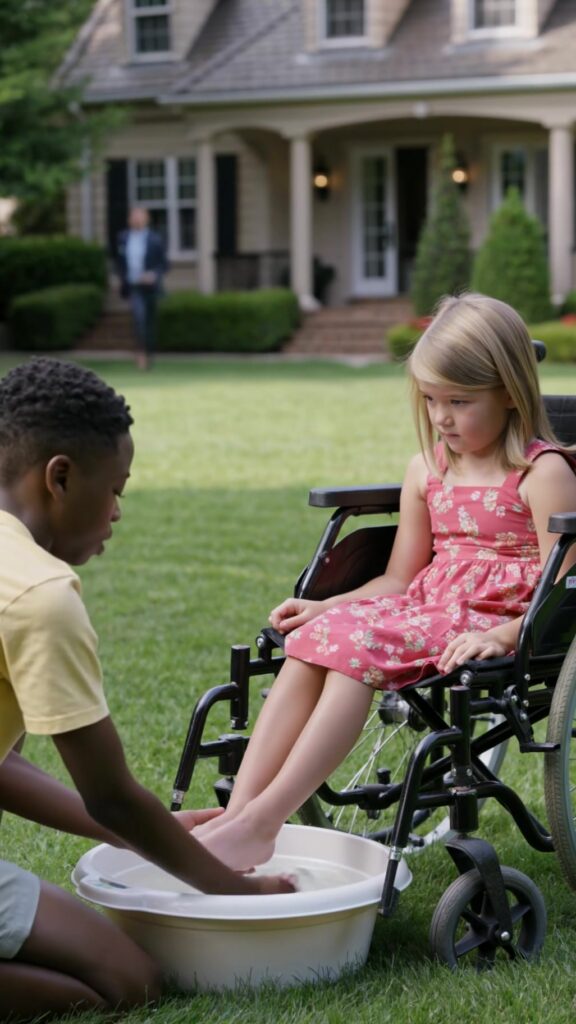
He carried a white basin as carefully as if it held something fragile and irreplaceable. Warm water trembled inside, catching sunlight, a faint ribbon of steam unfurling in the breeze. A folded towel was tucked beneath his arm. He crossed the open lawn, the way a sparrow might cross a patio full of cats—quickly, silently, uninvited.
Vivian stiffened when he approached. Her nurse was inside fetching more napkins for guests who didn’t need them. The staff had left Vivian alone because she’d insisted, because she hated being watched with pity like it was another kind of restraint.
“What are you doing?” she asked, her voice calm but edged with a suspicion she’d learned since the accident.
Mateo set the basin down in the grass. “I’m not here to stare,” he said softly. “And I’m not here because anyone sent me.”
Vivian’s hands tightened on the armrests. “Then why?”
Mateo looked at her feet—pale, careful, resting on the supports. “Because sometimes,” he said, “people call something permanent when it’s just… protected.”
Her throat bobbed as she swallowed. “Protected by what?”
Mateo didn’t answer that. He poured a little more warm water from a thermos, then knelt in front of her like the lawn itself was a chapel and she was its only altar. “Don’t be scared,” he told her. “Just trust me a little. If you want me to stop, I stop.”
Vivian searched his face. There was no smirk, no cruelty, no curiosity that felt like theft. Only concentration, like a boy trying to perform a difficult task without ruining it.
“Okay,” she said, though the word came out thin. “But—don’t make this weird.”
Mateo’s mouth twitched with something close to a smile. “I’ll try not to.” He lifted one of her feet gently and lowered it into the basin.
The water rippled. He washed her foot with slow, deliberate movements—thumbs circling the arch, fingertips brushing the heel. It wasn’t medical, not like the brisk, professional touches Vivian had grown used to. It was careful in a different way. Reverent, almost. Like he believed her body was listening.
Vivian flinched.
Mateo froze instantly. “Did I hurt you?”
Her eyes widened, the gray of them suddenly stormy. “No,” she whispered. “That’s the thing. You—”
She inhaled sharply, as if the air had turned to ice. “Wait,” she said, voice dropping. “I can feel this.”
The words seemed too loud for the lawn, too impossible for the sunny afternoon. Vivian stared down at her feet as if she’d never seen them before, as if they belonged to someone else and had just been returned.
Mateo’s hands steadied her ankle. “Good,” he murmured. “Just breathe. Let it happen.”
Vivian’s breathing turned ragged. “It’s like… pins and—” She swallowed. “Like they’re waking up.”
Across the yard, the back door slammed open.
Arthur Hawthorne burst onto the patio with the wrong kind of urgency, his face drained of its party-friendly color. He wasn’t confused. He wasn’t hopeful. He was frightened, the way a man looks when he sees his vault door swinging open.
He sprinted across the lawn, shoes tearing divots in the perfect grass. “Get away from her!” he shouted, so loud that conversations under the tents faltered into silence.
Mateo didn’t jerk back. He didn’t scramble. He simply kept his hands light around Vivian’s ankle, as though he refused to let panic be the loudest voice in the world.
Vivian’s head snapped up. “Dad?” she said, startled by the terror in him. “Why are you yelling?”
Arthur’s gaze flicked from Mateo to the basin to Vivian’s face. For a moment, his expression looked almost pleading, as if he could will time backward with sheer authority. “He’s humiliating you,” he said, words sharp and desperate. “He has no right to touch you.”
Vivian’s confusion sharpened. “It doesn’t feel like humiliation,” she said slowly. “It feels like—like I’m not numb.”
Arthur’s jaw tightened. The guests were standing now. The staff hovered. Even the string quartet under the tent faltered, their music collapsing into a thin, uncertain note.
Mateo rose to his feet. Water dripped from his fingers onto the grass, darkening it like ink. He looked at Arthur with a steadiness that didn’t belong to a boy who owned nothing.
“You’re scared,” Mateo said, not as an accusation but as a fact. “Not because she’s being embarrassed. Because if she can feel her legs again… she might also remember who pushed her.”
The backyard went colder than shade.
Vivian’s mouth parted. “Pushed?” she whispered. The word hit her like a slap, not because it was harsh, but because it rang true in some deep, buried place. Her eyes darted away from her father, as if her mind had turned into a room with a locked door and suddenly heard the key turning.
Arthur’s face emptied of all performance. “That’s enough,” he said, but the authority in his voice was cracking, splintering. “You don’t know what you’re talking about.”
Mateo didn’t flinch. “I was there,” he said. “Not on the steps. In the dark by the pond. I heard you tell her to stop asking questions. I heard her say she was going to tell her mother. And then—”
Vivian’s hands began to tremble on the armrests. “My mother,” she repeated, as though saying it might conjure the woman back from wherever grief had hidden her. Her mother hadn’t attended the luncheon. People said she couldn’t bear it. People said she was fragile. People said whatever Arthur instructed them to say.
Vivian’s gaze dropped to her legs again. She willed them to move. Nothing dramatic happened—no miracle leap, no cinematic stand. But she felt warmth. Pressure. The ghost of sensation becoming real.
And with it, a memory: stone under her palms, the sour smell of lilies at night, her father’s hand on her shoulder—too tight, too angry—then a shove that wasn’t meant to be gentle. The brief, weightless horror of falling. The cracking pain. The blankness afterward like a curtain pulled hard.
Vivian looked up at Arthur. “You were there,” she said, voice cracking into something raw and unmanageable. “You were… angry.”
Arthur took a step back, as if her words had physical force. “Vivian,” he warned, but the warning sounded pathetic under the scrutiny of a hundred eyes.
Mateo reached for the towel and wrapped it around Vivian’s foot, drying it carefully. His hands didn’t shake. “You don’t have to be afraid of remembering,” he told her. “Just don’t let anyone tell you the truth is too expensive.”
Vivian’s eyes filled, not with helpless tears, but with a kind of furious clarity. She drew in a breath and tried again, focusing on her toes. A faint twitch answered her effort—small, undeniable. A gasp went through the crowd like wind.
Arthur’s composure finally shattered. “Someone take him away,” he snapped, looking for staff, for security, for anyone who could put the world back in its box.
But the staff did not move. The guests did not rush to obey. They had seen too much: not just the twitch of Vivian’s foot, but the fear on Arthur’s face, the way it had risen instantly at the first hint of her recovery—like guilt recognizing daylight.
Vivian’s voice cut through the backyard, steady despite the tremor in it. “No one touches him,” she said. Then she looked at her father and added, softly but with lethal precision, “Call my mother. Now. And get me my phone.”
Arthur stood frozen on his own perfect lawn, surrounded by witnesses, while his daughter stared down at her feet—still mostly still, but no longer silent—and realized her body had been trying to speak for a year.
Mateo picked up the basin, warm water sloshing, and stepped back without bowing. The afternoon sun kept shining, indifferent and bright, but the estate no longer looked like a place that could hide anything.
Because in that backyard, the impossible had happened twice: Vivian had begun to feel again. And Arthur Hawthorne had begun to be seen.