He walked in smiling, because the world had finally begun to make sense again. The rain that had bullied the city all week had softened to a mist, and the bakery on Delancey had still had Elena’s favorite—almond sponge with bitter cherry jam, the kind she used to pretend she didn’t like and then eat in secret at midnight. He cradled the cake box in one hand like it was breakable glass. In the other, he held roses—too red, too dramatic, but he liked the idea of overdoing it. The ultrasound printout was in his jacket pocket, folded like a letter he kept touching to reassure himself it was real.
It wasn’t their anniversary. It wasn’t her birthday. That was the point. He’d been absent lately, buried under meetings and the sterile calm of boardrooms. He wanted to interrupt the pattern. He wanted to see her face light up and feel, for once, that he was not failing her.
The iron gate to the house gave its familiar groan when he pushed it open. In the windows, no lights. It was early afternoon; still, Elena usually played music when she was home alone. Something low and jazzy. Something that filled the rooms so silence couldn’t creep in and make a nest.
He let himself in with his key. The lock clicked too loudly. The foyer swallowed the sound and offered nothing back. No footsteps. No call of his name. Just air that felt thick, as if the house had been holding its breath.
The first wrong thing was the smell—a sharp, sour bite like wet wool left too long in a basement. The second was the floor.
It was wet.
Not the clean slick of freshly mopped tiles. This was uneven, streaked water across the marble like a shallow tide had come in and withdrawn in a hurry. His shoe slid half an inch. A faint track appeared behind him, dirtying the shine.
“Elena?” he called, careful at first. Then louder. “Lena?”
Nothing.
He stepped farther in. The hall opened toward the sitting room, and from there, toward the kitchen. Each room was too neat, too arranged, like a stage waiting for actors that didn’t want to come out. His smile thinned. The cake began to feel heavy.
And then he saw her.
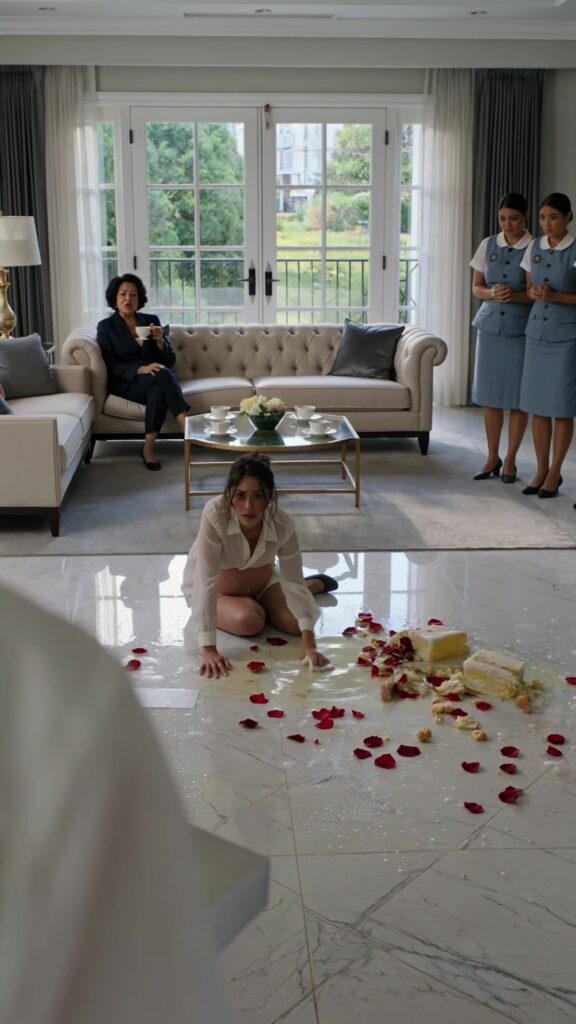
Elena was on her knees at the edge of the sitting room, her belly rounding beneath a faded sweater that used to be his. Her hair, usually pinned up in a purposeful twist, hung in damp strands along her cheek. She held a cloth in her hands and scrubbed the marble with small, frantic motions, as if the floor had offended her and she was punishing it. Her shoulders shook—not with dramatic sobs, but with the restrained tremor of someone determined not to make noise.
On the floor beside her was the cake box. It had been crushed, the cardboard caved in like a broken rib cage. Pale frosting and cherries bled into the grout. A piece of sponge clung to the cloth she was using, smeared into the water. The roses—his roses—lay in a limp bundle near the base of a chair, their petals browned at the edges as if they’d been thrown down hours ago and forgotten. One stem had snapped cleanly, a wound too neat to be accidental.
He couldn’t breathe for a moment. The house tilted. “Elena?” His voice came out cracked, a boy’s voice, not a man’s.
She looked up. He expected anger. He expected tears. He expected the hot, righteous flare of a woman wronged.
What he saw was worse.
Her eyes were dull in a way he hadn’t known eyes could be—like a candle that had been pinched out, leaving only the smell of smoke and a wick too short to light again. Defeat sat on her face as if it belonged there.
“You’re home,” she said. Not an accusation. Not relief. Just a fact.
A soft clink came from the sitting room. He hadn’t noticed the figure in the armchair because his whole world had narrowed to Elena on the floor.
His mother sat there with a porcelain cup balanced delicately between her fingers. She wore pearl earrings and a cardigan the color of old bones. Her posture was perfect, her expression mild, as if she were watching the rain from a café window. A saucer rested on her knee. The teaspoon made another small, metallic sound as she stirred.
“Marcus,” she said, like she had been expecting him at this exact minute. “You’re early.”
His gaze flicked back to Elena, to the red rawness on her knuckles, to the dampness darkening the knees of her leggings. “What is this?” he demanded. He didn’t recognize his own voice; it sounded too low, too dangerous.
His mother took a sip. “A mess,” she replied simply. “Which she is cleaning.”
Elena lowered her eyes again and scrubbed harder, as if the floor might swallow her if she worked fast enough.
“Stop,” Marcus said. “Elena, stop.”
She didn’t. Her shoulders trembled. The cloth squeaked. The sound scraped at his nerves.
His mother’s gaze moved lazily to Elena’s belly. “If she wants to stay here,” she said, her voice light, conversational, “she should learn her place.”
Marcus froze. The sentence landed with a weight that made the room feel smaller. He stared at his mother as if seeing her for the first time—this woman who had taught him to tie his shoes and to say please, who had kissed his scraped knees and praised his first promotion. Her mouth looked the same, her eyes the same, but something behind them was unfamiliar. Something cold.
“Her place?” he echoed. “She’s my wife.”
“Wife,” his mother repeated, as if tasting the word and finding it lacking. “And yet she forgets herself.”
Marcus’s hands tightened around the cake box and the roses until his fingers ached. “What happened?”
Elena’s lips parted, but no sound came. It was as if the air had been stolen from her lungs. She glanced toward the doorway, toward the kitchen, with a flicker of fear so brief he almost missed it.
A movement there—a shadow. Then a woman stepped into view, wiping her hands on a towel.
Mira, the new maid. Young, quiet, efficient. Elena had hired her two months ago because climbing stairs had started making her dizzy. Marcus had barely learned her name. Now, Mira’s face was pale, her eyes wide. She looked as if she’d been standing behind that wall for a long time, listening to the quiet and waiting to be called into it.
“Sir,” Mira said, her voice shaking. “I—”
His mother’s eyes narrowed. “Mira, that will be all.”
But Mira didn’t move. Her gaze locked on Marcus with the desperation of someone about to jump from a burning building. “Sir, please,” she blurted. “It wasn’t… it wasn’t an accident.”
Marcus felt his stomach drop. “What wasn’t?”
Mira swallowed hard. “The water. The cake. The flowers. Mrs. Elena didn’t drop them.” Her hands clenched around the towel until her knuckles went white. “Your mother told me to bring the roses in from the delivery. She—she threw them on the floor. Then she opened the cake box and pressed her hand into it. She said—she said the house must be taught what kind of woman lives in it.”
Elena made a small sound, not quite a sob, more like a breath that had been held too long and finally escaped.
Mira’s eyes filled. “And then… she told Mrs. Elena to clean it. On her knees. She said if she couldn’t kneel properly, she wasn’t fit to raise a child in this family.”
The room went very still. Even the air seemed to pause. Marcus stared at his mother’s tea cup, at the calm hands that held it. He realized he had been afraid of disappointing her his entire life, afraid of her silence more than her anger. Now the fear turned, reshaped itself into something sharp and hot.
His mother set the cup down with care. “Mira,” she said softly, “you are being dramatic.”
Mira shook her head, tears slipping down now. “No, ma’am. I’m being honest.” She looked back at Marcus, voice breaking. “And there’s more.”
Marcus’s throat tightened. “Say it.”
Mira took a trembling breath. “She told me to keep an eye on Mrs. Elena. To report if she calls anyone. She said… she said there are doctors who can ‘correct mistakes’ if a woman gets too proud.”
The words rang in Marcus’s ears like a bell struck too hard. He looked at Elena, and suddenly the wet floor made sense—the spilled water, the frantic scrubbing, the quiet. It wasn’t a mess.
It was a warning.
His mother’s expression didn’t change, but her eyes hardened. “Marcus,” she began, as if about to offer a reasonable explanation.
He didn’t let her finish. He stepped forward and set the cake and roses on a side table with a gentleness that felt like restraint. Then he crossed the distance to Elena and crouched beside her, ignoring the dampness that soaked into his trousers. He reached for her hands. They were cold, raw, and trembling. She flinched at first, a reflex that sliced through him.
“Look at me,” he said, voice low. “Elena. Look at me.”
She met his eyes slowly, as if lifting her gaze cost her everything.
“You’re not cleaning another thing,” he told her. “Not here. Not for her. Not ever.”
Behind him, his mother’s chair creaked as she shifted. “Marcus,” she warned, the first edge entering her tone.
He didn’t turn around yet. He pressed Elena’s hands between his palms, trying to warm them. “Can you stand?” he asked.
Elena nodded once, a small motion. She tried to rise, and Marcus wrapped an arm around her back, steadying her carefully, mindful of the child between them.
When she was upright, he finally faced his mother. The calm in her posture looked less like elegance now and more like arrogance, like she believed the house itself would choose her side.
“You’re leaving,” Marcus said.
His mother’s lips curved faintly. “This is my son’s home.”
“It is my wife’s home,” he corrected. His voice didn’t waver. “And my child’s.” He glanced at Mira. “Mira, call someone. My lawyer. And—” he looked back at his mother, the anger in him now controlled, almost surgical. “And the police, if she refuses to go.”
Elena’s breath caught. Mira nodded quickly, as if grateful for permission to move.
His mother rose slowly, cup and saucer in hand, as though she were the one in control of pace and consequence. “You would embarrass me,” she said, her tone soft but venomous. “In my own family.”
Marcus stepped between her and Elena without thinking, a human wall. “You embarrassed yourself the moment you made her kneel,” he said. “You can take your pearls and your tea and whatever story you planned to tell. You won’t take another inch of her dignity.”
For the first time, his mother’s composure cracked. Her eyes flashed, and in them he saw something raw—possession, rage, a certainty that love was ownership. “She has turned you against me,” she hissed.
Marcus didn’t answer that. He only held Elena closer. He felt her lean into him, light as paper, and realized how long she had been bracing alone.
Outside, the mist thickened into rain again, tapping softly against the windows. Inside, the house finally exhaled, as if it had been waiting for someone to speak the truth out loud. Mira hurried away to make the call. His mother stood rigid, as if she might still bend reality by refusing to accept it.
Elena’s voice came quiet at his shoulder. “I thought you wouldn’t believe me,” she admitted. “She said… she said you’d choose her because you always had.”
Marcus closed his eyes for a beat, pain flaring at how plausible that had sounded to Elena. Then he opened them and looked straight ahead, at the woman who had raised him and now demanded his obedience at the cost of everything else.
“I’m choosing,” he said. “And I’m choosing you.”
Elena’s fingers tightened around his sleeve—not much, barely there, but it was a beginning. And as the rain deepened, Marcus understood that the surprise he had brought home was not the cake or the roses at all.
It was the moment he stopped being his mother’s son first—and became his wife’s husband, entirely.