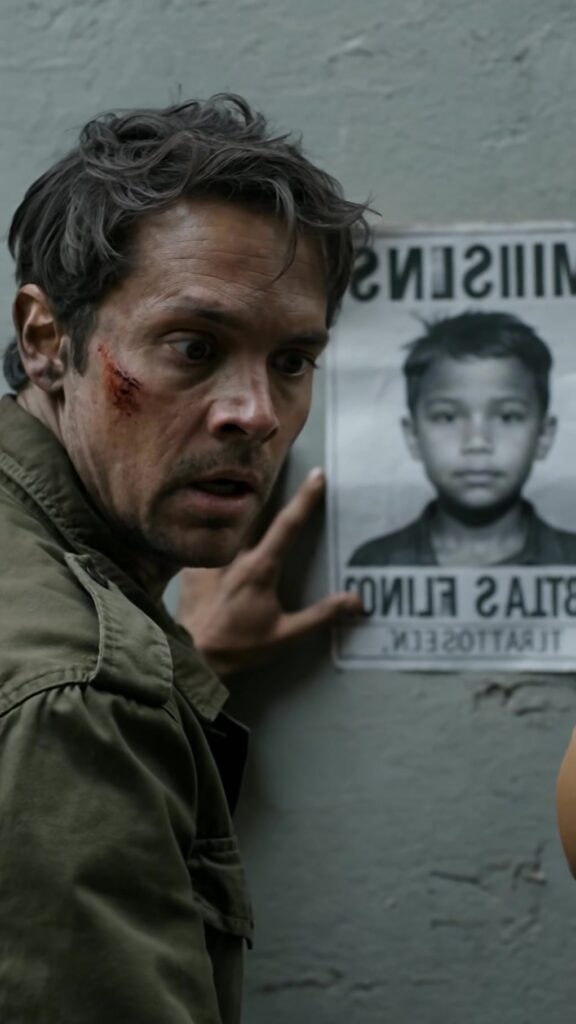
By the thirteenth night, the city had learned his grief by heart.
It clung to the lampposts and bakery shutters, to the sides of buses, to the cracked tiles of the underpass where rainwater pooled like dark mirrors. A boy’s face—round cheeks, a gap in his front teeth, eyes that looked straight at strangers with a trust that now felt like an accusation—stared from paper after paper. The word at the top was always the same, printed so large it seemed to shout: MISSING.
Gideon’s fingers were perpetually tacky with glue. Even when he sat on the edge of his bed and tried to force sleep, his hands kept the memory of it: the squeeze of the bottle, the smear, the slap of paper against brick. He had pasted his son into the city until the city had no excuse not to see him.
He had also done the other things, the proper things. He had spent hours under fluorescent police lights repeating the same details to rotating officers. He had walked shelter corridors that smelled of bleach and wet coats. He had rattled padlocks on abandoned buildings as if any one of them might open into a room where his child was sitting patiently, waiting to be retrieved like a forgotten bag.
For twelve nights, he had barely slept. For twelve mornings, he had woken with the instant, crushing memory that he was not waking alone.
On the thirteenth afternoon, he was in an alley behind the closed video store, where the wall stayed dry enough for posters to last more than a day. He pressed another sheet into place, smoothing the corners like they were fragile skin. Above him, a drainpipe clicked with each drip. Somewhere close, a radio played tinny music, and the tune made his throat burn with sudden anger—how could anything still be cheerful?
“Sir,” a small voice said.
He didn’t look up at first. People had stopped him before—offering pity, asking intrusive questions, suggesting theories that felt like knives. He kept his eyes on the paper, as if staring at it hard enough might pull his son out of whatever darkness held him.
“Sir… that boy lives in my house.”
The sentence hit like a thrown stone. Gideon’s breath lodged behind his ribs. His hand remained on the poster, fingers splayed over the printed cheeks. He turned so fast the edge of the paper tore with a soft sound.
A girl stood at the mouth of the alley in a faded blue dress that hung too loose. Her hair was gathered in a hurried knot. Her feet were bare on the wet concrete, and she didn’t flinch from the chill or the filth, as if the ground had long ago surrendered any power to discomfort her.
“What did you say?” Gideon asked. His voice broke on the last word.
The girl pointed at the boy’s face on the poster with an almost solemn certainty, the way someone points to a picture of a saint.
“He cries at night,” she said. “He calls for his dad.”
Gideon’s mouth opened and shut. The city seemed to tilt. Everyone could guess a missing child might cry, might call for someone. But Eli—his Eli—had never cried for help when he woke from nightmares. He always called for Gideon. Always. It had been their private ritual: Eli’s small voice, half-asleep and trembling, and Gideon’s hand on his hair, promising that monsters had no permission to stay.
The girl could not have invented that.
“Where?” Gideon whispered. The word felt too small to hold what it asked.
Without another question, without the bargaining that Gideon would have expected from anyone trying to profit from his panic, the girl turned and trotted down the alley as if she had simply remembered an errand.
“Come,” she said over her shoulder. “But don’t talk too loud.”
He followed with the poster still in his hand, the torn corner fluttering like a wounded wing. They moved through passages the sun barely touched—past peeling yellow walls tattooed with old notices, past windows boarded from the inside, past a stray dog sleeping under a rusted staircase with its ribs showing through its fur. Gideon’s shoes slapped against the damp ground; the girl made almost no sound, her feet knowing where to land to avoid broken glass.
At the far end of a narrow lane stood a building that looked emptied out by years. The doorway was a mouth of darkness. A rotten intercom hung beside it like a dead insect.
The girl stopped. For the first time, fear crept across her face, tightening her mouth. She hugged herself with thin arms.
“He’s upstairs,” she whispered. “But you have to be quiet. The lady with the red ring comes back before dark.”
Gideon felt the world sharpen into a single, terrifying point.
In the first hours after Eli vanished from the supermarket parking lot, the police had shown Gideon a grainy security clip. A woman’s figure in a coat, hair hidden, face mostly turned away. But her hand was visible as she guided Eli toward a van. On one finger, bright even through the blur, was a ring so red it looked like a drop of blood that refused to fall.
His hands began to tremble. Not from cold. From the certainty that the story of his son had been living next to him in secret while he ran himself ragged in circles.
“What’s your name?” he asked the girl, forcing himself to speak softly.
She hesitated, as if names were things that could be stolen.
“Mara,” she said at last.
“Mara,” Gideon breathed. “Did you tell anyone else?”
She shook her head. Her eyes flicked up the stairwell, then back to his face.
“The lady says I shouldn’t talk to strangers,” she said. “But the boy… he gets thirsty. He asks for water in the dark. I sneak him some. He says his dad will find him. I wanted to see if you were real.”
Gideon’s throat tightened until swallowing felt impossible. He reached into his pocket for his phone, then froze. If he called now and sirens arrived, if the woman returned and heard them, if she had another door, another exit—he could lose Eli a second time. The thought was like standing at the edge of a roof.
He nodded once. A promise without words. Then he stepped into the building.
The hallway smelled of mold and dust and something sour beneath it, like spoiled medicine. The air was cold in a way that seeped into the bones. Somewhere above, a floorboard creaked with a slow, deliberate weight. Gideon paused, listening, counting his own heartbeats because any other sound seemed too dangerous.
He climbed the stairs behind Mara. The railing was sticky. Each step complained. On the second landing, a door sat slightly ajar, and light leaked from within in a thin, yellow line. Mara pointed toward it and then, unexpectedly, reached for Gideon’s sleeve with small, grimy fingers.
“If she comes,” Mara whispered, “don’t let her take him somewhere else.”
Gideon looked at the child beside him—bare feet, frightened eyes, a bravery that did not belong to someone so small—and understood that whatever had been happening in this building, Mara had been surviving it alone. She wasn’t merely a guide. She was a witness. Maybe the only one willing to become one.
He lowered himself to the level of her face. “I won’t,” he said. “And I won’t leave you here either.”
She stared at him for a beat, as if weighing whether adults could be believed at all. Then she stepped back and let him pass.
Gideon pushed the door open the width of a hand. The room beyond was dim, curtains pinned shut. A mattress lay on the floor, and on it a small shape was curled beneath a blanket too big for him. There was a plastic cup near the mattress, and a bowl with the dried edge of something like soup. The walls were bare except for a child’s scribble in pencil: a lopsided house, a stick figure with long arms, a second smaller figure beside it.
Gideon’s breath stopped.
“Eli,” he whispered, not daring to be louder, as if volume might shatter the moment.
The blanket shifted. A head lifted, hair sticking up in sleep-worn spikes. Eli’s face was thinner than Gideon remembered, and there was a fading bruise along his jaw. His eyes searched the dark and then locked onto Gideon as if pulled by a string.
For a heartbeat, Eli didn’t move. His lips parted, forming a sound that seemed too fragile for the air.
“Dad?”
Gideon stepped into the room as quietly as a man falling apart could. He dropped to his knees beside the mattress, hands hovering for a second—afraid to touch, afraid the child might dissolve like a dream. Then Eli surged forward, burying his face in Gideon’s chest. His small arms clutched with a desperate strength.
Gideon held him so hard he feared he might hurt him, and then loosened, rocking, pressing his cheek against Eli’s hair, breathing him in like oxygen.
Behind him, Mara remained in the doorway, a small shadow in blue, watching as if she needed proof that rescue was something that could happen in real life.
Somewhere downstairs, a lock clicked.
Mara’s eyes widened. Her voice was barely audible. “She’s back.”
Gideon’s body went cold and hot at once. He kept one arm around Eli, feeling the boy’s heart thudding against him like a second, frantic clock.
There was no time for plans built carefully. Only choices made with blood in the ears. Gideon rose, lifting Eli into his arms. Eli clung, silent now, as if he understood the rules of this place too well.
Gideon looked at Mara. “Is there another way out?” he asked.
Mara nodded quickly and pointed past the curtain. “Window,” she whispered. “Fire ladder. But it’s broken on the second part. You have to jump.”
From the stairwell came the slow, unhurried sound of footsteps climbing. A woman humming under her breath, as if she had nothing to fear from any corner of her own life.
Gideon crossed the room and yanked at the pinned curtain. Dust rose in a cloud. The window was cracked open. Outside, a rusted metal ladder clung to the wall, its lower rung twisted away. The drop to the alley was not far, but far enough to break an ankle, far enough to shatter a child if he landed wrong.
He turned back once. Mara stood very still, her bare toes curled against the floor.
“Come,” Gideon said. “Now.”
Mara’s mouth opened in surprise—as if she had expected to be left like a detail, like a tool—and then she ran to him. Gideon shifted Eli higher in his arms, freeing one hand. He took Mara’s wrist.
The footsteps reached the landing outside the room. A key scraped in a lock that wasn’t there, then stopped—confused. The humming faltered. Silence gathered, heavy and attentive.
Gideon didn’t wait for the door to swing wide.
He pushed the window up, swung one leg out, and felt the ladder groan beneath his weight. Cold air slapped his face. He lowered Eli first, guiding the boy’s feet to the rung with a gentleness that fought panic. Eli didn’t cry. He only stared, trusting Gideon with the kind of faith that made Gideon’s heart ache.
“Hold tight,” Gideon whispered. Then he moved Mara out after him, pulling her onto the ladder as the room behind them filled with the sound of a door thrown open.
A woman’s voice snapped, sharp with sudden fury. “What—”
Gideon didn’t look back. He climbed down one-handed, Eli clinging like a koala to his neck, Mara gripping the metal with white knuckles. When they reached the twisted rung, Gideon’s stomach dropped. There was no safe way down.
He tightened his hold on Eli, braced his feet, and looked at Mara. “When I say, you jump to me,” he murmured. “Don’t be scared. I’ll catch you.”
Above them, the woman leaned out the window, her hand visible now in the slanting light. On her finger, a red ring flashed like an open wound.
“Stop!” she screamed. “That’s my boy!”
Gideon’s jaw clenched. “No,” he said, not loudly, but with a certainty that seemed to shake the air. “He’s mine.”
He dropped first, landing hard in the alley, pain lancing up his legs. He kept Eli safe, turning his body so any impact belonged to him. Then he reached up.
“Now, Mara!” he called.
Mara jumped.
He caught her—awkwardly, barely, her bony shoulder slamming into his chest—and stumbled back until the wall stopped him. For a second, all three of them were a tangled heap of breath and trembling. Then Gideon forced himself upright.
Sirens were not yet wailing. The city had not yet been told to look here. The woman above was already disappearing from the window, likely running for another exit, another shadow.
Gideon didn’t chase her. Not now. His priority had weight in his arms and a small hand gripping his sleeve.
He ran—down the alley, out into the street—Eli pressed against him, Mara keeping pace on bare feet that somehow did not bleed. The posters on the walls watched him as he passed: his son’s face, multiplied, begging the world to notice.
At the corner, Gideon finally pulled his phone free and dialed with shaking fingers, giving the address between gasps. When he looked down, Eli had lifted his head, eyes wide, lips trembling with something that was not fear anymore.
“I told her you’d come,” Eli whispered.
Gideon glanced at Mara, who stared straight ahead as if she could not bear to watch joy too closely. He tightened his grip on both children.
“You were right,” Gideon said. “And this time, I’m not letting the city lose either of you.”
Behind them, the crumbling building stood quiet, keeping its secrets for a few more minutes. But Gideon had learned where to look, and he would not look away again.