The sunlight spilled across the street like nothing was wrong. It poured over the curb in a clean gold sheet, warmed the back of parked cars, and made the glass storefronts across Maple Avenue wink as if the day were ordinary. If you stood at the corner long enough, you could almost believe it: that a city could keep its secrets buried, that time could seal what it swallowed.
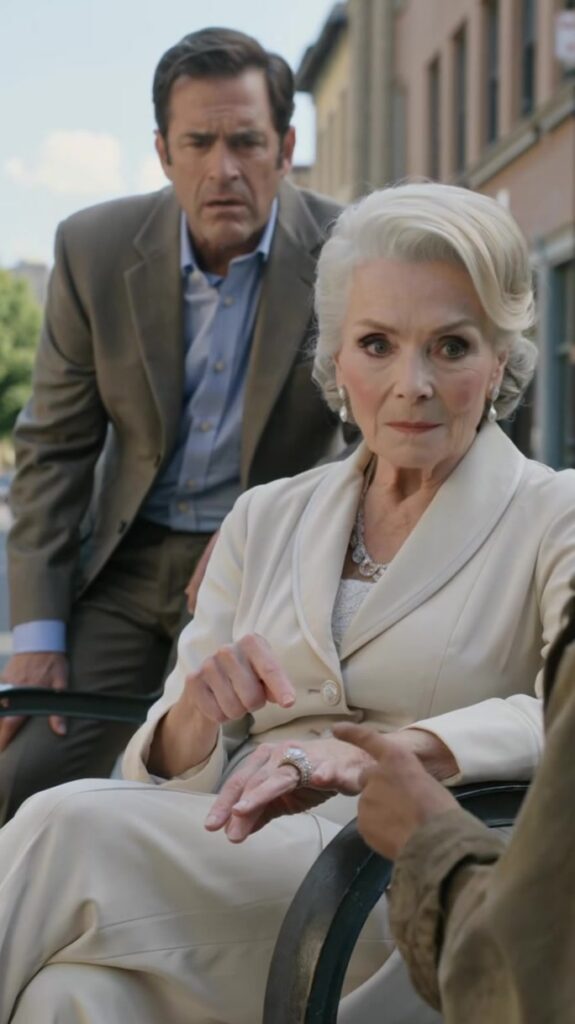
On the bench outside the florist, an elderly woman sat with the stillness of a portrait. She wore a cream coat that never met lint, gloves the color of bone, and pearls that rested against her throat like a measured breath. Her posture was so perfect it looked painful, each joint aligned to an invisible ruler. People passed and glanced once, then away—the way they did when money occupied public space as if it owned the air.
Her right hand lay atop her purse. On the ring finger, a gemstone caught the sun and threw it back in hard shards of light. It wasn’t only the size that made it strange. It was the feeling of it: too immaculate, too certain, a prize sitting on skin like a claim staked into earth.
A little girl stopped in front of the bench. She might have been ten, or twelve; hunger makes age difficult. Her hair was unevenly cut, her cheeks drawn tight, her coat too thin for the season and too big for her shoulders. She stood with the wary balance of someone used to being pushed aside. The crowd flowed around her and did not alter for her, as if she were a pothole everyone had learned to step over.
Except the old woman saw her. Perhaps because the girl didn’t ask. She didn’t beg or hold out a cup. She only stared at the ring, as if it were a door she recognized in a house she’d once lived in.
Slowly, the girl lifted her hand and pointed. Her finger hovered inches from the bright stone, not quite touching. “My mommy had a ring just like that,” she said.
The old woman’s expression did not shift the way faces usually do. It broke in a subtler place—behind the eyes, under the skin—like ice cracking in a pond. “What?” she snapped, too sharp for the quiet sidewalk, as if she could slice the sentence in half and make it disappear.
The girl didn’t flinch. Her gaze stayed fixed on the ring. “She said she’d never take it off,” she went on, voice small but steady. “Not for sleeping. Not for showers. Not for anything. She said it was a promise.”
For a moment, even the traffic seemed to lower its volume. The florist’s bell chimed as someone entered, and the sound landed wrong, like a laugh at a funeral.
A man in a dark jacket slowed as he passed. Middle-aged, tired eyes, the kind that assessed the world without wanting to be involved. He would have kept walking if not for the old woman’s tone. It pulled him like a hook. He turned his head, first to the girl, then to the ring—then something drained out of his face, leaving it pale and naked.
The old woman made a sound meant to be a chuckle. It came out brittle. “That’s impossible,” she said. “Lots of rings look alike.” She slid her gloved hand toward herself, an instinctive retreat, but the movement only drew attention to the stone’s flash.
The girl stepped closer, close enough that the perfume from the old woman’s coat brushed her like a wall. “No,” she said quietly. “Not this one.”
The man’s attention sharpened. He leaned in as if pulled by a gravity he couldn’t resist. “Ma’am,” he said, and his voice had the cautious authority of someone used to being believed, “can I ask where you got that ring?”
The old woman rose too quickly, the bench creaking in protest. “This is harassment,” she said, raising her chin as if the angle could deflect accusation. “I don’t owe anyone explanations.” But her voice trembled on the last word. Control, carefully practiced for decades, had begun to slip like a glove off a sweating hand.
The girl’s eyes shone, not with tears but with something colder than crying. “My mommy was rich too,” she said. “Before she met you.”
The sentence hit the air like a thrown stone. The man inhaled sharply. “Met you?” he repeated, as if the phrase were a key he’d dropped years ago and suddenly found beneath a couch.
The girl nodded once. “She told me about an older woman she trusted. She said you were like family. Like… an aunt.” The child swallowed. “She said you were the only person who knew where she kept her paperwork. The safe. The accounts.”
The elderly woman’s mouth opened, then closed. Her skin, so carefully maintained, seemed to lose its color as if the blood had retreated into hiding. “You’re lying,” she whispered. The words weren’t loud enough to convince anyone.
The girl’s voice lowered until it was almost swallowed by the passing cars. “She disappeared the same night she told me about you.”
People began to slow. A couple coming from the café hesitated. A delivery cyclist rolled by, looked back, and coasted to a stop. The sidewalk, so intent on hurrying a moment ago, found an excuse to pause.
The man took another step forward. His hands were open at his sides, palms half-raised without realizing it. “Ten years ago,” he said, and the words tasted of old paper and fluorescent lights, “there was a missing woman. Wealthy. A whole thing—press, neighborhood searches, a reward no one collected. No suspects that stuck.” His gaze snagged on the ring again, and his throat tightened. “But they said the ring vanished with her. Distinct stone. Engraving.”
The old woman’s eyes flicked down, a mistake. She jerked her hand behind her back, but the sun had already illuminated what it needed to illuminate.
“This is insane!” she burst out. “You have no proof. You have—”
“I do,” the girl interrupted.
The man blinked. He hadn’t spoken. Neither had the old woman. The child’s small voice held the line like wire pulled taut.
From inside her torn coat, the girl produced something carefully protected: a photograph inside a cracked plastic sleeve. She held it up with both hands as if offering a sacred object.
It showed a younger woman with an arm around someone just out of frame, laughing toward the camera. On her right hand, angled toward the light, was the ring: the same stone, the same cut, the same arrogance of beauty. The girl’s thumb shook as she tilted the photo, and the second figure in the picture came into view.
The elderly woman on the bench—only younger then, with darker hair and the same eyes. Her smile in the photograph was not kind. It was possessive, the smile of someone standing beside a thing she intended to own.
The man’s face tightened with disbelief, then loosened into horror. “Oh my God,” he breathed, not as a phrase but as a reflexive prayer.
The child’s hand trembled, but she didn’t lower the picture. “She wasn’t just my mom,” she said. “She was your partner.” Her gaze locked on the older woman. “In business. On paper. She said you helped her when she was starting out. That you were the only person she trusted.”
The old woman staggered back a step. Her heel caught the curb and she recovered too fast, snapping upright, as if to prove her body still obeyed her. “No,” she said, but it sounded like a question she’d asked herself for years.
“And you didn’t just take the ring,” the girl continued. “You took everything. Her accounts. Her company. Her name off the door.” The child’s voice hardened. “You took me too, in a way. You left me.”
A long silence settled. The traffic light changed. Cars rolled forward. The sunlight kept spilling across the street, indifferent and radiant, gilding a scene that had turned suddenly and completely wrong.
Then the girl said, almost gently, as if offering the final piece of a puzzle no one wanted completed, “I saw you that night.”
The old woman stopped breathing. You could see it in the way her chest held still, in the way her throat refused to move.
The man’s voice fell to a whisper. “What do you mean you saw her?”
The child didn’t look at him. She stared at the old woman with eyes that had learned, too young, how to be unblinking. “You thought I was asleep,” she said. “You told her to drink the tea because it would calm her down. You said it like you were doing her a favor.”
The old woman’s lips parted. No sound came out. The ring, still on her finger, caught the sun again and flared—violent, bright, undeniable. It looked less like wealth now than like a spotlight.
The man reached into his jacket with a shaking hand. His phone appeared, suddenly heavy. “What’s your name?” he asked the girl, and his voice tried to be steady and failed.
“Lena,” she answered. “My mom’s name was Mara.” She lifted her chin. “Mara Kestrel. She’s not a missing person to me.”
The old woman’s eyes darted, calculating exit routes, scanning faces that had become witnesses. Her composure—her lifelong armor—had fractured beyond repair. “You don’t understand,” she began, but the sentence collapsed under the weight of everything it had to carry.
The man dialed with his thumb, gaze still fixed on the ring. “I’m calling this in,” he said, more to himself than to anyone else. “I don’t care how long ago it was.”
Across the street, the florist’s door opened and a ribbon of music drifted out, cheerful and wrong. The sunlight stayed beautiful. The world kept its rhythm. But on the sidewalk, under that shining, ordinary day, a child held up a photograph like a knife, and an old woman stood with stolen light burning on her hand, finally unable to pretend nothing was wrong.