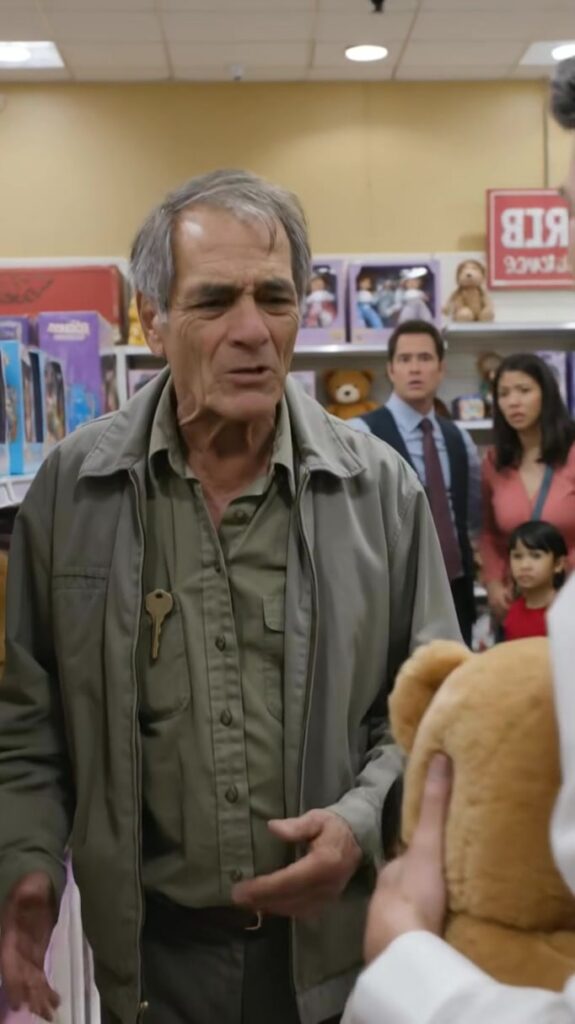
The toy store was loud with music, color, and happy voices. A carousel tune spilled from ceiling speakers, bright enough to make the air feel sugared. Balloons trembled against their strings above aisles arranged like little kingdoms—plastic castles, dollhouses lit from within, racks of costumes shimmering with sequins. Parents drifted with baskets on their arms, debating brands in casual tones. Children darted between displays, leaving behind squeals and the soft slap of sneakers on polished floor.
In the back aisle, where the lights were warmer and the crowd thinned, an old man stood as if he’d been placed there and forgotten. His coat had seen too many winters for a store that smelled like cinnamon and new cardboard. Beside him, his granddaughter looked like a sparrow that had wandered into a greenhouse—alive, watchful, and painfully out of season. Her shoes were scuffed at the toes. Her sleeves ended shy of her wrists. Yet her gaze was steady, fixed on a brown teddy bear perched at the center of a shelf as if it were honored there.
The bear wasn’t extravagant. It had soft fur, stitched paws, and button eyes that caught the light. But it held something most toys didn’t: a kind of calm. The girl lifted her hand until it hovered a breath away from it, as if she feared the bear might break under her touch. Then she whispered, barely louder than the music, “Grandpa… if I hug him just once, will that count as mine for a second?”
The old man’s jaw tightened, not with anger but with the ache of arithmetic. He could calculate what he had in his pocket down to the coin, and he already knew it would not become a bear. Still, he bent slightly, preparing to answer with whatever tenderness he could afford.
Before he could speak, a store employee strode into the aisle like a storm in a pressed polo. She snatched the bear off the shelf with a sharp, efficient motion, the way one might pull a vase from a child’s reach. “Hands off,” she snapped, loud enough for nearby shoppers to hear. “This is a store, not a charity show.”
The music kept playing. The laughter wavered. A few heads turned. A boy with a toy truck froze mid-roll, his mouth open. A mother near the dolls paused, lips compressing. At the register, the cashier lifted her head as if the sound had been a bell.
The girl jerked her hand back as if she’d brushed a hot pan. Heat rose in her cheeks. She retreated a half-step, pressing herself to her grandfather’s side, trying to hide inside his coat. The old man’s hand closed around her shoulder—firm, protective, and quiet.
He kept his voice steady. “Please,” he said to the employee, “don’t scare her.”
The employee’s face pinched with contempt, as though kindness had offended her. She pointed down the aisle toward the doors. “Then take her outside before she starts crying for things you can’t afford.” The words rang out with practiced cruelty, as if she’d delivered them before and liked the taste of them.
The child’s eyes flooded instantly. She didn’t sob—not yet. She did something worse: she tried not to, swallowing the sound like a broken promise. The old man stood very still. People like him knew the rules of public humiliation. Protest could become a spectacle, and spectacle had a way of multiplying costs.
Then a shadow fell across the end of the aisle. The store manager rounded the corner, a tablet in one hand, his tie slightly askew from a day of smoothing complaints and selling delight. He was already speaking—something brisk, managerial—until he registered the tableau: the employee with the bear clutched in her arm, the girl shrinking, the old man holding her as if bracing against wind.
His eyes flicked to the old man’s pocket, and his voice died mid-word.
Something heavy hung there on a short chain: a brass key, old and large, dulled by years and rubbed smooth at the teeth. It looked out of place among plastic and glitter, like an artifact mistaken for a trinket. The manager stared as though the key had spoken his name.
He stepped closer. “Where did you get that?” he asked, and the question came out lower than he intended, stripped of its business polish.
Silence moved through the aisle, pushing aside the music. Even the employee’s breath seemed to stop. The manager’s gaze locked on the key, not on the man’s face, as if he were afraid to look up and confirm something.
The old man’s fingers rose instinctively to cover it. “It was given to me,” he said, his voice worn but controlled, “by the woman who lost this store before your family ever owned it.”
The manager went pale, color draining from his cheeks in a sudden, undeniable rush. His mouth opened, then closed, as if he had swallowed a story he’d heard too many times to question.
He had grown up with a legend that was told in the back office during inventory nights, the kind of tale meant to warn and justify. There had been an earlier shop here, smaller and humbler, owned by a woman whose name his father rarely spoke. There had been rumors of missing money, accusations of theft. In the story as it was told, the woman’s young daughter had disappeared after the scandal, and the original keys were never recovered. The rebuilding came afterward—new walls, new signage, a family claim sealed with paperwork and time.
Now a key from that first door hung from a stranger’s pocket like a sentence.
The little girl lifted her head, tears clinging to her lashes. She looked from the manager to her grandfather, confusion fighting with shame. Her voice came out small but clear. “My mommy told Grandpa never to throw it away,” she said. “She said one day it would prove who she really was.”
The manager’s grip tightened on his tablet until his knuckles blanched. “Your mother,” he repeated, and the words sounded unfamiliar in his mouth, as if he’d never needed them. “What is her name?”
The old man swallowed. He seemed older in that moment, as if the store’s lights had revealed every year he’d carried. “Her name is Lidia,” he said. “She’s my daughter. She used to fall asleep under the counter in the first shop while her mother counted receipts and sang to the radio. When the accusations started, the men in suits came. They asked a child questions like she was a criminal. And when her mother died—shame and grief in one winter—Lidia ran. Not because she was guilty, but because she was scared.”
A murmur rippled from the shoppers. The employee’s face shifted, uncertainty cracking her certainty like ice. The manager stared at the old man with something close to fear—not of him, but of what the truth would do to the world he’d inherited.
“My father said there was proof,” the manager whispered. “That the money was taken.”
The old man’s eyes hardened, not with violence but with a weary anger that had nowhere left to go. “There was money missing,” he said. “There were also ledgers your father never showed anyone. And there were debts he didn’t want the bank to see. I cleaned the first store’s floors after closing. I know what I saw. I know whose hands were in the safe.”
For a beat, the toy store felt like a courtroom dressed as a wonderland. The music returned, but it sounded thin now, like an echo from another room.
The manager looked at the girl, really looked at her—at the too-short sleeves and the brave, burning eyes. Then he looked at the bear still trapped in his employee’s arms, its stitched smile ridiculous against the tension.
“Put it back,” he said sharply, not to the girl but to the employee. “Now.”
The employee obeyed, her hands suddenly clumsy. The bear settled on the shelf again, soft and waiting.
The manager exhaled once, as if he’d been holding his breath since childhood. “Sir,” he said to the old man, and his voice shook with the effort of changing direction, “come with me to the office. Bring the key. Bring whatever you have. If what you’re saying is true—if my family took what wasn’t ours—then we’re going to open every file. We’re going to find out what happened to that first store. And we’re going to fix what can still be fixed.”
The girl’s fingers reached toward the bear again, slower this time, as if the air had turned dangerous. She looked up at her grandfather for permission.
He nodded once, the smallest motion in the world, heavy with everything he’d held back. The girl hugged the teddy bear to her chest—not for a second, not as a borrowed comfort, but as a life raft she’d been denied too long. Her face disappeared into its fur, and this time, she didn’t try to hide the tears.
The manager watched her, then glanced at the brass key, as though it were a compass needle that had finally swung north. “I used to think this place was built on joy,” he said quietly, more to himself than to anyone. “I didn’t know it was built on a missing child.”
The old man’s hand covered the key again, not to conceal it now, but to steady it. “She wasn’t missing,” he said. “She was pushed out. There’s a difference. And there’s a cost.”
Outside the aisle, the store continued to glitter. But in that back corner, beneath warm lights and watching strangers, an old key began to turn the lock on a story that had been sealed for years—one harsh word at a time.