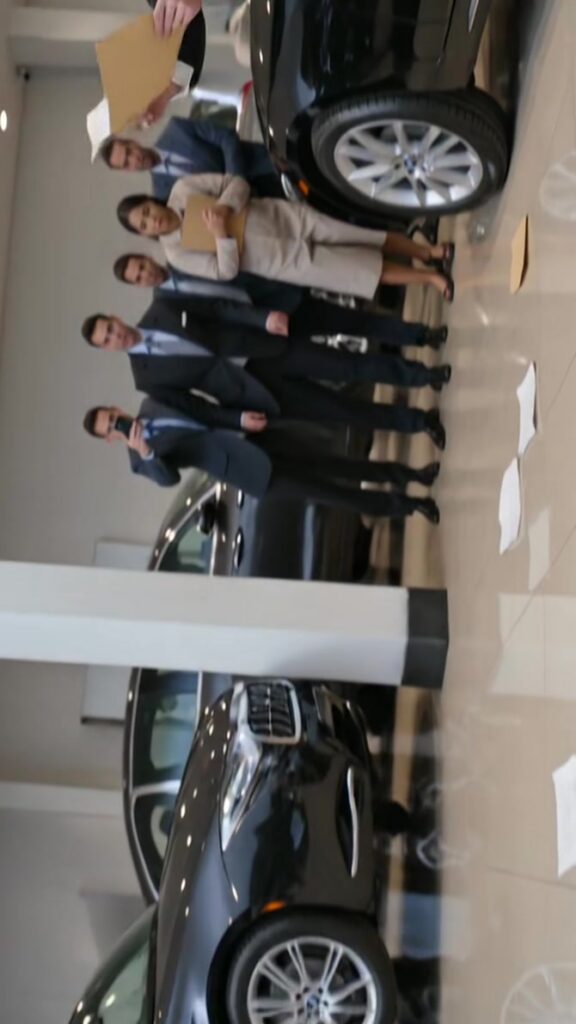
The day Lidia Reyes took the extra shift at Hartwell Imports, she told herself it was only floors. Marble floors, glass walls, metal railings that reflected a person back at themselves until they forgot what they’d come in looking for. She was used to being a reflection—someone you noticed only when the light hit wrong.
At the reception desk, a thin young salesman with a too-loud tie handed her a clipboard without looking up. “Back showroom first,” he said, eyes trained on the revolving door. “There’s a delivery and the boss wants it perfect.”
Lidia nodded, tucked the clipboard under one arm, and balanced her cleaning caddy in the other hand. Her folder—creased, too thick for its own dignity—was pressed against her ribs. Inside were papers she’d read so many times the edges had softened: her husband’s death certificate, a stack of correspondence, and one vehicle title she couldn’t make sense of until she’d found the right person to explain it.
She moved quietly along the showroom’s edge, wiping fingerprints from the glass partitions and catching snippets of voices drifting across polished air. Talk of “quarterly numbers,” “limited allocation,” “a client who wants to be impressed.” And, underneath it, laughter that sounded like money being spent.
Then she saw it—the black car at the center of everything, a sedan so sleek it looked like it had been poured from shadow. The overhead lights glided across its hood as though the paint had depth, as though you could fall into it. A velvet rope circled it, but someone had moved the posts, leaving a gap.
Lidia paused, not because she wanted to touch it, but because the car held a memory that made her chest tighten. The night Mateo died, the officer had said, very gently, “He was driving a company vehicle.” As if those words could explain the rest: the sudden phone call, the cold shock of the hospital corridor, the part of her life that ended in a fluorescent waiting room.
She stepped closer—only close enough to read the small placard at the windshield. The model name wasn’t one she recognized, but the badge—an angled crest—looked like the one stamped on the key fob the police had given her along with Mateo’s wallet.
Before she could think better of it, she crouched and peered toward the lower edge, as if the car could tell her something from its undercarriage. She’d been told to clean around it; no one had told her it was forbidden to look.
A hand clamped around her arm.
The grip was hard, practiced, like a man used to moving people aside without asking. Lidia gasped as she was yanked upright and jerked backward. Her shoulder bumped the car’s glossy side with a hollow thud that carried across the room like a bell.
“Don’t touch what you could never afford,” a voice snarled.
The showroom fell into a hush so sudden the air seemed to thicken. Conversations stalled. A salesman’s rehearsed pitch died on his tongue. Somewhere, a phone camera quietly began recording.
Lidia looked up into the face of a man wearing a suit that fit like armor. He was tall, silver-haired, his cuff links bright enough to cut. She recognized him from the magazines stacked in the break room: Grant Mercer, local billionaire, patron of symphonies and headlines, the kind of man whose name owned rooms before he entered them.
Her folder slid in her grip as her fingers trembled. She pressed it tight to her chest, instinctively shielding it like a wound. “I’m sorry,” she said, though she wasn’t sure what for. Her voice sounded small in all that space.
Mercer’s gaze dropped to the folder. The corner of his mouth curved in a thin, amused line. “What’s that?” he said, loud enough for everyone. “Your résumé? A list of things you think you deserve?”
He plucked the folder from her arms with one sharp tug. Lidia reached for it, panicked, but her hands hovered helplessly. The folder opened in his hands; papers fluttered out like startled birds and skated across the glossy floor.
“Please,” Lidia whispered. “Those are important.”
Mercer let out a laugh that invited the room to join him. “Important,” he repeated, savoring the word. “Incredible.”
Lidia dropped to her knees. Pride was a luxury she’d used up on the day Mateo stopped coming home. She gathered papers quickly, palms sliding over the cold marble, her cheeks burning as she felt eyes on her back. Her fingertips caught the edge of an envelope, then another sheet, then—
A document slid away from her and disappeared beneath the black car.
Lidia froze.
The paper was the title. The one she didn’t understand. The one she’d been carrying like a question she was afraid to ask.
“Look at that,” Mercer said, turning toward the nearest cluster of customers as if he were hosting them. “She’s hiding something under my car.”
“Sir,” a voice cut in, careful and controlled. The dealership manager, Edwin Hartwell, stepped forward from the desk area. He wore a neat vest and a smile that usually meant reassurance, but now it had been replaced by a tense line. He took in Lidia on the floor, Mercer looming above her, and the scattered papers like debris after an accident.
“Everything all right here?” Hartwell asked.
“Perfectly,” Mercer said. “Your staff allowed someone to paw at my purchase. I’m teaching a lesson.”
Hartwell’s eyes flicked to the black sedan. “Your purchase,” he echoed, but the words sounded like he was checking them for weight.
He crouched with a grunt and reached beneath the car, careful not to smear the polished bodywork. His hand came out holding the title by one corner.
At first his expression was irritation—paperwork in the wrong place, an embarrassment in front of customers. Then his gaze caught on the printed name.
The color drained from his face so quickly it seemed the overhead lights had changed.
“Mr. Hartwell?” Mercer prompted, still amused, still performing for the silent crowd. “Go on. Read it. Let everyone hear what the cleaning lady was carrying around.”
Lidia swallowed. Her throat felt raw. She could not move from the floor; she could only watch Hartwell’s eyes scan the document again, as if he expected the ink to rearrange itself into a safer story.
“This car…” Hartwell began, voice suddenly quieter. He stared at the title, then lifted his eyes to the car, then to Mercer. “This car is not registered to you.”
The silence deepened. Even Mercer’s grin held in place like a mask that had forgotten how to move.
Hartwell’s fingers tightened on the paper. “It’s not registered to this dealership, either.” He turned the title so Mercer could see it. “It’s registered to Mateo Reyes.”
Lidia’s breath left her in a painful rush. Mateo’s name—her husband’s name—felt like a hand reaching out from the grave.
Mercer’s smile faltered, then snapped back with forced brightness. “That’s impossible,” he said, but the edge in his voice betrayed him. “There’s been a mistake. My assistant handled all of this.”
Hartwell didn’t look away. “Mateo Reyes is deceased,” he said, almost to himself, then to Lidia: “Ma’am… why are you here with this title?”
Lidia pushed herself up on trembling legs. Around her, people shifted. Someone whispered. A salesman near the desk stared at Mercer as if seeing him for the first time, not as a myth but as a man with blood in his veins.
“He worked nights,” Lidia said, voice shaking but clear enough to travel. “He told me it was temporary. That he was driving for a client. He died in an accident, and they told me it was a company car.” She pointed to the title. “I found that in his things. I didn’t know what it meant. I came to ask.”
Mercer’s jaw clenched. “This is absurd,” he snapped. “You’re trying to extort—”
Hartwell lifted a hand, cutting him off with a firmness that surprised even himself. “Sir,” he said, “if this title is valid—and it appears to be—we have a serious legal situation. This vehicle should not be on our floor.”
Mercer took a step toward him, anger rising like heat. “I paid for that car. Everyone here knows I paid for it.”
“Payment isn’t ownership,” Hartwell said. His voice trembled, not with fear, but with the sudden, terrifying recognition of consequence. He looked at Lidia again, and his expression softened into something like horror. “Your husband’s name… on a vehicle of this value… That’s not an accident.”
Lidia felt the room tilt. For months she had lived with grief that had no edges—only ache. Now, at last, there was a shape to it, a line drawn in ink: Mateo’s name attached to something that should have protected him, not killed him.
Mercer’s eyes darted around, calculating. “Edwin,” he said, lowering his voice as if intimacy could erase what had been spoken aloud. “Let’s not make a scene. I’ll handle this privately.”
Hartwell took a step back, as if the closeness itself were contaminated. “I think,” he said slowly, “the scene has already been made.” He glanced toward the reception desk. “Call our legal team. And—” he hesitated, then squared his shoulders—“call the police. Do it now.”
A murmur rippled through the customers. Phones lifted higher. Mercer’s face hardened into something sharp and pale. For the first time, his gaze landed on Lidia not as an inconvenience, but as a threat—an unremarkable woman holding a single piece of paper that could unravel him.
Lidia’s hands shook as she reached out. Hartwell placed the title in her palms like it was fragile, like it was evidence, like it was a relic. The paper was warm from his grip, and for a heartbeat she imagined it warm from Mateo’s hands, too, the night he’d left and never returned.
Mercer exhaled through his nose, a sound like controlled fury. “You think this changes anything?” he asked, voice low enough to feel meant only for her.
Lidia looked at him. Her humiliation was still there—hot in her cheeks, heavy in her bones—but it was no longer the only thing in the room. Now there was truth. Now there was a name that did not belong to Mercer, printed in unforgiving black.
“It changes everything,” she said, surprising herself with the steadiness of it.
And as sirens began to rise somewhere beyond the glass walls of Hartwell Imports, the black luxury car sat gleaming under the lights—no longer a symbol of someone else’s power, but the first crack in it.