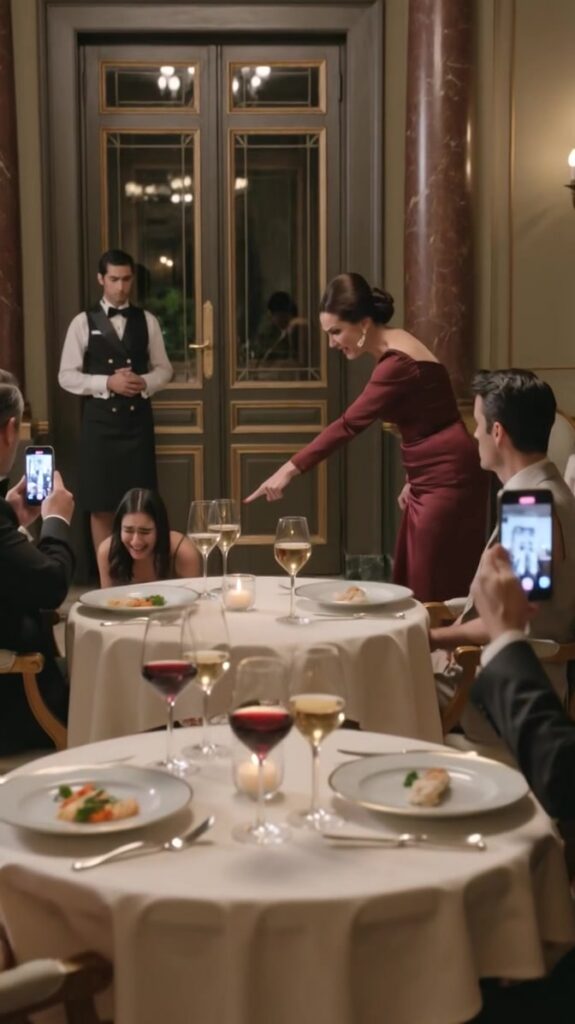
The bag didn’t merely fall—it struck the marble with a crack that sounded like a verdict. Its clasp sprang open, and a small life scattered: a lipstick worn down to a slant, coins that rolled in bright circles, a packet of tissues, and a leather cardholder softened by years of being held too tightly. It looked private on the floor, like a diary thrown open. In the gilded hush of the restaurant, under candles that made everyone’s skin appear expensive, it was a kind of nakedness.
The hostess dropped to her knees before anyone told her to. She seemed not to decide to move; her body simply did, as if trained by a thousand small humiliations to scramble first and ask later. Tears came fast, shocking her as much as the noise had. She reached for the lipstick, fumbled, and it skittered away, a tiny red smudge left behind like a wound.
Above her stood a woman in dark red, her couture dress catching the light like spilled wine. The woman’s finger cut the air, then stabbed down at the scattered belongings as though pointing out evidence in a trial. Her voice rose, full and practiced, carrying the confidence of someone who knew she’d be believed. “Open it all up,” she demanded, loud enough for every table to hear. “Show them where you put my ring.”
The violinist stopped mid-note. Forks halted halfway to mouths. A waiter, frozen beside a tray of glistening oysters, blinked as if he’d woken into someone else’s dream. At the far end, a woman beside a marble column lifted her phone, the screen a pale rectangle of hunger. Another followed. Then another. The room rearranged itself into an audience.
The hostess—Mara, her name stitched in small letters on her dress—looked impossibly young at that moment. Her fingers shook as she gathered what she could: a transit pass that had been folded and unfolded too many times, a cheap compact mirror scratched cloudy, a photo with a corner bent back to reveal a smile beneath it, and a note folded into a narrow strip as if meant to be hidden. Each item felt like a confession in the open. “I didn’t,” she whispered first, and then louder, breaking, “I didn’t take anything. Please.”
The woman in red moved closer, the perfume around her sharp as gin. With the tip of a heel, she nudged the cardholder away from Mara’s reaching hand, as though it might contaminate her shoe. She turned to the nearest tables, offering the room a lesson in disgust. “Look,” she said, letting the word stretch. “She works here and thinks she can take what she wants from people she’ll never be.”
The sentence landed like a slap. The accusation wasn’t just about a missing stone; it was about permission—who was allowed to exist without being suspected, who could make a mistake without being punished, whose tears counted as inconvenience. Mara’s face collapsed. She looked toward the manager’s station as if a rescue might materialize there. No one moved. Not one person said, “That’s enough.” Silence pooled and grew heavy, and the candles kept burning as if they approved.
“Pick it up,” the woman in red continued, voice honeyed with cruelty. “Gather your little things. If you have nothing to hide, it should be easy.” Mara’s hands fluttered. She chased a coin that had rolled under the edge of a table, and when she retrieved it she held it so tightly her knuckles blanched. She was crying openly now, trying to make herself small enough to be forgiven for existing.
Then the private dining room door swung inward, slow and decisive, cutting through the spectacle. A tall man stepped into the candlelight. His tuxedo sat on him like armor, but his face was calm, unreadable, the calm of someone who understood exactly how much damage a room could do. He held a diamond ring up between thumb and forefinger, and it caught the light and threw it back across the ceiling.
The room stopped breathing. Mara looked up, eyes shining, mouth parted as if she couldn’t remember how words worked. The woman in red went rigid, as though every bone had been suddenly warned. The man crossed the marble floor with measured steps, not hurrying, not performing urgency—only certainty. He stopped at the center of the ruin: Mara kneeling, her belongings exposed, her dignity in pieces; the woman in red towering above her like a judge who had already written the sentence.
He glanced down at Mara first, and his eyes softened by a fraction, the way a curtain shifts when a window is opened. Then he looked at the woman in red and lifted the ring slightly higher. “Curious,” he said, his voice quiet but cleanly cutting through the room. “Because this was recovered from your sister’s bag before she even came out to the table.”
The color drained from the woman’s face as if pulled by invisible hands. “That’s impossible,” she breathed, but the protest was thin, already defeated by the weight of the ring held aloft. Around them, chairs creaked as people leaned forward, suddenly allergic to the role they’d been playing. The phones did not lower.
The man didn’t turn toward the audience. He didn’t need to. “You called a young employee a thief in front of everyone,” he said, still facing the woman in red, still holding the ring like a small, shining witness. “And you did it with confidence. Which tells me you’ve done it before, or you’ve watched it done, or you’ve benefited from a world that lets you do it without consequence.” He paused, then lowered his hand just enough that the diamond’s light moved from ceiling to faces. “The ring was never missing. It was a story. And you chose Mara to play the villain because it was easy.”
Mara’s breathing hitched. Her hands hovered over the scattered items, unsure whether she was allowed to touch her own life again. The manager finally stepped forward, mouth opening as though words could reverse time. The woman in red’s sister—somewhere behind her—made a small sound, a choked, guilty note. A few guests looked down at their plates, suddenly fascinated by crumbs.
“Why does it matter?” the woman in red demanded, but there was fear behind the question now, fear like a draft under a door. Her eyes flicked to the phones, to the waiters, to the man in the tuxedo, searching for an exit that didn’t exist.
“Because,” the man said, and his voice carried a different kind of sharpness now, not cruel but exact, “this restaurant is under contract with my firm. Because my client is the foundation hosting tonight’s gala. Because we were deciding whether to continue funding this place’s ‘community employment’ program.” He looked down at Mara’s transit pass, the worn cardholder, the bent photograph. “And because the easiest way to measure a room is to watch what it does when someone small is hurt.”
The words sank in slowly, like ink into linen. The manager’s face turned the shade of curdled milk. One waiter swallowed hard, as if he’d been holding his breath for years. Mara stared at the man, bewildered, as if she couldn’t understand how truth could arrive with a tuxedo and a diamond.
The man crouched—not fully, not in a way that pretended they were equals, but low enough that Mara didn’t have to look up as far. He placed the ring, not in her hand, but on the marble beside her spilled things, a deliberate juxtaposition: wealth and ordinary life sharing the same cold floor. “Finish gathering your belongings,” he said to her, softly enough that only she could hear. Then, louder, to the room: “And if anyone has something to say about what they just watched—now would be the moment to earn their elegance.”
For the first time all night, the silence changed shape. It was no longer a weapon. It became a challenge, pressing against throats and conscience. A chair scraped. Someone cleared their voice. A woman in pearls lowered her phone and stood, her face tense with shame. “That was vile,” she said, not loudly, but clearly. Another guest nodded. A third followed. The crowd’s comfort began to crack, and in the fissures, consequence appeared.
Mara gathered the last of her coins, slipped the worn cardholder back into her bag, and tucked the bent photograph inside as if sheltering it from the room. Her tears slowed. She wiped her face with a tissue and stood, still trembling but upright. The marble was cold under her shoes, yet she felt, for the first time since she’d started working there, the shape of her own spine.
The woman in red looked around as if discovering she was no longer the center of the world. Her mouth opened, then closed. The man straightened and stepped aside to let Mara pass. As she walked toward the hostess stand, the restaurant did something it had refused to do minutes earlier: it made space for her without resistance. Not applause, not drama—just a path, finally cleared.
Behind her, the candles continued to burn. But the light had changed. It no longer belonged only to the people who could afford it.