Ethan agreed to the cleaning job for one reason and one reason only: tuition was due in three weeks, his financial aid had been slashed in half, and the diner shifts he’d been stacking weren’t enough. Pride didn’t pay invoices. Neither did grief. So when a notice appeared on the community board—CASH, SAME DAY, LIGHT HOUSEWORK—he copied the address, ignored the blank space where a name should’ve been, and told himself that whatever waited at the end of that alley couldn’t be worse than dropping out.
The alley was a narrow throat between brick buildings, choked with weeds and old bottles that caught the sun like jagged teeth. Halfway down, the air changed—cooler, heavier—carrying a smell like paper left too long in a closed drawer. The house at the end looked less built than abandoned into existence. Its shutters hung crooked, the paint flaked in thin curls, and the front door bore scratches as if someone had tried to claw their way out. Neighbors had warned him in passing, voices lowered as though the walls might hear. An old woman lived there. Strange. Hoarded. Waiting for a ghost. Ethan didn’t do ghosts. He did shifts and scholarships and the careful arithmetic of survival.
She opened the door before he knocked, as though his footsteps had announced him. Her hair was silver and gathered into a knot that didn’t quite hold. Her eyes were a pale blue that didn’t blink enough. “You’re the boy,” she said, not asking. Inside, the hallway narrowed, lined with stacked newspapers tied in bundles, jars of buttons, and wooden frames turned facedown. Everything was clean in a way that felt uninhabited—no crumbs, no cluttered dishes—only objects saved and placed as if each had a job. Ethan caught a glimpse of a parlor where a sheet covered the furniture like an old snowfall. “Bedroom,” she said, and led him past a stopped pendulum clock that hung mid-swing, arrested forever in the act of measuring time.
The bedroom was dim, but the morning pushed a weak stripe of light through a cracked window, landing on a quilt too bright for the room—hand-stitched squares of red and yellow and cornflower blue. The woman lay back down with the ease of someone practiced in surrendering to sleep. “Sweep,” she murmured, already drifting. “Just sweep.” Ethan hesitated. It felt wrong to work while someone slept a few feet away. But wrongness was a luxury he couldn’t afford. He moved quietly, broom bristles whispering over warped floorboards, dust rising in thin ghosts that caught the pale beam and vanished. The air tasted of cedar and time. The curtains barely stirred, as if the house had forgotten how to breathe.
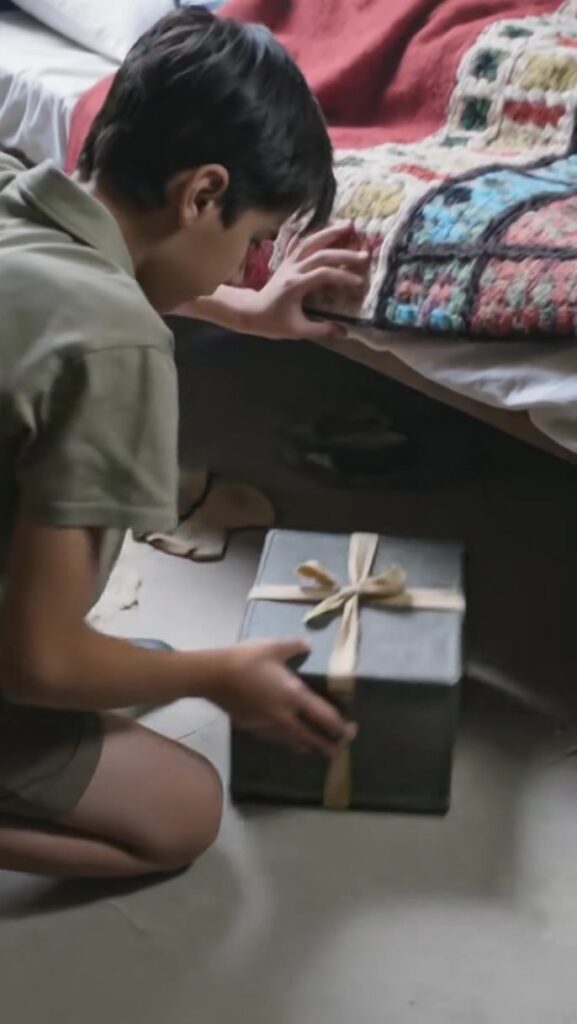
Ethan pushed the broom farther, reaching under the iron bedframe where the shadows thickened. The broom snagged on something that did not sound like wood or cloth. A hard metallic note rang out—a small, bright clink that cut through the room. He stopped so abruptly the dust settled around him. The woman’s eyes opened at once, wide and wet, focused not on him but on the space beneath the bed. She hadn’t looked sleepy a moment ago; now she looked like someone who’d been holding her breath for years and had finally heard the signal to release it.
“Don’t—” Ethan began, but the word died in his throat. His hands moved before his caution did. He crouched, reached into the darkness, and felt cold metal under his fingertips. He tugged and dragged out a small tin box, dulled by dust and wrapped in a ribbon so faded its original color was a guess. The ribbon was knotted carefully, almost ceremonially, as though it held more than a lid closed. Ethan sat back on his heels, box in his lap, and felt his chest tighten in a way he couldn’t explain. Across from him, the woman’s gaze did not waver. Tears gathered at the corners of her eyes and hung there, refusing to fall until permission was granted.
“You weren’t supposed to find it like that,” she whispered, voice thin but sharp. Not angry. Terrified—of what finding it would mean. Ethan’s fingers trembled as he worried the knot loose. The ribbon slid away like a surrender. He lifted the lid a fraction and the smell of old paper rose up—ink, perfume, and something else: the dry sweetness of pressed flowers. Inside were letters, their envelopes yellowed, corners softened by handling. Beneath them lay a photograph of a toddler held on a woman’s hip, both faces turned toward the camera in a summer glare. Under the photo were certificates—school awards, attendance slips, clippings—stacked with reverence. Ethan’s eyes locked onto a name printed in a bold school font, repeated across multiple pages.
His last name.
He stared until the letters blurred. His father’s surname had been a thing said rarely, like a fragile object that might break if you touched it too much. His father was dead—two years now—gone in a car accident that left more silence than answers. Ethan had never met anyone on that side of the family. His father never spoke about his past except in the soft, guarded way people speak about rooms they keep locked. Ethan’s breath caught. The broom slipped from his fingers and fell with a muted thud, as though even it understood not to make too much noise.
“Where did you get these?” Ethan managed. His voice sounded too loud in the room that had been hoarding quiet. The woman pushed herself up, bones shifting under the quilt. She looked at him like he was an apparition made solid. “I kept them,” she said. “I kept everything that proved you existed.” She swallowed, and the tears finally broke free, tracking down the folds of her cheeks. “My son left this house forty years ago. He said he’d come back after he found work. He said he needed to make a life. He said—” Her breath hitched. “He stopped writing. Or maybe the letters stopped reaching me. I don’t know which was worse.”
Ethan’s head rang. “Your son… what was his name?” The question came out hoarse, as if scraped raw on the way up. The woman reached toward the box with fingers that shook more than his. She pulled out one envelope, careful as if it might crumble, and pressed it to her chest before answering. “Daniel,” she said. “Daniel Hartwell.” The name struck Ethan like a slammed door. His father’s name. His father who had changed jobs, changed apartments, changed the subject whenever Ethan asked about grandparents. Ethan’s vision tunneled. He felt suddenly thirteen again, hearing his father wake in the night from dreams he refused to explain, the way his hands would tremble when the mail arrived.
“He’s gone,” Ethan said, and then hated himself for the bluntness of it. The woman’s face did something strange—closed, then opened—like a room receiving light for the first time. “Gone,” she repeated, tasting the word as if it were both punishment and release. Her shoulders sagged. For a moment Ethan thought she might collapse back into the bed and never rise again. Instead, she nodded once, a small, fierce motion. “Then you’re what’s left,” she said. “You’re what came back.”
Ethan looked down at the certificates again and realized what they were—not his, but his father’s. Old awards from a school district across the river. A science fair ribbon. A perfect attendance certificate. A newspaper clipping about a scholarship. The life his father had built before he severed the line and fled. The box wasn’t a hoard. It was a shrine to an absence. “Why didn’t you find us?” Ethan asked, and his anger startled him. It wasn’t aimed at her alone; it was aimed at the years, at the secrets, at the way his father had died without unlocking the rooms inside him.
“I tried,” she said, and her voice sharpened into something like steel. She swung her feet over the edge of the bed, planted them on the floor as though reclaiming gravity. “I wrote. I called numbers that were disconnected. I went to addresses that belonged to strangers. When I finally found a trail, it was too late—he had changed his name on paper. I kept waiting for a mistake, for a slip, for the world to let him fall back into my arms. This house became the only place I could be sure the past would still recognize me.” She gestured weakly around the room. “So I saved the proof. In case someone came. In case you did.”
Ethan’s throat tightened, not with fear now but with something heavier. He imagined his father as a young man, leaving this alley behind, carrying a suitcase and a war inside his ribs. He imagined the old woman counting days like beads, each year another knot in the ribbon. Ethan had come for money. He had walked into a family history his father had buried so deep even death hadn’t dug it up. “I didn’t know you existed,” he said, the confession tearing out of him. “He never told me.”
“Then we start here,” she replied, and the simplicity of it broke him more than any accusation could have. She reached out, hesitated, then touched the back of his hand lightly, as if testing whether he was real. Her skin was thin, warm, and trembling. Ethan let her. In the stripe of trapped sunlight, the dust floated like slow snow, and the stopped clock on the wall remained stubbornly still. Yet something in the room shifted—an almost imperceptible easing, like a breath finally taken.
When Ethan rose to fetch a glass of water for her, his legs felt unsteady, as if he’d stepped off a familiar map. He had come to sweep a floor and leave with cash in his pocket. Instead he found a name that matched his own and a woman who had been waiting for a knock that never came. In the kitchen, he poured water from a pitcher covered in a crocheted cozy, his hands no longer shaking as much. He realized school would still be there, tuition still due, the world still demanding its numbers. But now there was a different arithmetic, one that counted letters not received and love not delivered, and the possibility—terrifying, necessary—that survival might mean more than making it alone.