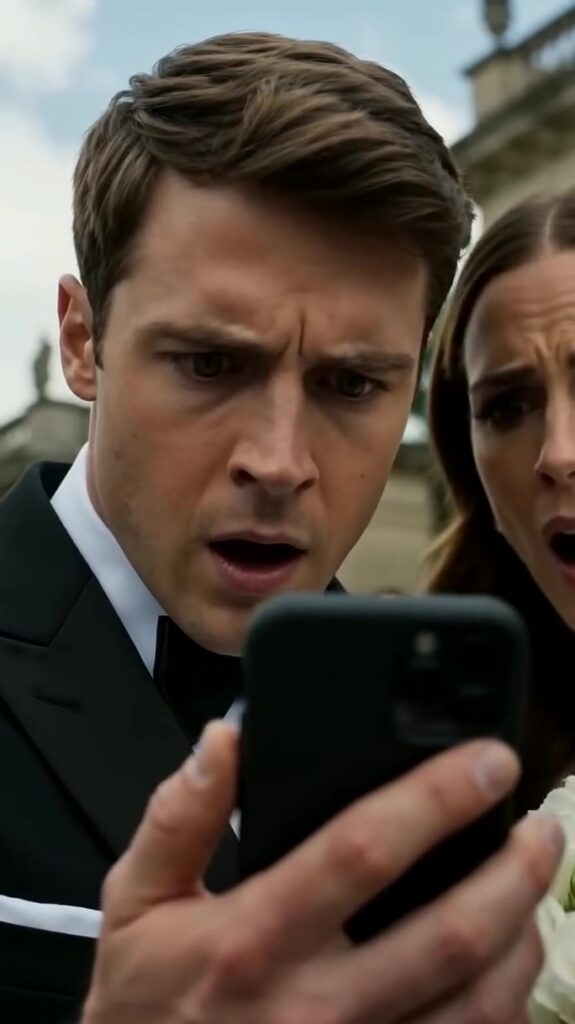
The wedding had just ended, and the church steps became a stage the moment the doors swung open. Sunlight poured across the stone like spilled champagne, catching on sequins and cufflinks and the pale petals that clung to shoes. Someone’s cousin held a phone high and shouted for everyone to squeeze closer. Laughter rose in quick bursts. The bell tower behind them hummed with the last vibrations of celebration. Elodie Vale stood at the top step, bouquet pressed to her bodice as though it were the final button holding her together. Her veil trembled in the light wind, and her new husband—Julian, immaculate in black—placed his hand at the small of her back with the practiced ease of a man accustomed to being watched.
“Just one more,” the photographer called, backing down the steps, framing them with the arch of the doorway. “Look at each other.”
Julian turned to Elodie, and his smile—wide, perfect, rehearsed—landed on her like warmth. He had been charming her since their first dinner, and even as she learned the rhythm of his life—meetings, donors, late-night calls he dismissed as “work”—she had never seen that smile falter. It was the expression of a man who believed life could be handled like a negotiation.
Then, below the lowest step, someone moved against the current of guests.
At first Elodie thought it was a latecomer searching for an exit. But the figure didn’t drift away. She came forward—thin, layered in clothing the color of old mud, shoulders hunched under a coat that had forgotten its original shape. Her hair was a tangle that caught in the light like wire. A raw smell of street rain and unwashed wool followed her, a scent so out of place among roses and cologne that Elodie instinctively tightened her grip on the bouquet.
The woman stopped directly in front of Julian, so close that his polished shoes could have touched her worn boots. Her eyes were the only thing about her that did not seem exhausted. They fixed on him, unwavering, as if she had pinned him there with an invisible nail.
Julian’s hand left Elodie’s back. His posture stiffened. His smile drained away so quickly it seemed to fall off his face.
“You can’t be here,” he said, low and sharp. Not loud enough for the photographer, but loud enough to cut through the nearest circle of chatter.
The woman flinched. She did not retreat. Her gaze slid briefly to Elodie, not with hostility, but with something like apology—an acknowledgement that this day was being taken hostage.
“It’s all right,” she murmured. Her voice was roughened by cold nights. “Just check your phone.”
Julian let out a short, humorless breath, the kind people made when confronted with inconvenience they couldn’t ignore. “What are you talking about?” His eyes flicked left and right, measuring how many people had noticed. Too many. A cluster of guests had slowed on the steps, the bright cheer in their faces curdling into curiosity.
Elodie leaned closer to him. “Julian,” she whispered, keeping her lips turned in a semblance of a smile because the cameras were still there. “Do you know her?”
“No,” he said immediately. Too quickly. His jaw worked as though he were chewing down a truth.
The woman’s mouth trembled. “Please,” she said, and the word did not sound like a request so much as a verdict. “Just look.”
Elodie saw Julian’s fingers twitch toward his pocket. She thought, absurdly, of a magician reaching for a final trick. He drew out his phone as if to end the scene by calling security, to sweep the stain away before it set. He unlocked it with the stiff precision of a man opening a door he was certain was empty.
A message sat at the top of his screen, already open as though it had been waiting.
Julian’s eyes moved across it—one line, then another—and something inside him buckled. The color pulled back from his face, leaving him as pale as the lilies pinned to his lapel. His hand tightened on the phone until Elodie could see the tendons stand out.
“Julian?” Elodie asked again, more urgently. The bouquet trembled; she hadn’t realized she was shaking.
The woman stepped closer, close enough that her breath brushed Julian’s cheek. She whispered something too small for anyone else to catch, words tucked into the hollow of his ear. Whatever she said landed like a key turning. Julian’s throat worked. For a second, Elodie saw not her confident groom but a frightened boy wearing a man’s suit.
He did not answer her. He simply turned the screen slightly, as if drawn by a force stronger than his pride.
Elodie leaned in, her veil catching on his shoulder. The image on the phone loaded, bright and merciless: a photograph, grainy but unmistakable. A child on a hospital bed, tubes curling like pale vines. A tiny wrist with a hospital band. The child’s eyes were half-open, and beside the bed—caught mid-motion, face turned away from the camera—was a younger Julian, barely more than a teenager, his hand clasping that small wrist. On his own wrist was a braided cord, the kind made from cheap embroidery thread. The timestamp in the corner was nearly twelve years old.
Under the photo, a single sentence: You promised you wouldn’t leave us again.
Elodie’s free hand flew to her mouth. Sound vanished around her—not because the world had gone silent, but because her own blood had begun to roar in her ears. She stared at Julian’s face, willing him to explain. His eyes were locked on the image like it had become a trapdoor opening beneath him.
Across the steps, guests had stopped pretending not to watch. The photographer lowered his camera as if sensing that this was no longer something that could be framed into beauty. A bridesmaid murmured Elodie’s name, but Elodie didn’t turn.
Julian lifted his gaze slowly to the woman. His voice, when it came, sounded cracked, as if he were pushing it through rubble. “This photo…”
A tear slid down the woman’s cheek, cutting a clean line through the grime. “I told you I’d find you,” she said. Her fingers curled tightly around the strap of a battered bag, knuckles white. “You changed your number twice. You moved cities. You learned how to smile on television. But you didn’t change what you did.”
Elodie’s stomach clenched. She forced herself to breathe, tasting the sharpness of fear and the sweetness of wedding cake still lingering on her tongue. “Who is she?” she demanded, the question slicing through the tense air. “Julian—who is she?”
Julian stared at Elodie as if seeing her for the first time too, as if he had built their entire life on a floor that was now collapsing. He looked down at the phone again, at the child in the bed, at the cord on his wrist.
“Her name is Mara,” he said finally, each syllable dragged out. “She… she was my sister’s friend. From before.”
“Don’t do that,” Mara interrupted, her voice rising with a sudden strength. “Don’t shrink it into a sentence you can survive.” She lifted her chin. “Tell her what you promised in that hospital room.”
Julian’s lips parted. No sound came. His eyes glittered with something Elodie had never seen in him—shame, naked and frantic. He swallowed hard. “I promised,” he said, and his voice broke on the word, “that I would take care of him.”
Elodie’s breath stopped. “Him?” she echoed.
Mara dug into her bag with shaking hands and pulled out a folded paper, edges softened by years of being opened and closed. She held it out, not to Julian, but to Elodie, as if Elodie deserved the truth directly. “His name is Tomas,” Mara said. “He’s twelve now. He has your husband’s eyes. And he’s been asking his whole life why his father disappeared after promising not to.”
The world tilted. Elodie took the paper without understanding at first. It was a birth certificate copy, the ink faded but legible. Father: Julian Merritt. The name Julian had once used before he became Julian Vale for donors and headlines, before he smoothed his past into something polished and empty.
Elodie looked up, her throat burning. Julian stood rigid, the phone hanging in his hand like a weight. He did not deny it. He could not. The lie had finally run out of air.
“You said you didn’t want children,” Elodie whispered, not caring that every guest could now hear. “You said you didn’t want anything that would tie you down.”
Julian’s eyes filled, and for an instant she saw the boy from the photo—the one who had once held a small wrist and meant his promises. “I was young,” he said, as if youth were an absolution. “She—Mara—she vanished. I thought—”
“You didn’t think,” Mara said softly. “You ran.”
Elodie’s bouquet slipped in her grasp, the stems scraping her palm. The petals seemed suddenly obscene. Around them, the steps were frozen with watching faces, people who had toasted love an hour ago now witnessing its fracture.
“Why today?” Elodie asked Mara, voice trembling with anger and grief. “Why here?”
Mara’s shoulders sagged. “Because I found you,” she said, the words simple, exhausted. “And because your wedding was the first time he stood still long enough for me to reach him. You get a ceremony and a hundred witnesses. I get one chance to make sure he can’t erase us again.”
Julian stared at the phone as though it were burning him. “What do you want?” he asked, and the question was thick with dread.
Mara’s eyes shone. “I want him to come to the clinic tomorrow,” she said. “Tomas needs surgery. I’ve sold everything I can sell. I’m done begging strangers. His father will look at him and decide who he is. Not the man in the tuxedo. The one in the photograph.”
Elodie’s chest hurt as if the stays of her dress had turned into a cage. She looked at Julian—her Julian, her stranger. She waited for him to spin another story, to weaponize charm, to make this disappear.
But Julian’s shoulders sagged, surrendering for the first time to something he could not purchase or outrun. His voice was barely audible. “I’ll come,” he said.
Elodie heard a murmur ripple through the guests like wind through dry leaves. Someone began to guide grandparents away. A bridesmaid reached for Elodie’s arm, but Elodie shook her off. She stepped down one stone stair, then another, until she stood level with Mara.
“Show me,” Elodie said, surprising herself with the steadiness in her tone. “Show me where he is. If there’s a child—if there’s a boy who needs help—then this doesn’t get handled with whispers.” She turned her head toward Julian, her veil sliding like a curtain. “And you,” she said, “don’t get to hide behind me.”
Julian blinked, as though the words struck him harder than Mara’s accusation. “Elodie—”
“The wedding had just ended,” Elodie said, tasting the bitterness of it, “and I thought that meant the beginning of something. Maybe it still is. Just not what I was promised.”
Mara’s eyes closed for a moment, a fragile relief. When she opened them again, she nodded toward the street. “The clinic is three blocks from the river,” she said. “If you’re coming, we leave now. The boy has been waiting long enough.”
Elodie looked once at the church doors, still open, spilling music and flowers and the remnants of a dream. Then she looked at the two people in front of her—one carrying the wreckage of survival, the other carrying the ruin of his own choices.
She lifted her skirt with one hand and stepped down into the sunlight, not as a bride being escorted, but as a woman walking toward the truth with her witnesses watching and the day’s brightness suddenly sharp as glass.