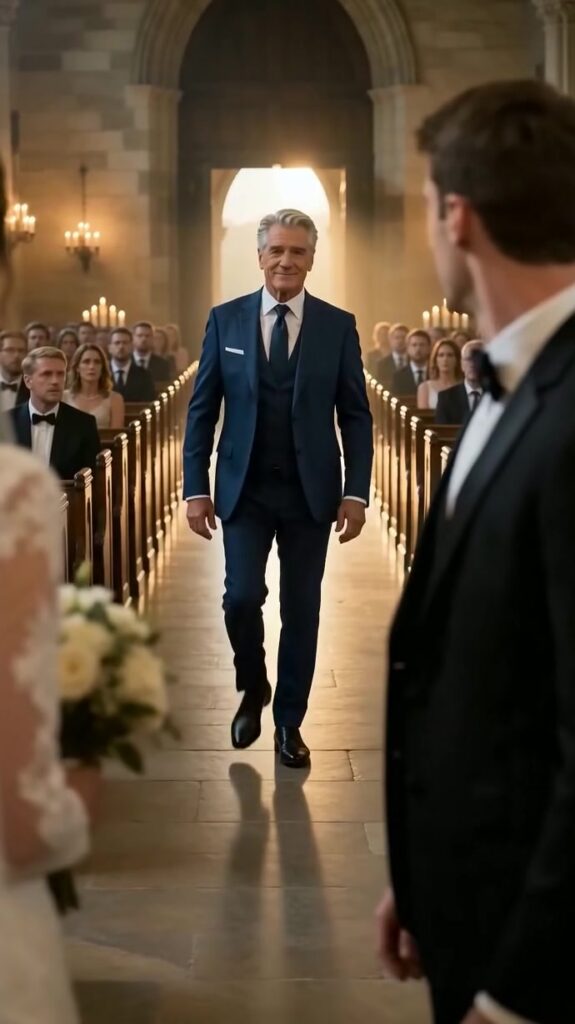
The church was so quiet you could hear the bride’s breath shaking under her veil. It threaded through the vaulted air like a confession—small, uneven, impossible to hide. Every candle flame held still. Even the organist’s hands hovered above the keys as if sound itself might be a kind of sin.
Clara stood at the altar in borrowed lace that fit her like hope, her fingers locked around a bouquet of white lisianthus and bruised-blue hydrangea. The stems bit into her palm. She welcomed the sting; it anchored her to the moment. Her eyes were already wet, not from joy exactly, but from the cruel mix of wanting something and being terrified it would vanish if she blinked.
The sanctuary was full. Faces she didn’t know filled the pews—friends of the groom, men in expensive suits, women in tailored dresses and pearls that caught the light like tiny watchful eyes. Clara’s own side was sparse: her aunt with her worn handbag clasped like a rosary, her former professor who’d cried when Clara got her scholarship, two nurses from the hospital where she worked nights. They sat close, shoulders squared, smiling too hard as if determination could make a miracle feel inevitable.
At the altar, Michael’s hand rested on top of hers. His fingers were cool, his grip practiced. He looked handsome in his charcoal suit, jaw set with the kind of confidence that made people step aside on sidewalks. Clara had met him at a gala she hadn’t belonged at—there to serve cocktails, there to disappear behind trays. He’d found her by the service door, smiling as if she were the only person in a crowded room. He’d said her name like it was a secret worth keeping.
When the officiant asked for the rings, Clara’s pulse surged. She lifted her chin beneath the veil. This was it. The moment that would stitch her hard years together into something new, something bright.
Michael leaned in, and for an instant Clara thought he was going to whisper something tender—some last reassurance that she’d been safe all along. But his voice arrived without warmth, and his hand moved with a quick, sharp motion.
He pushed the bouquet back into her hands as if it had offended him.
Clara blinked. The flowers bobbed violently; one petal detached and drifted to the floor, turning slowly like a leaf in a pond.
Michael stepped half a pace away, not enough to make a scene, but enough to make her feel suddenly alone. His lips curved in something that wasn’t a smile.
“You really thought I would marry a poor girl like you?” he said, loud enough for the front rows to catch every syllable.
A soundless shock rippled through the pews. Clara’s mind tried to find the joke and couldn’t. Her lips parted. No words came. The air turned thick and hot beneath her veil. Her breath caught on itself, snagging in her throat like cloth on a nail.
Michael’s laugh clicked against the stone walls, bright and cold. “I only used you.” He looked at the guests as if inviting them to share in the punchline. “It made a good story. The saintly executive with the charity case bride. People eat that up.”
Clara stood frozen, bouquet trembling so violently petals loosened and fell in a quiet rain. A few guests exchanged glances; one woman lifted a manicured hand to her mouth, then lowered it again, as though scandal required decorum. Clara’s aunt made a small sound, but it died in her chest. No one stood. No one spoke.
Clara’s face burned. Tears squeezed past her lashes and slid down her cheeks, catching on the edge of her veil. Her throat tightened. She swallowed hard, tasting salt and humiliation. She wanted to turn and run, but her legs refused to move, the aisle suddenly longer than any road she’d ever walked.
Michael watched her with the bored attention of someone inspecting a purchase he’d already decided to return. “Don’t look so shocked,” he murmured, softer now, for her alone. “You knew what you were. Convenient.”
Clara’s hands shook around the bouquet. She thought of the nights she’d fallen asleep in her scrubs on her apartment floor because her bedframe had snapped and she couldn’t afford a new one. She thought of the way Michael had insisted on paying for everything, the way he’d said, You deserve to be taken care of. She thought of how she’d tried to protest, and how he’d smiled until she gave in, because it felt like love.
She tried to speak. Her voice broke before it became a word.
Then the heavy church doors groaned open.
The sound wasn’t loud, not compared to Michael’s laughter, but it carried in the hush like thunder. Light poured in from behind the figure in the doorway, turning dust into gold. Every head turned as if on a hinge.
An older man stepped inside—silver hair neatly combed back, a navy suit cut to fit as if stitched from authority itself. He walked slowly down the aisle, not hurried, not hesitant, as if time belonged to him and always had. His gaze didn’t flick to the guests. It didn’t pause at the altar. It went straight to Clara, steady and intent, as though he were crossing a great distance to reach her.
Clara’s breath stalled. She knew that face, though she hadn’t seen it in years. She’d once known it in the harsh light of a foster home kitchen, leaning down to tie a child’s shoelaces. She’d known it from the corner of a newspaper photo: a businessman donating an absurd check to a children’s shelter, his smile restrained, his eyes tired.
He stopped at the front pew, then climbed the steps to the altar without asking permission. The officiant, pale as the lilies, took one step back as if making room for something inevitable.
The man’s voice was gentle. It carried love in it, a love so plain it seemed out of place among the marble and lace.
“Sorry I’m late, sweetheart,” he said.
Clara turned so quickly her veil shifted, the comb tugging at her hair. Her whole face changed—heartbreak giving way to shock, as though someone had yanked her out of a nightmare by the collar.
“Mr. Harrow?” she whispered. Her fingers loosened around the bouquet, and it nearly fell.
Michael’s confidence cracked like thin ice. His face drained until even his lips looked bloodless. “Boss…?” he choked out, the word scraping his throat. He stared at the older man as if seeing a ghost step off a boardroom wall.
The man—Elias Harrow—moved closer to Clara and placed a steadying hand at her elbow, careful not to smudge her gown, careful as if she were something precious and breakable. His eyes softened as he looked at her, and for a moment the sanctuary seemed to breathe again.
“Clara,” he said quietly, as if reminding her she was real. “You don’t have to stand here alone.”
Her tears surged, but something changed in them—less shame, more relief. “You knew…?” she managed, the words trembling out. “You knew he would—”
Elias lifted his gaze from her to Michael. The warmth in his expression didn’t disappear; it simply withdrew, like light leaving a room. What remained was calm, and it was more frightening than anger.
“I didn’t know,” Elias said, each syllable placed with care, “that you would be foolish enough to humiliate someone you thought had no one.”
Michael swallowed. His Adam’s apple bobbed. “Sir, I can explain—”
Elias’s hand rose slightly. The gesture was small, but it stopped Michael mid-breath. “You will,” he said. “Privately. Later. In the presence of people whose job depends on truth.”
Clara stared at Elias as if the world had been rearranged. “Why are you here?” she whispered, fear and wonder tangled together.
Elias’s gaze returned to her, and the gentleness came back, startling in its steadiness. “Because ten years ago,” he said softly, “a little girl in a shelter handed me her half-eaten apple and told me I looked lonely. Because she grew up and never asked me for anything. Because she invited me to her wedding and wrote in the corner of the envelope, ‘You once said if I ever needed family, I could call.’”
Clara’s throat tightened. “I didn’t think you would come.”
“I promised,” he said. Then, with a glance toward the silent pews, “And I don’t like promises broken.”
Michael’s voice came out thin. “This is ridiculous. She’s nobody. She’s a nurse with loans and—”
Elias turned fully toward him. “She is the person you chose to weaponize in front of a room full of cowards,” he said, and his calm sharpened. “That makes her somebody. And it makes you—” He paused, as if selecting a word that wouldn’t stain Clara’s day further. “—unfit.”
The guests shifted. One man coughed. A woman’s pearl earrings trembled as she turned her head, finally looking at Clara with something like shame.
Elias held out his arm to Clara. “Come with me,” he said, voice low. “Not because you’re running. Because you’re leaving.”
Clara looked down at her bouquet, crushed now, petals scattered like fallen snow around her feet. She had walked into the church believing love was something given by someone stronger. She realized, in the hush, that love could also be a door held open.
She slipped her hand around Elias’s arm. Her fingers were cold; his sleeve was warm. She took one step. Then another. The lace at her wrists fluttered. The veil swayed like a curtain finally drawn back.
Behind her, Michael made a strangled sound—half rage, half panic. “You can’t do this!”
Elias didn’t turn. “Watch me,” he said, quiet as prayer.
And as Clara walked down the aisle, past faces that had refused to move for her, she heard something else beneath the silence: her own breathing, steadier now, no longer shaking. Not because she had become unbreakable—but because someone had finally arrived and stood beside her as if she had always been worth saving.
Outside, the light was blinding. Clara blinked, and the tears on her cheeks dried in the air like something finished. She didn’t know what would happen next—what stories would be told, what consequences would fall like dominos behind the church doors.
But she knew this: the moment meant to destroy her had opened into an exit. And when Elias guided her down the steps, his hand steady at her back, Clara felt the shape of her life shifting—not into a fairy tale, not into easy happiness, but into something truer.
She was not a punchline.
She was not alone.
And the quiet church behind her had finally, unmistakably, learned the sound of a bride leaving on her own terms.