The cobblestone street glowed under warm string lights and old yellow street lamps, as if the stones had been heated from below by the day’s last breath. The alleyway was narrow, stitched between a bakery that smelled like melted sugar and a shuttered bookshop whose windows reflected the lights in wavering gold. In that soft, forgiving glow, even chipped stones looked polished, and even strangers looked like they belonged to one another for the length of a song.
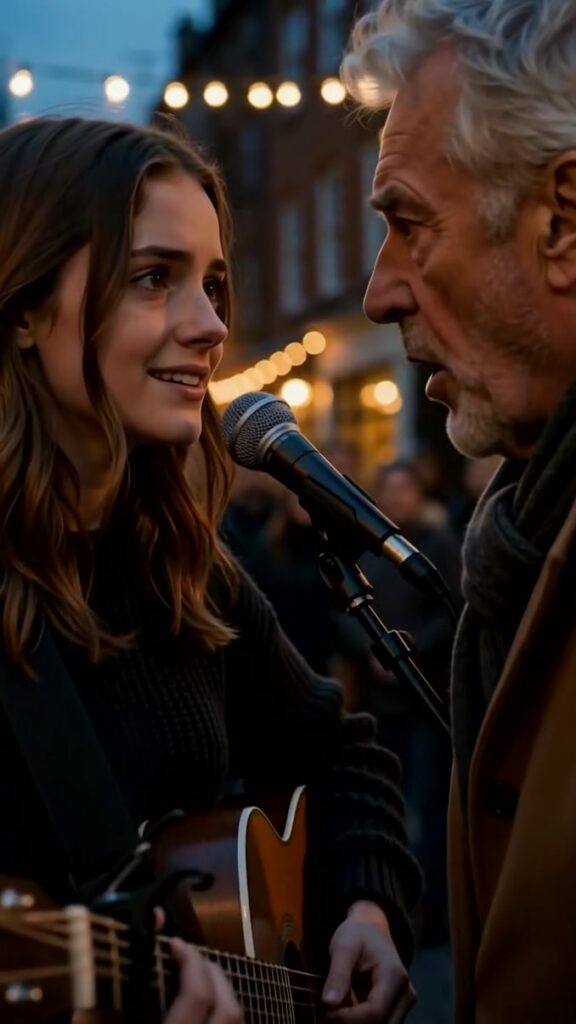
Mara stood on a small wooden crate that someone—no one ever knew who—dragged out each evening for buskers. Her black sweater was too thin for the cold, but she clung to the warmth of the guitar pressed against her ribs. The instrument was scuffed along its edge, the wood dulled by years of hands. She’d inherited it the way some people inherited family rings: wrapped in a blanket, heavy with stories no one told.
A half-circle of listeners gathered close enough to hear but far enough to pretend they were only passing through. A couple held hands in their coat pockets. A teenager in a knit cap recorded without looking at his screen. An elderly woman clutched a paper bag of pastries and stopped chewing to listen. The air smelled like cinnamon and damp stone.
Mara’s eyes were shut as she reached the final verse. She sang it the way her mother had always sung it—soft at first, then rising like a wave that knew it would break. Her voice shook on the last line, not because she performed sadness well, but because she carried it. She sang as if she were calling someone across water.
“Come back home to me…”
The last chord thinned out into the street until it was swallowed by traffic far away and the faint hiss of a coffee machine behind a door. For a heartbeat the crowd stayed suspended, unsure whether sound would ruin what had just happened. Then a few people clapped, careful and small, the way you might applaud in a hospital corridor.
Mara opened her eyes. She leaned toward the microphone and gave them the smile she practiced for strangers—gentle, grateful, distant enough to keep her safe. “Thank you,” she murmured.
Then she saw him.
He stood near the back where the alley widened into the main street. An older man in a brown coat and a scarf wound tight around his neck, as if he expected the cold to strike like a blade. He didn’t clap. He didn’t even breathe correctly. His face was rigid, but his eyes were wet, shining under the lamps with a rawness that looked out of place among the casual listeners.
It wasn’t the look of a fan. It was the look of someone who had been pulled without warning into a room he’d locked for years.
Mara’s smile faltered. The man began to move toward her, slow as tidewater. Each step seemed to cost him something. People parted without speaking, a silent seam opening in the crowd. The laughter from the café nearby dimmed. Even the bakery’s doorbell stopped ringing. The alley itself felt as if it were listening.
He stopped in front of her, close enough that Mara could see the creases in his hands and the reddish marks where his scarf had rubbed his skin. The guitar’s body pressed harder against her, a shield that suddenly felt inadequate.
For a long second neither of them spoke. Mara heard her own pulse, the small crackle of the microphone, the faint buzz of the string lights overhead.
His voice, when it came, was low and frayed at the edge. “I’m sorry… that song.” He swallowed as if the words were too large. “Where did you learn it?”
Mara tightened her fingers around the neck of the guitar. Her confusion sharpened into unease. People asked about songs all the time. But no one asked like that—like the melody had opened a wound.
“My mother,” Mara said quietly. “She sang it to me when I was little. When I couldn’t sleep.”
The man’s expression changed in a way that made Mara’s stomach drop. It wasn’t recognition exactly. It was the collapse of a barricade. His mouth parted. His eyes filled more, and he blinked too slowly, as though he didn’t trust himself not to vanish if he closed them too long.
He took the smallest step closer. “What was her name?”
The question landed like a stone in water. Names were not souvenirs. They were keys.
Mara stared at him, really stared. There was something familiar in the angle of his jaw, the shape of his brow, the way he held himself as if expecting blame. Familiar in a way she’d seen only in mirrors and photographs that never told the whole truth.
Her throat tightened. Her mother’s name had been both a lullaby and a locked door in their house. Spoken rarely. Guarded always. A name that could make her mother’s face soften with love and harden with fear in the same breath.
The crowd had gone silent, the half-circle now a still life. Someone’s phone lowered. The elderly woman’s pastries sagged in their bag. Even the teenager forgot to record.
Mara’s lips trembled. She felt suddenly eight years old again, listening to her mother hum in the dark, pretending the outside world couldn’t reach them.
“Her name was Eli—” she began, and stopped, as if the rest might scorch her tongue.
The man flinched. The sound he made wasn’t quite a sob, more like a breath that had been held for decades and released too fast. “Elinor,” he finished for her, barely audible. “They called her Eli.”
Mara’s hands went numb. “You… you knew her?”
He nodded once, sharply, as if that single movement might fracture him. “I wrote that song,” he said. “Not alone. With her. In a rented room above a tailor’s shop. We were young and very sure we could outrun anything.”
Mara’s mouth went dry. Her mother had said the song was old. She’d never said it was hers.
The man’s eyes searched Mara’s face with a terrible hunger, as if he could piece together the past by examining the present. “She’s—” He couldn’t finish. “Is she alive?”
Mara’s vision blurred. The streetlights haloed. “She died three years ago,” she whispered. “Cancer. She… she didn’t tell many people. She didn’t want anyone to come looking.”
The man’s shoulders sagged, as if a cord inside him snapped. He pressed his palm to his mouth and looked down at the cobblestones, at the gold light puddled between the stones. When he spoke, his voice sounded like it had scraped against gravel. “She left without a word,” he said. “One day she was there, the next day the room was empty. I spent years thinking I’d done something unforgivable. Then I told myself she was safer without me. I built a whole life out of that lie.”
Mara shook her head, frantic. “She was scared,” she said, the words spilling out before she could control them. “She said there were people who wanted to take her music. People who wanted to own her. She said she couldn’t trust anyone, not even—” She stopped. Her mother’s warnings had always ended there, like a sentence cut with scissors.
The man looked up. “Not even me,” he said softly, not accusing, just devastated by the shape of it. “Did she ever…” He glanced at the guitar, at Mara’s fingers on the frets. “Did she ever tell you who I was?”
Mara’s chest felt too small for her heart. She thought of the envelope she’d found after the funeral, hidden under a false drawer. Her mother’s handwriting on the front: FOR MARA, WHEN YOU’RE READY. Inside had been a photograph of a younger Eli with a man who looked startlingly like the one standing here now, their foreheads touching, laughter caught mid-flight. And a letter that began with an apology and ended with a name: Jonas Hale.
Mara swallowed. “She did,” she said, and the crowd collectively held its breath. “But only at the end. She said you were… my father.”
Jonas made a sound like the world had tipped. His eyes shut, and tears escaped anyway. He reached out, stopped halfway, his hand hovering as though touching her might be a crime. “Mara,” he repeated, tasting the name as if it were sacred. “She named you Mara.”
Mara’s own tears slid hot down her cheeks. She hated how quickly her body believed him. How quickly something inside her leaned toward him like a compass finding north.
“Why didn’t you come?” she asked, the question breaking apart as it left her.
Jonas’s jaw tightened. “I looked,” he said. “God, I looked. I found a trail of false addresses and closed doors. And then… I stopped. Because every year that passed made me more certain that showing up would only hurt her.” He stared at the guitar again. “But that song… it’s not just a song. It’s a map. It was our promise. I never thought I’d hear it again.”
Mara wiped her face with the back of her sleeve, angry at herself for crying in front of strangers, furious at the strangers for witnessing it, furious at her mother for burying the truth and at herself for wanting it anyway. “I don’t know what to do with you,” she said honestly.
Jonas nodded, accepting the sentence as if it were deserved. “You don’t have to do anything,” he said. “I only needed to know it was real. That she was real. That you’re real.” He drew a shaky breath. “May I—” His gaze flicked to the guitar. “May I hear it again? Not for me. For her. The way she meant it.”
Mara looked down at the worn wood, at the tiny dent near the soundhole where her mother’s ring used to tap in rhythm. She imagined Eli in some small room above a shop, young and fearless, writing a song that could travel farther than any of them. She imagined her mother choosing silence, choosing distance, choosing a life where Mara would grow without shadows—only to leave her with this one glowing thread back to the past.
Mara adjusted the strap on her shoulder. She leaned into the microphone, not smiling now, not performing. Just breathing. The crowd didn’t move. The alley held its light like a held candle.
She began to play, and the first notes fell onto the cobblestones like rain on warm stone. Jonas stood very still, hands at his sides, as if any motion might shatter the moment. Mara sang with her eyes open this time, watching his face as the song reached for the place in him that had been broken and waiting.
And as her voice steadied, the street seemed to brighten—not because the lamps changed, but because something long lost had finally been found, trembling and imperfect, in the narrow space between two lives that should have met sooner.
When she reached the final line, she didn’t whisper it into the night as a plea. She sang it as an answer.
“Come back home to me.”