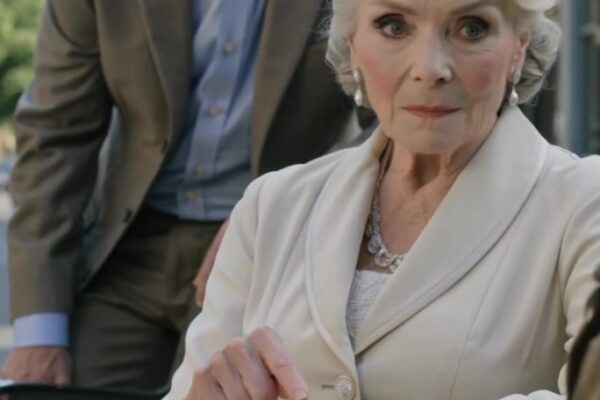
The bell above the door did not ring so much as sigh, a soft breath of sound that felt too polite for the street outside. Warmth wrapped the boy the moment he stepped in, the kind that belonged to old buildings and careful people. Amber lamps cast a honeyed glow over glass cases where diamonds sat like trapped starlight. The air smelled faintly of cedar and metal polish, and beneath that, a ghost of lavender that made him think of clean linen—something his apartment never quite managed.
He hovered just inside the threshold, hands tucked into the short sleeves of his worn gray shirt like he could hide his trembling there. The city’s noise thinned behind the glass window—horns, footsteps, a distant siren—until it became a muffled reminder that the world was still moving even when his had stopped.
He had rehearsed what to do. Walk to the counter. Put it down. Don’t beg. Don’t cry. Don’t look like a thief. Still, the shop’s beauty made him feel like an intruder in a museum. His sneakers squeaked on the polished floor, and the sound seemed loud enough to crack the display cases.
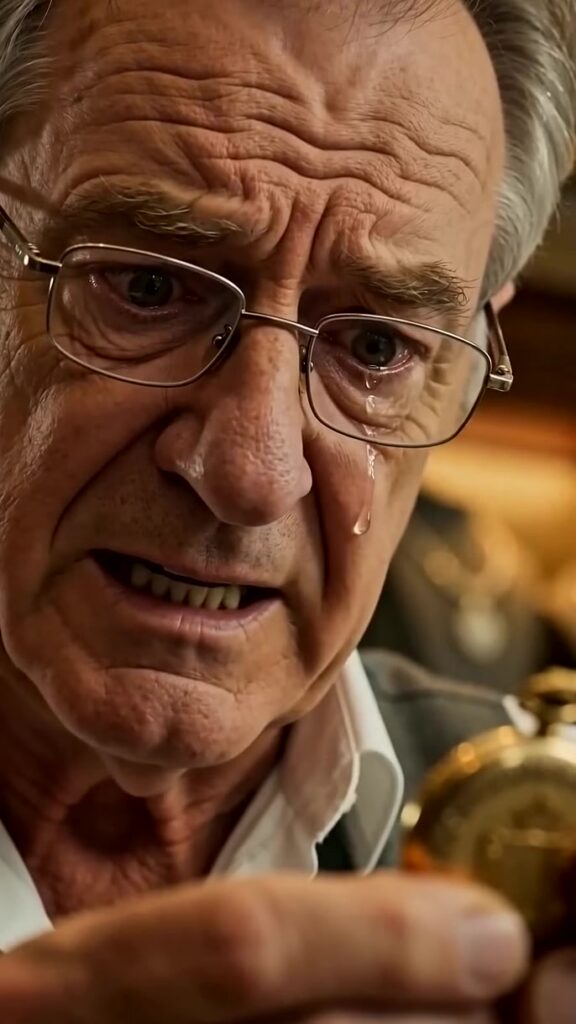
Behind the counter stood an old man with thin silver hair and rectangular spectacles. He was adjusting a tiny chain beneath a magnifying lamp, his fingers steady as if the world had never asked him to hurry. He did not look up immediately. The boy’s heart hammered, and he took that moment—the jeweler’s mild inattention—as permission to breathe.
Then he crossed the shop in a straight line, as if bending his path would make him lose courage. He climbed onto his toes and set a small gold pocket watch on the glass counter with both hands. The metal made a gentle click, but the sound landed with weight, like a coin dropped into a deep well.
The jeweler’s eyes rose. They moved from the watch to the boy’s face, then back again, as if measuring the space between them. “That’s a fine piece,” he said softly, voice worn smooth by years of speaking gently in expensive rooms. “Where did you get it?”
The boy swallowed. His throat felt sanded raw from nights of waking up to his mother’s coughing. “My mom,” he whispered. “She’s sick. She said… she said I should sell it. We need medicine.” The words came out in a rush at the end, as if he could shove the fear through the gap of the jeweler’s sympathy and it would become something else on the other side.
The old man reached toward the watch with care that bordered on reverence. He did not snatch. He did not assume. His fingers hovered a moment before touching the metal, as if asking permission from the object itself. He turned it over once, slow enough that the boy could see the engraved back catch the light.
The jeweler’s face changed—just a flicker, the smallest betrayal of composure. His mouth tightened, then relaxed. He angled the watch toward the lamp. The boy tried to read the engraving upside down: letters worn by time, a name perhaps, a date. But the script was too fine and his eyes too full.
“May I?” the jeweler asked, not looking up. His thumb moved to the clasp.
The boy nodded, though his whole body wanted to reach out and pull the watch back, to keep it as a talisman against bad days. It was the last thing his mother owned that seemed to belong to a life before hunger and illness.
Click.
The lid sprang open. The jeweler’s breath stopped as if someone had pushed a hand against his chest. Inside, tucked behind the inner cover, was a tiny photograph, faded at the edges and browned with age. The boy had never looked at it closely; his mother had kept the watch in a cloth pouch and had always snapped it shut if he asked to see. He’d assumed it was just decoration, another secret adults held tightly.
But the jeweler stared at the picture as though it had come alive. The muscles along his jaw quivered. His eyes glossed, then flooded, and a tear slipped down the crease of his cheek with humiliating speed, as if grief had been waiting a long time to find a door.
Silence thickened the shop. Even the street noise seemed to pull back, respectful or afraid.
“Where,” the jeweler said at last, each syllable breaking slightly, “did your mother get this?”
The boy blinked, thrown. “She… she always had it.”
The old man’s shoulders lowered a fraction, as if the answer had cut a cord holding him upright. He leaned over the counter, closer now, his gaze leaving the photo and fastening on the boy’s face. Not the general face—the specific one. The shape of the boy’s eyes. The angle of his nose. The small crescent scar near his left eyebrow that looked strangely familiar.
“I made this watch’s casing,” the jeweler whispered, voice hoarse. “I commissioned the engraving for my daughter. Eighteen years ago, I put it in her hands the day she left this shop. She never came back.”
The boy’s mind refused to take the sentence in. It was too large, like trying to swallow the sky. He shook his head once, a tiny denial. “No. My mom… she’s not—” He didn’t know what he was denying: that his mother was someone else, or that his life had been leaning against a lie.
The jeweler’s fingers trembled around the open watch. He turned it slightly, revealing the inside of the lid where the engraving continued, finer than the outside. “Elena,” he murmured, the name like a prayer he’d stopped saying out loud. “My Elena.”
“My mom’s name is Lena,” the boy said, as if offering a small correction could keep the ground from splitting. “Just Lena.”
The jeweler closed his eyes briefly. When he opened them, they were fierce with a tenderness that hurt to look at. “Names get shortened,” he said. “Lives get hidden. Tell me—does she have a scar on her right hand? Between the thumb and finger?”
The boy stared. He saw it instantly: the pale line that crossed his mother’s hand, the one she covered with bandages when it cracked in winter. “Yes,” he breathed. “From… from broken glass. She said it happened when she was young.”
The old man’s face collapsed into grief and recognition at once. He reached out, stopped, and then placed his palm flat on the counter as if anchoring himself. “It happened here,” he said. “She cut herself helping me sweep a shattered case. She cried because she thought I’d be angry. I kissed her hand and told her she was braver than most adults.” His voice wavered. “I have told that story to myself every time I thought I heard her footsteps in the street.”
The boy’s eyes burned. He had come to trade away metal for pills. He had not come to learn he might be standing across from blood. “Are you saying…” He couldn’t finish. The words were too dangerous.
The jeweler leaned even closer, and for a moment the boy saw not an old man but a father trapped in the instant before hope becomes heartbreak. “Boy,” he said, the single word trembling with all the questions he was afraid to speak. Then he steadied himself with a breath that sounded like surrender. “What is your name?”
The boy’s voice shook. “Milo.”
At that, the jeweler flinched. His eyes dropped to the photograph again, and when he turned it toward the boy, Milo saw it clearly for the first time: a young woman with dark hair, smiling shyly, her arm around an older man in a work apron. The man’s eyes were the same shape as Milo’s. Not identical—time had carved new lines—but unmistakably kin.
The jeweler touched the edge of the photo with the softest part of his finger, as though he could feel the past through paper. “She wrote to me once,” he said. “A letter without a return address. Only one sentence. ‘If I ever have a child, I will name him for the quiet kindness you showed strangers.’” His throat worked. “My father’s name was Milo.”
The boy’s breath came in jagged pieces. The shop around him blurred: the gold, the glass, the warm lights, all turning watery. “I just need medicine,” he said, as if repeating the purpose could keep him from falling into this new abyss.
The jeweler’s eyes lifted, clear now with decision. He closed the watch gently, like shutting a fragile door, and slid it back across the counter—not away, but toward Milo, as if returning a piece of him. “You will not sell this,” he said. “Not today. Not ever. Tell me where you live. Tell me what doctor you’ve seen. Tell me what she needs.”
Milo hesitated. Trust had never been easy; poverty taught him that promises were often bait. But the old man’s hands were still shaking, and his grief looked too real to be a trick. “She’s in bed,” Milo whispered. “She can’t go outside. She says it’s just a bad fever, but… it’s been weeks.”
The jeweler stepped out from behind the counter, moving with surprising speed for someone his age. He reached for a coat hanging on a hook and grabbed his keys. Then he paused, and his gaze softened in a way that made Milo’s chest ache. “You did the bravest thing a child can do,” he said. “You walked into a place you thought you didn’t belong and asked for help.”
The bell sighed again as the jeweler held the door open. The street’s noise rushed back, cold and sharp. Milo clutched the pocket watch in his fist, its warmth transferred from the shop to his skin. He followed the old man out, stepping from beauty into chaos, carrying a secret heavier than gold and a hope that frightened him more than hunger ever had.
Behind them, the lights in the quiet shop continued to glow, as if keeping vigil for a daughter who might, at last, be found.