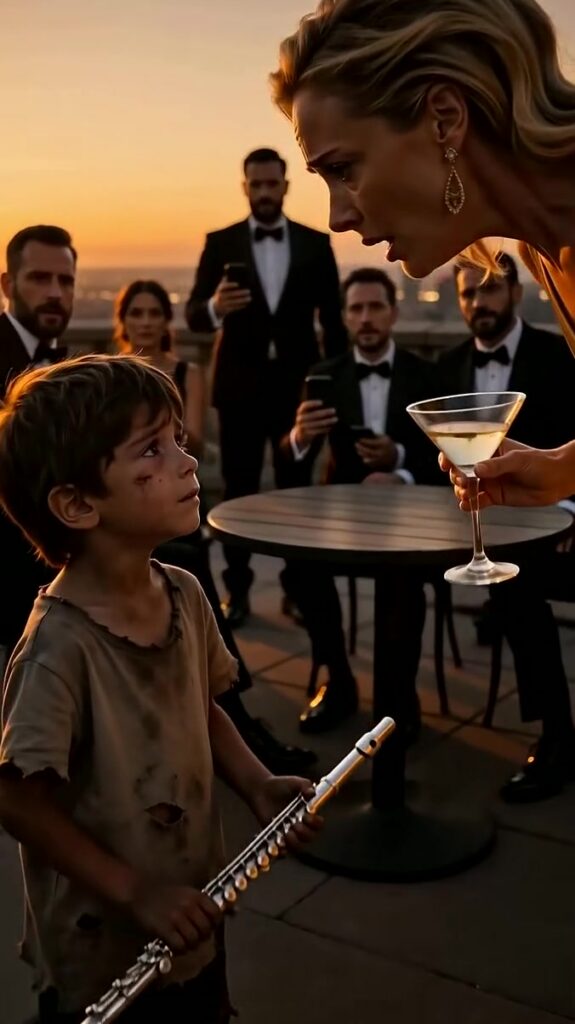
No one invited the child to the rooftop, yet there they were—bare feet on warm stone, a frayed shirt fluttering in the high wind, and a silver flute held with the careful reverence of a relic. The terrace was a stage for the city’s polished people: champagne sweating in tall flutes, lenses lifting toward a sunset engineered by money and timing, laughter arranged like flower centerpieces.
When the first note sounded, it did not belong to any playlist. It came clean and thin through the air, a single phrase that seemed to slice open the rooftop’s comfort and let something colder climb out. Conversations snagged mid-syllable. Photographs stuttered. Even the skyline looked suddenly like a painted backdrop.
At first, the guests smiled as if it were performance. Someone murmured about “street talent,” and a few chuckled, too relieved by the idea that everything had an explanation. But a woman in a gold dress—Elena Marlowe, whose name had purchased half the evening—did not smile. The phrase on the flute was not simply beautiful. It was familiar in a way that made her stomach drop.
Her chair scraped the stone as she stood. She did not care that heads turned; she did not care that her bracelets rang like alarm bells. Her eyes fixed on the child’s hands, on the way the fingers moved with practiced certainty, on the tiny nick near the flute’s lip plate that she recognized like a scar on a loved one.
“That melody,” Elena breathed, as if saying it too loudly might break what was left of her world. She crossed the terrace, each step swallowing the glittering noise behind her. “Who taught you that?”
The child lowered the flute. Wind pushed hair across their forehead. Dust clung to their ankles, and on one cheek a red imprint bloomed—an angry mark that told a story without words. Their gaze did not flinch, though their mouth trembled once, as if deciding whether truth was worth the trouble it always brought.
“She did,” the child said. Their voice was small, but it did not waver. “My mom.”
Elena’s breath caught hard enough to hurt. “Who?” she asked, though she already feared she knew. The city’s lights were coming on one by one behind the child, and each new point of brightness seemed to emphasize the dark in Elena’s chest.
“Anna,” the child answered.
It was the simplest name in the world. On Elena’s tongue, it tasted like ash. Her glass slipped from her hand and struck the terrace, shattering into a bright scatter of fragments. No one moved. It wasn’t the breaking crystal that silenced the rooftop; it was the way Elena’s face drained of color, as if the sunset had stolen it.
A man near the bar cleared his throat and offered a nervous laugh that died immediately. Someone whispered, “Coincidence,” but their own voice did not sound convinced.
Elena crouched in front of the child, carefully, as if approaching a frightened animal. She extended one hand and stopped short of touching. The child’s grip tightened around the flute, knuckles blanching. Elena noticed then: the flute was too clean for the child’s clothes, too well cared for, as though it had been hidden under a shirt and polished with love.
“Anna… what?” Elena asked. She could not say the surname. To speak it would make it real, and reality was a thing her life had always been designed to keep out.
The child hesitated. Their eyes flicked across the rooftop, searching faces that looked away. “I don’t know,” they admitted quietly. “She didn’t like the papers. She just said Anna. She said if I ever got lost, I should play that, and the right person would hear it.”
Something fractured inside Elena at the word lost. Years ago, an Anna had been lost. Not misplaced, not misunderstood—vanished. A woman who taught music at a community center, who carried a silver flute in a soft cloth and laughed with her whole body, who had left one night after Elena called her in tears and said she was ready to stop being afraid.
Elena had waited at a café at street level—safe, anonymous. Anna had never arrived.
A voice cut through the hush like a blade drawn from a sheath. “That’s enough.”
Elena turned. At the far end of the terrace stood her husband, Victor Marlowe, framed by the last bright strip of sun. His suit was perfect. His expression was the calm of someone who believed he owned every room he entered. In one hand he held a flute case—silver-edged, with a worn leather handle—so familiar that Elena’s vision blurred.
The child saw it too. Color left their face. For a heartbeat, they looked like they had forgotten how to breathe.
Elena’s mouth opened, and no sound came out. Her eyes went from the case to Victor’s hand to the faint scar along his thumb—an old cut she’d once asked about and been told it was nothing, a careless accident with a kitchen knife. She realized, with an icy clarity, that her life had been built on answers given too smoothly.
Victor walked closer, unhurried, as if strolling through his own home. Guests parted instinctively. He stopped beside Elena and looked down at the child with mild interest, the way a collector appraises an item he thought he’d misplaced.
“You’re making a scene,” Victor said to Elena, soft enough that it sounded almost affectionate. Then his gaze returned to the child. “You shouldn’t be here.”
The child’s lips moved, barely forming words. “That’s… my mom’s.” Their voice cracked on the last word. “She said it was mine someday.”
Victor’s smile did not reach his eyes. “Your mother said many things,” he replied. The breeze lifted a corner of the tablecloth and rattled the silverware like nervous teeth.
Elena forced herself to stand. Her knees threatened to buckle, but anger—bright and sudden—caught her spine and held it upright. “Where is she?” Elena demanded. “Where is Anna?”
Victor tilted his head as if considering which truth would be most convenient. The guests watched with the tense fascination of people who knew they were witnessing something they would later pretend not to remember.
“Anna is… not a problem anymore,” Victor said. He held the matching case up, letting the terrace lights flash along its edge. “I told her to stop writing you. I told her to stop imagining she could have a life that didn’t belong to her station. She didn’t listen.”
The child’s eyes shone with tears, but their posture stayed strangely steady, like someone who had practiced holding themselves together through worse. “She listened to me,” the child whispered. “She said music is how you tell the truth when people don’t let you talk.”
Victor’s gaze hardened. His voice lowered, meant for the child alone—and yet it carried. “You should’ve stayed quiet,” he said, each word crisp as snapped thread, “just like your mother.”
Elena made a sound then—half a gasp, half a broken laugh—because the sentence clarified everything. It wasn’t just that Anna had disappeared. It was that Victor had ensured she would. And he had said it here, on a rooftop full of witnesses, because he believed witnesses were harmless if they were wealthy enough to value comfort over conscience.
Elena’s hand rose, not to strike him, but to steady herself against the vertigo of understanding. She looked around at the guests: faces painted with concern, curiosity, calculation. She saw people who had donated to children’s hospitals and posted about justice, people who would still accept Victor’s invitations next month if given the chance.
Her eyes returned to the child. The red mark on their cheek glowed like a warning. Elena took off her gold shawl, trembling, and draped it around the child’s shoulders. This time she did touch them—lightly, at first, then with a firmer grip when she felt how thin they were beneath the cloth.
“What’s your name?” Elena asked, her voice hoarse with effort. She kept her gaze on the child as if Victor were suddenly invisible.
“Mara,” the child said after a pause, as though testing whether it was safe to offer even that.
Elena nodded once, decisively, a small movement that felt like the first honest thing she’d done in years. “Mara,” she repeated. “You’re not alone.”
Victor gave a quiet, amused exhale. “Elena,” he warned, the way one warns a pet at the edge of a road. “Don’t embarrass yourself.”
Elena turned her head just enough to meet his eyes. “You already did,” she said. Then, louder, to the rooftop at large: “Someone call the police.”
A shock ran through the guests. People looked at each other, waiting for permission, waiting for someone else to be brave first. Victor’s smile tightened. “You think they’ll come?” he asked softly. “Do you think they’ll take your word over mine?”
Elena reached into her clutch with fingers that no longer shook. She pulled out her phone—not to dial, but to open a hidden folder she had never dared to look at for long: old messages Anna had sent before the silence, screenshots Elena had saved like guilty charms, voice notes filled with fear. For years she had told herself they meant nothing, that they were melodrama, that Victor would never—
But now the child stood beside her with a flute like evidence, and Victor stood across from her with the matching case like a confession.
Elena pressed record and held the phone between them, angled so the tiny red light faced Victor. “Say it again,” she said, her voice turning steel. “About her being ‘not a problem.’ About what you told her.”
For the first time, Victor hesitated. The rooftop’s silence sharpened. Even the city’s hum seemed to lean in.
Mara lifted the flute again—not to perform for the party, but to anchor themselves. A single note trembled into the air, fragile and defiant. It was not the melody that had summoned Elena; it was a new sound, a thread of breath that insisted on being heard.
And in that moment Elena understood: the rooftop had been built for spectacle, but truth had climbed up anyway, barefoot and uninvited, and it was not leaving quietly.
Victor’s gaze flicked around at the guests, at the phones now rising not for sunsets but for him. His carefully arranged world shifted on its foundations. He took a step forward, and Elena stepped with Mara, placing her own body between the child and the man she had once mistaken for safety.
“No one invited you here,” Victor said to Mara, voice tight.
Mara met his eyes. Their hands did not shake on the flute. “My mom did,” they replied.
The terrace lights brightened as the sun vanished completely, and for the first time all evening, the rooftop did not feel like a celebration. It felt like a courtroom that had finally decided to convene.