The café terrace was full of golden light and expensive calm. It pooled on the linen tablecloths and slid along the rims of glasses like a promise. Above, plane tree leaves whispered in a practiced hush. The clientele wore their ease the way they wore their watches—quietly, confidently, as if comfort were a moral virtue. Spoons tapped porcelain. Marble held the last heat of day. The city beyond the terrace felt distant, softened by the hour that makes even hard streets look forgiving.
Lena sat alone at a corner table, framed by a hedge that smelled faintly of lemon. The black dress she’d chosen was too severe for summer, but she’d worn it anyway—armor disguised as elegance. She pretended to read the menu, though she already knew what she would order: espresso, unsweetened, no indulgences. Indulgences were how people got hurt. Across the terrace, a man laughed too loudly, then lowered his voice as if remembering the rules of this place. Lena’s phone lay beside her saucer, face down, as though hiding could change what it contained.
She was thinking about anniversaries. Ten years had a way of turning grief into a tidy story other people expected you to tell. Her family had made theirs sound respectable: Miriam, older sister, bright and reckless, seduced by a job offer, vanished somewhere between a signed contract and a train platform. “A misunderstanding,” her father had insisted for years, even as the police shrugged and the papers stopped calling. Lena had been nineteen then, young enough to believe answers were owed to her. Now she was twenty-nine, and she’d learned the world paid in silence.
The waiter arrived with her coffee. The cup was white and flawless, the kind that made even bitterness seem refined. Lena wrapped her fingers around it, absorbing its warmth, staring into the dark surface. She told herself she was here because she deserved one hour of stillness. She told herself she was not watching the walkway beyond the hedge, the narrow strip where pedestrians passed in fleeting fragments—hands, shoulders, the hem of a coat. Stillness, she reminded herself. Nothing ugly can reach you here.
Then something small and rough brushed her hair.
The contact was light, almost hesitant, but Lena jerked back so sharply her chair scraped stone. Her coffee sloshed, a dark crescent leaping toward the saucer. For a moment, the terrace’s music—clicking cutlery, the low murmur of moneyed conversation—tilted and thinned. Lena’s heart punched once, hard. She spun toward the intrusion, anger arriving to cover fear the way a blanket covers a wound.
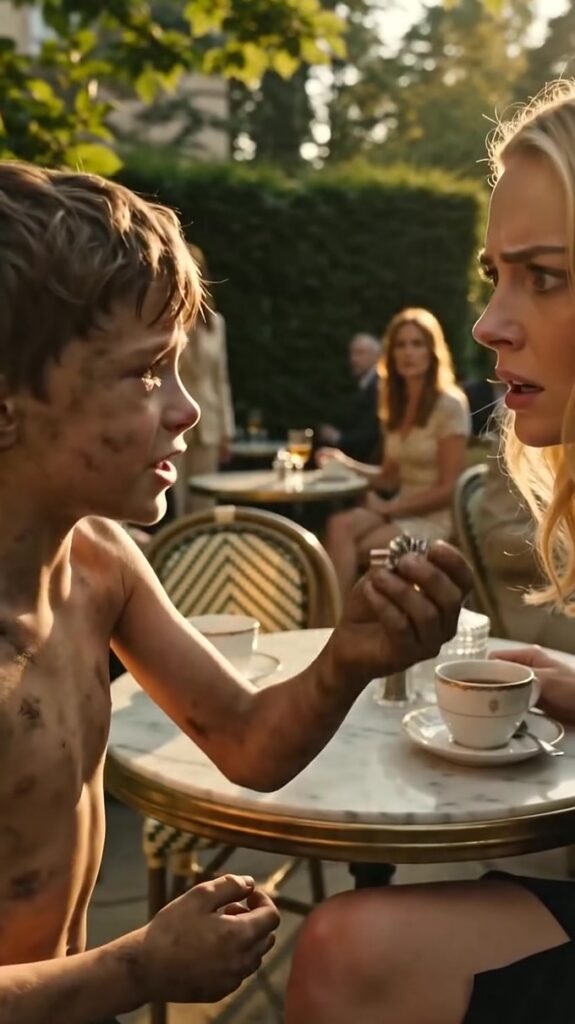
Beside her table stood a boy no older than eight. He was barefoot. His knees were crusted with dirt, one shin marked by a fresh scrape. He wore no shirt, only shorts too large for him, held by a knotted string. Dust clung to his lashes, and sweat shone on his forehead. His chest rose and fell too fast, as if he’d been running for a long time. He stared at Lena not like he wanted her purse or her pastry. He stared as if he’d finally reached a place he’d been told existed only in stories.
“Don’t touch me,” Lena snapped, because the terrace had rules and she was part of them. She heard her own voice—sharp, polished—and hated its tremor. People at nearby tables paused. A woman with pearls leaned back, disapproving. A man in a jacket despite the heat narrowed his eyes, already deciding what kind of nuisance this was.
The boy withdrew his hand slowly, palm open as if showing he carried no weapon. His fingers trembled. Not guilty. Something else—careful, almost reverent. He looked at Lena’s face, the line of her jaw, the shape of her brow, as if mapping it against a memory. His lips moved, trying to find the courage for the words.
“It’s the same,” he whispered.
Lena’s anger faltered. “The same as what?”
The boy swallowed. His eyes brimmed, but he didn’t let the tears fall yet, like he’d learned that crying too soon could ruin negotiations. “Her hair,” he said. “My mom. She said… she said I would know you because of your hair.”
Lena felt the coldest kind of unease slide under her ribs. Her scalp prickled where his hand had been. “Your mother?” she repeated, hearing how thin the word sounded in her mouth.
The boy nodded once, as if nodding kept him from breaking apart. Then he unclenched his fist. Inside lay an ornate barrette, the kind of object that belonged in a velvet box, not in a child’s dirty hand. Its metal was aged to a soft gleam, set with stones that caught the evening light and threw it back in sharp flashes—green, gold, a bruised purple at the edges. It was delicate, old-fashioned, too particular to be mistaken for anything else.
Lena’s throat closed. Her mind tried to produce a logical explanation—stolen, replicated, coincidence—yet her body reacted first, recognizing before she could deny. She had seen that clip in her sister’s hair the last night Miriam came home, laughing at their father’s lecture, twirling the barrette between her fingers as if it were a spell. Lena remembered the way Miriam had bent close, smelling of citrus shampoo, and said, “Keep it safe for me if I forget.” And then, in a rare moment of sentiment, she’d pressed the clip into Lena’s palm and walked out the door with nothing but a suitcase and a grin that didn’t reach her eyes.
“Where did you get that?” Lena asked. She heard herself, and the terrace heard her too; the surrounding voices turned quieter, as if the air had changed density.
“She gave it to me,” the boy said. At last the tears spilled, cutting clean tracks through the dust on his cheeks. He wiped at them with the back of his hand, smearing grit. “She told me to hold it and not let anyone take it. She said I had to find you. Here. She said… she said you would be sitting in the light.”
Lena’s fingers tightened around the coffee cup until her knuckles ached. “What is your mother’s name?” she demanded, then hated herself for demanding, for making it sound like a cross-examination when her lungs were burning for answers.
The boy hesitated. His gaze flicked past Lena, beyond the hedge. Something in him pulled tight like a string being drawn. “I’m not supposed to say it loud,” he whispered. “She said there are ears everywhere.”
Lena leaned forward, voice dropping. “Where is she?”
The boy didn’t answer with words. He turned his head slowly, like someone obeying an instruction he feared. His eyes fixed on the walkway’s edge where the hedge thinned, where shadows from the leaves made broken patterns on the pavement.
There, half concealed by the greenery, stood a woman in a beige suit.
Not a tourist beige, not a summer linen beige. The suit was structured, exact, the color of paperwork and offices and decisions made behind closed doors. Her hair was pinned into a smooth twist. She held a small handbag close to her hip, posture immaculate. She wasn’t looking around like someone waiting for a friend. She was watching, steady and patient, as if the entire terrace were a stage and she owned the script.
Lena’s blood drained so fast she felt dizzy. Recognition hit like a blow: a memory of a station platform, her sister’s bright scarf, and this same woman smiling with a warmth that had felt rehearsed. Their parents had called her “professional.” “Trustworthy.” Lena remembered the beige sleeve guiding Miriam forward, the gentle hand at the elbow, the way Miriam had glanced back once—just once—with a question she didn’t speak. Then the doors had closed, and the years had opened like a pit.
The woman in beige met Lena’s stare without flinching. For a heartbeat, she looked almost pleased.
The boy’s small fingers hovered near Lena’s tablecloth, unsure where to go. “She said you’d say it couldn’t be real,” he murmured. His voice wobbled, and something like hope and terror tangled together in it. “She said you’d look like you do right now.”
Lena couldn’t move. The terrace, with its golden light and expensive calm, seemed suddenly fragile—as if one raised voice could shatter it into screaming. She wanted to stand, to run, to grab the boy and bolt into the street. She wanted to stay seated and pretend none of this was happening. Her body chose neither. It simply shook, very slightly, under the table.
The woman in beige lifted her hand.
Not to wave. Not to beckon.
She raised one finger and pressed it to her lips, eyes never leaving Lena’s face.
Silence, the gesture said. Or else.
The boy’s tears paused mid-fall. He stared at the woman as if he had seen that signal before. Then he looked back at Lena, mouth opening to speak—perhaps to say the name he’d been holding inside him like a coal, perhaps to tell her where his mother was hiding, perhaps to warn her that the calm was a lie.
Lena’s coffee cup finally slipped from her numb fingers. It struck the saucer with a brittle clink that sounded, in the sudden hush of the terrace, like the first crack in a glass wall.
And the woman in beige smiled as if she’d been waiting for that exact sound.