The rain came down like it had been saving itself for weeks—thick, relentless sheets that flattened the hibiscus leaves and turned the road into a ribbon of brown water. The whole lane had leaned out from under tin awnings and cracked doors the moment they heard the shouting at the Santos gate. In a neighborhood where everyone knew what time everyone boiled their rice, a raised voice was an announcement.
Mrs. Rose stood at the edge of her son’s porch, barefoot in the puddles, her thin blouse clinging to her shoulders. She looked smaller than the last time the neighbors had seen her, as if the years had been shaving her down quietly. In front of her, Anton—her Anton, who used to hide behind her skirt on the first day of school—held a burlap sack the size of a child and thrust it into her arms.
“Take it and go, Mom.” His voice was hard, sharpened in public on purpose.
Rose’s hands closed around the wet fiber. The sack was heavy, not only with grain. Something in it had weight that didn’t belong to rice. She didn’t flinch. She didn’t defend herself. She only nodded once, slow, as rain ran down her cheeks and mixed with what the watchers would call tears. Her eyes didn’t seek the neighbors; they stayed on her son’s face as if she were memorizing it in a storm.
Behind Anton, his wife—Liza—stood within the shelter of the doorway, arms folded, hair dry, mouth thin. She did not speak. She didn’t have to. Her silence was a hand at Anton’s back.
“Take the rice and go,” Anton repeated, louder, the syllables thrown outward so the street could catch them. “Go back to your place.”
A few people gasped. Someone whispered, “After all she did for him…” Another hissed, “That’s what happens when mothers cling.” A tricycle driver, stalled at the corner, shook his head like he’d just seen a sin committed in broad daylight.
Rose adjusted the sack on her forearms, pulling it to her chest like a swaddled thing. Her lips moved in a soundless prayer—or maybe a sentence she didn’t want anyone to own. She bowed her head as if accepting a verdict. But when she lifted her eyes again, she looked at Anton with the steady gaze only a mother can carry, the kind that travels through skin and strikes bone.
“He’s just struggling,” she murmured, more to herself than to him. Then, without another word, she turned her back on the gate and stepped into the downpour.
The neighbors watched her go, the sack humped against her ribs, her shoulders bent not by age alone but by something invisible. She didn’t walk quickly. She didn’t stagger. She moved as though every step had been decided long ago. When she reached the bend where the streetlights flickered, she did not look back.
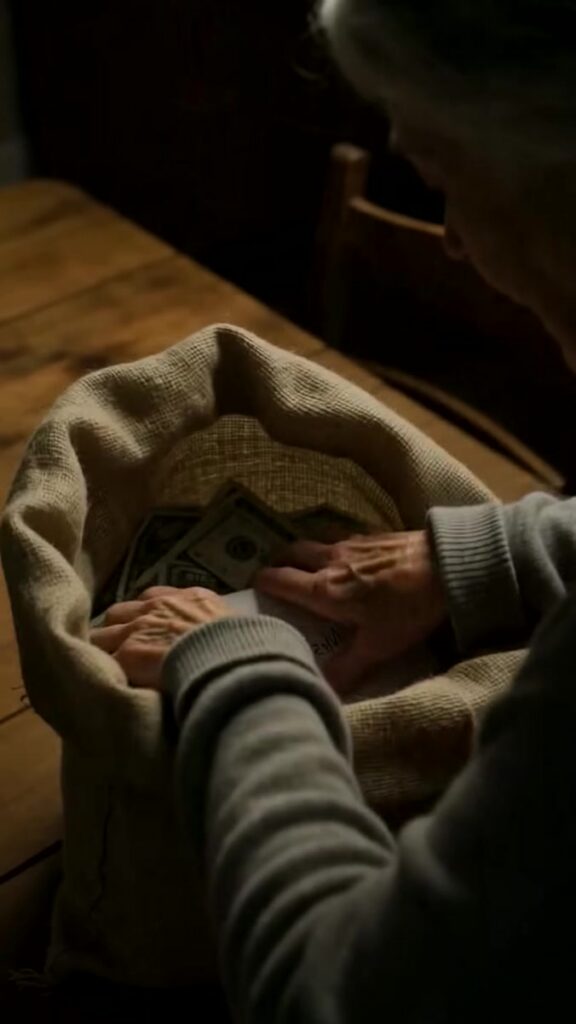
Her room was at the rear of a narrow property she rented behind a small tailoring shop. A single bulb hung from a wire and swung gently in the breeze that slipped through cracks in the wall. The place smelled of damp cloth and old soap. Rose set the sack on her table with care, as if setting down a sleeping child. Only then did her hands begin to shake.
She untied the knot, peeling back wet burlap. On top lay rice, exactly as promised—white grains swelling with the rain that had soaked through. But beneath the rice was something wrapped in plastic. Rose’s fingers dug carefully, as if afraid of what they might find. She pulled out a white envelope, thick and stiff, her name written in careful block letters across the front.
Mrs. Rose.
The handwriting was Anton’s, but older than his usual quick scrawl—forced into calm. Her throat tightened. For a moment she held the envelope against her forehead, eyes closed. Then she opened it.
Inside was a stack of crisp hundred-dollar bills that smelled faintly of air-conditioning, of places with polished floors. Her breath caught. Beneath the money was a folded sheet of paper.
The first line made her knees soften until she gripped the table to stay upright: I had to humiliate you in front of her… because if she knew the truth, she would destroy everything.
Rose read it again, the words blurring as her eyes filled. The rain on her hair dripped onto the paper, darkening the ink. She pressed her palm to her mouth to keep the sound in. Outside, a motorcycle passed, its engine briefly drowning the beat of her heart.
Anton’s note was short, written like someone stepping across broken glass. He wrote that Liza had become sharp as a knife since the day she found the old hospital receipt, since the day she began counting years and asking questions about a baby who wasn’t in any photo album. He wrote that Liza had threatened to go to the police—not about money, not about property—but about “what you did back then.” He wrote that she had eyes in the neighborhood, women who would carry rumors like baskets.
Rose’s fingers trembled as she turned the page over. There was a second message on the back, written in a different hand—tighter, slanted, the strokes angry enough to cut.
Don’t trust your daughter-in-law. She already knows what happened to the baby.
Rose stared at that last word until it became a hole. The baby.
The room seemed to tilt back through time. Her mind returned to the hospital corridor twenty-six years earlier, the fluorescent light buzzing like an insect. She remembered the metal bench cold against her thighs, her hands still sticky with milk and fear. She remembered a nurse with tired eyes saying there had been a complication, that the infant had not survived the night. Rose remembered Anton—only a boy then—standing outside the ward with a red balloon he had begged someone to buy, because he wanted to greet his new sibling with color.
She remembered how she had swallowed her scream so the balloon wouldn’t pop.
She remembered signing papers she could barely read because her eyes kept filling. She remembered the way the nurse avoided her gaze. She remembered the empty blanket they handed her, too neatly folded, and how she had clutched it as if she could wring life back into it.
And she remembered, months later, the rumor that started like a stain: babies had been disappearing from that hospital, sold to childless couples through a chain of clean hands and dirty money.
Rose had told herself it was just talk. She had needed it to be just talk. Grief could be survived. What she couldn’t survive was guilt she hadn’t earned.
Now, in the small room, she set Anton’s note down and picked up the bills. They were more money than her son had ever admitted to having. Money meant urgency. Money meant danger. And the second handwriting—she recognized it after a few seconds, the way you recognize a voice in a crowded market. It was Sister Amalia’s.
Sister Amalia had been the midwife attached to the parish clinic, the woman who had slipped Rose bread when her husband died and Anton was still in school. The same woman who had visited Rose once, years later, with a face drained of color, and had asked, trembling, “Did they ever show you the body?” Rose had answered no, and Sister Amalia had left without saying another word.
Rose rose from the table so abruptly her chair scraped the cement floor. Her knees ached, but she didn’t sit back down. Her eyes went to the window slats where rain streaked like tears on a face. Somewhere beyond this room, Anton was still standing at his gate with Liza, playing a part in a cruel scene so that someone—his wife, the neighbors, whoever had been listening through walls—would believe he had cut his mother loose.
He had made himself the villain to keep her alive.
Rose wrapped the money in the note and slid everything back into the envelope. She dug under her bed for the tin box where she kept documents in plastic: death certificates, baptismal papers, a yellowing receipt from that hospital. She had kept it like a thorn under her tongue. She had never dared to pull it out. Now she placed it beside the envelope and held both to her chest.
Outside, thunder rolled, a long, bruised sound. Rose listened for a knock at the door, for footsteps, for the neighborhood’s gossip made flesh. But all she heard was rain.
She lit a candle because the bulb flickered and because, suddenly, she wanted light that couldn’t be switched off from outside. The flame steadied. In it, her face looked older and fiercer, carved by years of quiet endurance.
“You think I’ll go,” she whispered into the dim. It wasn’t a question. It was a promise. “I will. But not the way you think.”
She pulled on a dry shawl and tucked the envelope inside her blouse, against her skin, where her heart could guard it. Then she took a pen and wrote three words on a scrap of paper, each letter firm despite her shaking hand: I understand. Wait.
She would find a way to slip it to Anton. She would find Sister Amalia. She would go back to the hospital that had stolen her grief and sold it to someone else. If Liza truly knew, if she was already sharpening her threats, then the only shield Rose had left was the truth—whole, ugly, undeniable.
Rose stepped to her door and opened it. The rain hit her face again, cold and cleansing. In the distance, the Santos gate was no longer visible through the curtain of water, but she could picture it—the porch light, the dry doorway, Liza’s folded arms, Anton’s rigid shoulders.
Let the street think what it wanted. Let it crown Anton with cruelty and call Rose pathetic. Their judgment was cheap, and it could be paid in full with one envelope and a sack of rice.
Rose walked into the storm, not away from her son, but toward the thing that had been hidden beneath the grains all along: the reason he had needed the world to believe he was heartless, so his mother could move through the rain unseen—carrying a secret heavy enough to break a family, and a truth sharp enough to cut it free.