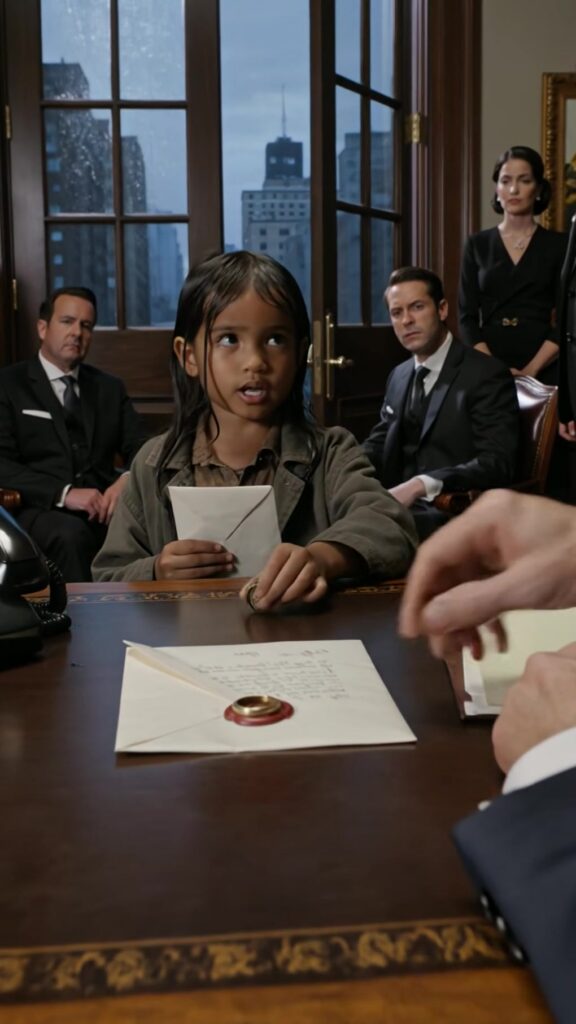
Rain dragged itself down the tall windows of Hargrove & Pell like a slow confession. Beyond the glass, the city blurred into charcoal and silver—sirens distant, headlights smeared, the afternoon collapsing early into night. Inside Conference Room A, the air was too warm and too clean, scented with lemon polish and money.
They waited in a half-circle around the long walnut table, black suits and black dresses pressed so sharp they looked newly bought for this purpose. There were six of them—relatives by blood, by marriage, by proximity to fortune—each with an expression carefully practiced in mirrors: grief with an edge of expectation. Umbrellas leaned in a neat row by the door as if even rain had been made to behave.
At the head of the table sat Arthur Pell, the attorney who had been Rowan Wexler’s right hand for fifteen years and, some would argue, his conscience for five. Pell’s hands were steady as he opened the thick folder sealed with crimson wax. The wax was stamped with a crest: a hawk clutching a thorned branch. Wexler’s signet. A private symbol, old as pride.
“Thank you for coming,” Pell said, voice low. He didn’t ask if they were well; it was not that kind of gathering. “As you know, Mr. Wexler’s final will and testament is to be read aloud in the presence of named beneficiaries.”
Immediately, Conrad Wexler—Rowan’s nephew, tall and polished and too young to look so sure of himself—leaned forward. His cufflinks were small clocks. “Let’s proceed,” Conrad said, as if he were chairing a meeting he already owned.
Pell’s gaze flicked over them. Miriam, Rowan’s sister-in-law, eyes red but dry. Leonard, a cousin with a politician’s smile. A young widow from a second marriage that had lasted eighteen months. An accountant whose name was on the list for reasons no one would explain.
Pell cleared his throat and lifted the first page.
The door creaked.
The sound was small, but in that room it cracked like a branch underfoot. Every head turned at once, not with concern but with irritation—because private rituals dislike interruption.
A little girl stood in the doorway. She couldn’t have been more than nine. Water dripped from her hair in dark strings, ran off the sleeves of an oversized hoodie, and pooled at her sneakers, leaving little maps on the carpet. Her cheeks were chapped. Her eyes were too steady for someone shivering.
In one hand, she held a sealed envelope, edges warped from moisture. In the other, an old ring—thick, dull gold, the face engraved with a hawk and thorned branch.
Conrad rose so quickly his chair scraped. “This is a private family matter,” he snapped toward her, then to Pell. “Arthur, is this your doing?”
Pell didn’t answer. His attention had narrowed to the ring, as if the rest of the room had fallen away.
The girl took one step, then another. The carpet soaked up the rain from her shoes, but she did not hesitate. She walked to the table as though she had memorized the route in a dream.
“My mom said,” she began, voice thin but clear, “this belongs with the letter.”
She placed the ring on the walnut. It made a soft, final sound.
Pell’s breath stopped. He stared at the ring’s face, then at the crimson wax on the will, then back again. The imprint on the wax—hawk, thorn—was a perfect match to the ring, down to a tiny notch on one wing that Pell remembered because Rowan had once cursed it while pouring whiskey, calling it the flaw that proved it was real.
“Where did you get that?” Pell asked, and the question came out like a plea.
The girl’s fingers tightened around the envelope. “He gave it to her,” she said. “A long time ago. She told me to keep it safe and find you if… if something happened.”
“Who is your mother?” Miriam demanded, half rising, eyes flashing with offense. “What is this?”
Conrad’s jaw was clenched so hard a tendon jumped in his neck. “This is a stunt,” he said. “Someone’s trying to—”
“Enough,” Pell said, and there was iron beneath the word. He reached for the envelope the girl offered. The seal was not wax but a strip of tape, pressed on by trembling hands. Across it, in ink that had bled from rain or tears, was written: ARTHUR PELL. ONLY YOU.
Pell’s thumb hovered. His fingertips were suddenly unsteady, as if his body knew before his mind did that the room was about to split open.
He broke the seal and unfolded the letter inside. The paper smelled faintly of smoke and cheap soap. His eyes moved across the first lines, and the color drained from his face in a slow tide.
He looked up at the girl. For a moment, the attorney’s composure—fifteen years of carefully measured statements—collapsed into something raw.
“My God,” Pell whispered.
The room tightened. Chairs creaked. Breath caught.
“Read it,” Conrad said, voice sharp with fear disguised as command.
Pell swallowed. “This letter,” he said, “is from Elara Wynn.”
The name landed like a dropped glass. Leonard’s smile vanished. Miriam’s eyes widened as if she’d been slapped by memory.
“That’s impossible,” Miriam said. “Elara died. Years ago.”
Pell stared at the letter again, then at the child standing in rainwater near the table. “According to this,” he said slowly, “Elara did not die. She disappeared.”
The girl’s shoulders lifted with a shiver. Pell continued, each word heavy. “She says she fled after receiving threats. She says she was told that if Rowan ever acknowledged her child publicly, the child would be taken, or worse.”
Conrad’s face went pale in a way money could not hide. “This is ridiculous,” he said, but the denial sounded thin, rehearsed too late.
Pell’s gaze did not leave the letter. “She writes that Rowan Wexler is the father.”
Silence fell so abruptly it seemed to suction the air from the room. The widow’s hand flew to her throat. The accountant stared at the tabletop as though numbers might rearrange reality into something safer.
“No,” Miriam breathed. The word was not outrage; it was calculation discovering new math.
Pell lifted the ring between two fingers. It looked heavier now, as if it had absorbed all the secrets pressed into its metal. “Rowan gave this signet to Elara,” Pell said. “He told me once that if I ever saw it again, it would mean he had failed to protect what mattered most.”
The girl’s lips trembled, but she kept her chin up. “Mom said he tried,” she said. “She said he wanted me to have… a home. Not a fancy one. Just a safe one.”
Conrad rounded on Pell. “Arthur, you can’t—there are procedures. Proof. DNA. This—this child—”
“Procedures,” Pell repeated softly, and the word sounded like a prayer and a threat. He set the ring beside the will, aligning the hawk on gold with the hawk in wax. The symbols stared back, identical and unforgiving.
Pell opened the will again, but now his hands shook openly. “Ladies and gentlemen,” he said, voice rough, “there is a clause in Rowan Wexler’s will that none of you knew existed. It is sealed unless…” He glanced at the ring. “Unless the signet is presented to me.”
He turned a page in the folder and revealed a second seal—unbroken, bearing the same crest. He pressed the ring into the wax. It fit as if it had been waiting.
When he broke it, the snap sounded like a bone.
Pell read silently for three lines, then closed his eyes. When he opened them, the room was watching him like a jury watches a verdict being formed.
“The first heir,” Pell said, and the words scraped out of him, “is still alive.”
Every head turned toward the girl.
Rain dripped from her hair onto the carpet, each drop loud in the quiet. She stood small and soaked at the edge of a world built for people who never had to walk in storms. Yet the ring on the table had shifted the balance of the room. It had moved power from black-clad shoulders to thin, trembling hands.
Pell rose slowly, as if standing might change the laws of gravity. He pulled his chair back and came around the table, kneeling to bring his eyes level with hers.
“What is your name?” he asked.
She hesitated, then answered as if saying it might summon someone. “Lark.”
Pell repeated it, voice breaking on the single syllable. “Lark.” He looked behind her at the door still ajar, the corridor beyond dim, as if the building itself held its breath. “Where is your mother now?”
Lark’s gaze flickered, and for the first time her steadiness wavered. “She’s gone,” she said. “Last week. She told me to come here before anyone else found me.”
Pell’s hand lifted, then stopped, unsure whether it was permitted to touch the shoulder of a stranger who had just become the axis of a fortune. “You did the right thing,” he said, and then, louder, to the room: “This reading is suspended. Immediately.”
“You can’t do that!” Conrad barked.
But Pell’s eyes were cold now, sharpened by something older than law. “I can,” he said. “And I will. Because from this moment on, everything you thought you were waiting for is in question.”
He took the ring and placed it gently into Lark’s palm, closing her fingers around it as if returning a heart to its rightful chest. “You’re not leaving this office alone,” he told her. “Not in that rain. Not with them watching.”
Behind him, chairs began to scrape and voices rose—protests, arguments, names thrown like knives. But Lark stayed still, ring clenched tight, and looked at the will as if it were not paper but a door.
Outside, thunder rolled over the city, and in Conference Room A, the inheritance changed hands without a single dollar being counted—only a seal matched, a letter opened, and a child stepping out of the storm into the center of the room.