The limousine should have kept moving. It always did. It slid through the city like a polished knife, separating the man inside from the cold and the noise and the people who looked back too long.
But on the morning the snow came down like ash, Victor Halden told his driver to stop.
Not because he’d softened. Not because he’d suddenly understood what hunger did to a child. The newspapers had called him merciless long before they called him generous. He had earned both words, and neither one had ever kept him awake.
He stopped because he had run out of places to spend his hope.
For two years his daughters—Evelyn and Mara—had not walked. The accident was a sentence delivered without a judge: a black-ice turn, glass, twisting metal, and afterward the bright hospital lights that made everyone’s faces look like masks. Doctors offered vocabulary instead of answers. Specialists spoke in percentages with hands that never shook. Victor bought every new opinion the way a man in drowning water buys air.
At home, the mansion learned new sounds. Wheels over marble. The soft click of pills in a glass. Prayer murmured by people who had once only spoken about stock prices.
Then Agnes died.
Agnes had worked in Victor’s kitchens since he was a younger man who still believed money could be a fence against everything. She peeled apples with a knife that never slipped and told stories as if she were paying a private debt to the world. The week before she passed, she asked Victor to sit at the small table in the servant corridor—an indignity, he would have called it, if he had not been afraid of how thin she’d become.
“Mr. Halden,” she said, voice threaded with smoke and memory, “if a lost child ever touches your broken child and calls her by the name she’s forgotten… you don’t ask how. You open the door.”
He’d almost laughed. Almost. But Agnes’s eyes had held him the way a hand holds a lit match over spilled oil.
When Victor saw the little girl on the stone step outside the closed bakery, snow collecting on her hair and shoulders like a claim, Agnes’s story struck him like a slap. The girl wore an adult’s coat that swallowed her. Her hands were bare. She wasn’t crying. That, more than anything, made her look dangerous.
Victor rolled down the window. The cold rushed in, sharp enough to make him blink.
“Where are your parents?” he asked, immediately regretting the question. It sounded like concern.
The girl’s eyes lifted. They weren’t wide and pleading, as he expected. They were steady, dull with fatigue, as if she had watched too much of the world and found it repetitious.
“Gone,” she said.
Victor heard himself exhale. He could have handed her money. He could have called someone. He did none of those things. Money had failed him in rooms where his daughters screamed in the night because they could still feel their legs in dreams.
He said the sentence that had been fermenting in him since Agnes’s whisper became a hook in his thoughts. “If you can help my daughters walk again,” he said, “I’ll adopt you.”
It was a bargain, not a blessing.
The girl blinked once, slow. Snow melted on her eyelashes. “Okay,” she answered, as if he’d offered her a coat, not a life.
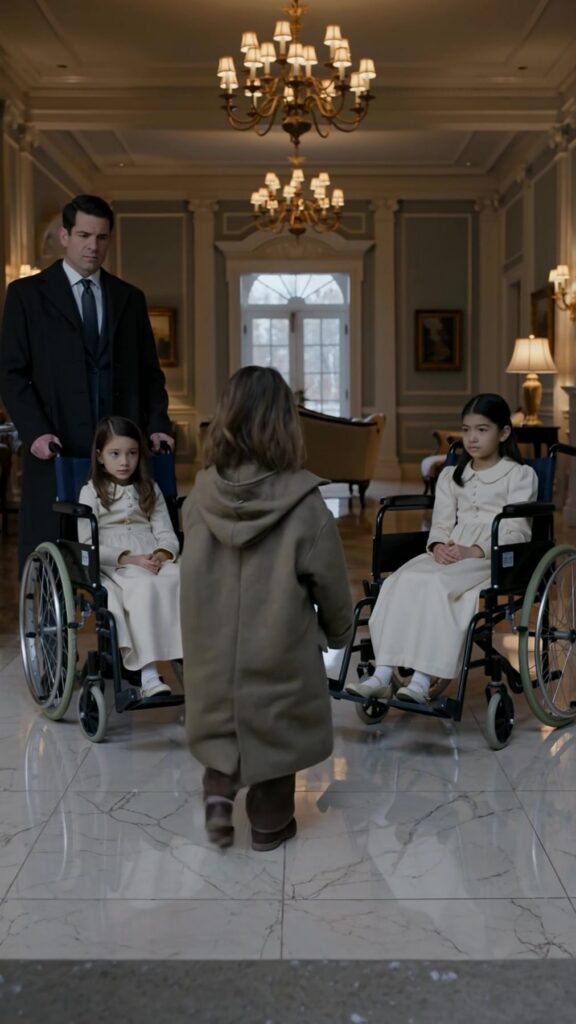
Inside the mansion, warmth rose from the floors and chandeliers cast light that felt too heavy for a child so small. Evelyn and Mara sat in their wheelchairs near the tall windows, watching the snowfall with the flat gaze of prisoners who had memorized the pattern of the bars.
Victor stood behind them, hands clasped so tightly his knuckles ached. He told himself this was foolish. He told himself he was humoring a dying woman’s superstition. He told himself anything but the truth: that he would do anything, anything, to hear running again.
The little girl moved forward without hesitating. She paused in front of Evelyn first. Evelyn was the younger by eleven minutes and a lifetime by temperament—sharp, suspicious, born with a refusal in her mouth.
“What’s your name?” Evelyn asked.
The child’s gaze flicked to Victor, then back to Evelyn. “Lina.”
“Lina what?” Mara pressed. Mara’s voice was softer. She used gentleness like armor.
“Just Lina.”
Victor felt irritation flare. A name mattered. Paperwork mattered. He opened his mouth to correct the situation, to restore order—then Lina held out her hand, palm up, to Evelyn.
“Can I try?” Lina asked.
Evelyn snorted. “Try what?”
“To find you,” Lina said, and the words made no sense until Evelyn’s expression tightened, as if something inside her recognized a scent.
Against every instinct, Evelyn put her hand in Lina’s.
The mansion did not fill with light. The air did not ring. There were no miracles that made good stories. What changed was smaller and worse: Lina’s face went slack, emptied, as if someone had stepped into her skin and taken the wheel.
Evelyn’s eyes unfocused. Her lips parted. “Dad?” she whispered.
Victor’s heart stuttered. “Evelyn, I’m right—”
But Evelyn wasn’t looking at him. She stared at Lina with a fear that made her look younger than she’d been before the accident.
Lina leaned close, voice dropping to a murmur meant for one ear. “You still hide the music box,” she said, “under the bed, behind the third slat, because you’re afraid he’ll hear it and come back.”
Evelyn inhaled sharply, as if struck. Victor felt the blood drain from his face. He didn’t know about a music box. He knew everything about his daughters’ schedules, their medications, their therapy appointments. But he had never known what they hid in the dark.
“Who told you that?” Mara demanded, and her hands gripped her own chair so hard her fingers whitened.
Lina’s eyes—no, not Lina’s, Victor realized with a cold wave of certainty—lifted to Mara. “You were the one who wound it,” the voice said, and it carried a strange echo, like sound in a long hallway. “You thought if it played loud enough, it would drown out the tires on the ice.”
Mara’s mouth trembled. “Stop,” she said, but the word fell apart.
Evelyn’s feet twitched on the footrests. Not a dramatic kick. A tremor like a signal from a buried wire. She stared at her own legs as if seeing them for the first time. Sweat beaded at her temple.
“I can’t,” Evelyn whispered.
Lina squeezed her hand once. “You can,” she said, and her face changed again—Lina’s own expression returning like a tide pulling back, leaving her small and very tired. “But it’s going to hurt,” she added, as if she had learned the truth of it the hard way.
Evelyn’s knees shook. Her feet lifted, a fraction, then dropped. Victor’s throat closed. He had watched surgeons drill into bone with confident calm. He had watched his daughters learn to transfer from bed to chair like old women. This—this tiny movement—made him dizzy.
Mara reached out, not to Victor, but to Lina. “Do me,” she said, voice raw. “Please.”
Lina took Mara’s hand. This time Victor felt it: a pressure in the room, subtle as a storm charge. Lina’s pupils widened. Her shoulders sagged, as if she carried a weight that wasn’t hers.
Mara’s eyes filled, not with tears, but with recognition. “Mom?” she breathed.
Victor’s stomach turned. His wife had died in the crash. The grief had been a hole he kept walking around, pretending it wasn’t there. The thought that grief might now have a voice, wearing a stranger’s face, made him want to flee the room like a coward.
Lina’s lips moved, careful. “I didn’t leave you,” she said, and the words were not a performance. They were too plain, too stripped of drama. “I was taken.”
Victor’s breath caught. “Taken?” he echoed, though no one had spoken to him.
Lina’s gaze snapped to him, and for the first time Victor understood what Agnes had meant by a lost child touching a broken child. Lina wasn’t simply poor. She was unclaimed by the world, a vessel left empty long enough for other things to climb inside.
“You made enemies,” Lina said to Victor, voice thick as if it didn’t fit her mouth. “You thought your walls were higher than consequences.”
Victor’s jaw clenched. He had. He always had.
“The crash wasn’t an accident,” Lina continued, and Mara began to sob soundlessly. “They wanted you to live. They wanted you to watch.”
The room tilted. Victor gripped the back of Mara’s chair. In his mind, the car’s spin replayed, but now he saw the gleam of a second vehicle, the strange flash of headlights where there should have been none.
Lina blinked hard. Whatever presence had ridden her seemed to loosen its grip. She sagged forward, catching herself on Mara’s armrest, suddenly just a child again—starved, shivering under too much coat.
“I don’t like when they use me,” Lina whispered, almost apologizing.
Victor stared at her as if seeing her for the first time. Not a miracle. Not a tool. A child who had learned to survive being a doorway.
Evelyn pushed down on the armrests of her chair. Her face contorted with effort. The tendons in her neck stood out. Her legs trembled like fawns on ice, but they moved—just enough to bring her feet under her knees.
“Dad,” she gasped, looking at him now, really looking, “help me.”
Victor lunged forward, catching her under the arms. He felt the heat of her body, the violent shake of muscles waking up from long sleep. He held her upright, terrified of breaking her, terrified of letting go.
Mara followed, slower, tears now spilling freely. She rose with Victor’s other hand supporting her elbow, and when both girls stood, shaking and furious with pain and alive with it, the mansion’s silence broke. Not with applause. With the raw sound Victor made when grief finally found its way out.
Lina watched them, swaying. She looked smaller than ever, as if the act of opening had hollowed her out.
Victor steadied his daughters against him, then turned to Lina. The bargain he’d offered came back like a blade held to his own throat. He had said he would adopt her if she helped. He had not promised to care.
He knelt, the marble cold through his trousers. “Who are you?” he asked, and his voice cracked on the word.
Lina’s eyes flicked to the grand staircase, to the portraits on the walls of people who’d never known hunger. “I told you,” she said. “Just Lina.”
“Where did you come from?”
“Nowhere,” Lina replied. “That’s why they can use me. No one looks for a child from nowhere.”
Victor felt the weight of that like a verdict. He had built an empire by making sure no one could make him disappear. And yet he had ignored the children the world erased every day.
“I didn’t stop for you because I’m good,” he said, because the truth had to be spoken out loud. “I stopped because I was desperate.”
Lina’s mouth twitched, not quite a smile. “Desperation is honest,” she said. “Kindness is usually just a costume.”
Behind Victor, Evelyn and Mara clung to each other, standing like two trees in their first storm. Their breath came in sharp bursts. Their faces shone with sweat and pain and something dangerously close to joy.
Victor looked at Lina again—this small, exhausted hinge between worlds—and understood the story Agnes had handed him like a key. Open the door. Not because you’re noble. Not because you’re forgiven. Open it because you cannot ask the impossible for free.
“You can have my name,” Victor said, voice low. “You can have my roof. And you can have my protection.” He swallowed the word he was not used to. “Not as payment. As a beginning.”
Lina’s eyes glistened, but she did not cry. “Protection from who?” she asked.
Victor stood, pulling his daughters closer, feeling their weight, their trembling. His gaze sharpened past the glass windows, out into the snow-smeared city. “From the people who wanted me to watch,” he said. “And from the things that think you are only a door.”
Lina nodded once, solemn as a judge. “Then open it,” she whispered.
Victor walked to the front entrance and unlocked it himself. Cold air rushed in, and with it the smell of winter and risk. He held the door wide, not for the storm, but for the child who had been claimed by no one and used by too many.
Behind him, his daughters stood—shaking, furious, alive—on legs that hurt and moved anyway.
Victor had not offered adoption out of kindness. He had offered it like a man offering his last coin to a stranger for a map out of hell.
But as Lina stepped over the threshold and into the mansion’s warmth as if she belonged there, Victor realized something that frightened him more than any miracle: desperation had brought her in, and now it would be love that kept her safe—if he could learn how to do it, even if it tore him apart first.