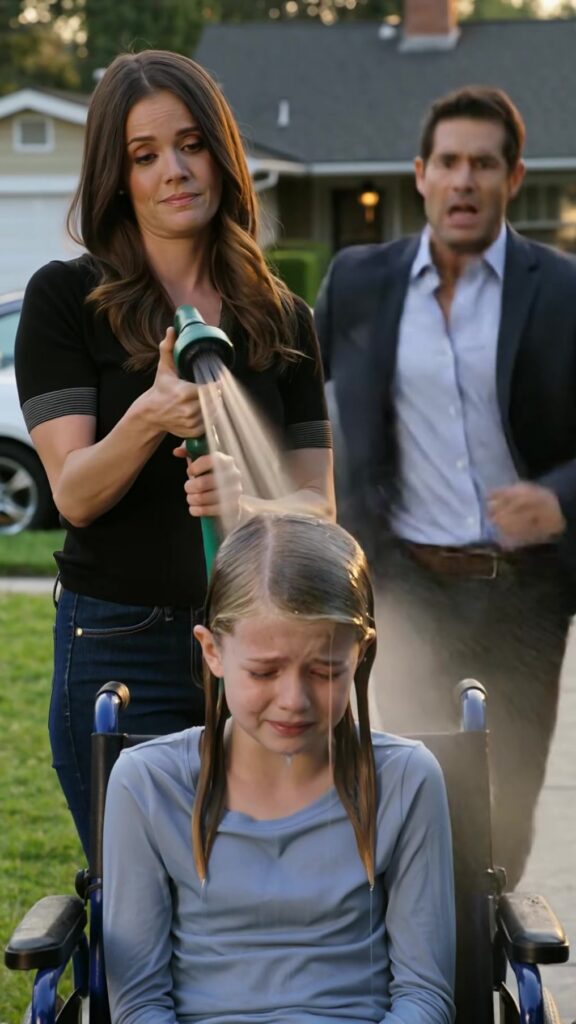
The call came like a siren through the walls of his office: a neighbor’s number he barely recognized, words crashing over one another—spraying, screaming, your daughter in the yard. Evan Marsh didn’t remember standing, didn’t remember grabbing his keys, didn’t remember the elevator ride down. He remembered only the dull, roaring certainty that something was happening to Lily and that he was late.
He drove with his jaw clenched so tight his molars ached. Three months of late-night spreadsheets and early morning physical therapy sessions with Lily had hollowed him out. He’d been living on coffee and hope and a furious kind of faith that if he did everything right—appointments, specialists, prayers—his little girl would be safe. When he turned onto Maplebrook Lane, that faith didn’t crack. It shattered.
The front yard was an ordinary picture you could’ve framed for a brochure: wet grass after morning rain, a sedan in the driveway, soft sun on beige siding. Then he saw the arc of water. It struck Lily full in the face, pushing her head back, turning her hair into a slick, pale rope. She sat in her wheelchair, soaked through, dress clinging to her knees, hands locked around the armrests as if they were the only solid thing left in the world.
Behind the chair stood Maren Cade—Lily’s private caregiver, hired after the accident, recommended by the clinic with spotless references and a voice like a lullaby. Maren held the hose in one hand as calmly as if she were watering petunias.
For half a heartbeat, Evan couldn’t translate what his eyes were showing him. Then the meaning landed, heavy and scorching.
“What are you doing?!” His shout tore out of him and startled a pair of birds from the maple tree.
Maren didn’t flinch. Didn’t rush to explain. Didn’t even turn the nozzle down right away.
“I’m cleaning your daughter,” she said, as if that were a kindness.
Something in Evan snapped clean. He strode across the slick lawn, shoes skidding, rage cutting through his exhaustion like a blade. “Have you lost your mind?”
He wrenched the hose from her hand. The spray whipped wild, arcing across his trousers, slapping the wheelchair, splattering Maren’s skirt. Lily’s shoulders shook. Water and breath and something like a sob tangled in her throat.
Evan aimed the nozzle at the ground and shut it with a violent twist. He moved instinctively to Lily, to cover her, to lift her out of the chair, to carry her inside where no one could reach her.
Maren stepped back, folded her arms, and watched him with a defiance that didn’t belong on a guilty face. Evan’s fury faltered for the first time—just a stutter—because Maren looked not frightened, but resolved.
Then he saw Lily’s expression.
It wasn’t the flinch of pain. It wasn’t anger. It was terror so sharp it seemed to bend the air around her. And it wasn’t directed at Maren. It was directed at the space between them, at the moment that had arrived, at whatever the water was meant to wash away.
“Lily,” Evan breathed, reaching for her shoulders. Her skin was cold. “It’s okay. Dad’s here.”
Lily didn’t look up. Her fingers clenched until her knuckles blanched. Her gaze fixed on the grass as if the lawn could swallow her whole. Evan felt his chest tighten. This was wrong in ways he couldn’t name.
Maren’s voice cut in, low and steady. “Don’t touch her yet.”
“Get away from my daughter,” Evan snarled, but his hands hesitated midair because Lily had gone still. Too still. Like she was listening for a cue only she could hear.
The silence stretched. A car passed somewhere down the street, tires hissing on wet pavement. Evan heard his own breathing. Lily’s shoulders trembled once—twice—then stopped.
And then, slowly, shakily, impossibly, Lily leaned forward.
Evan’s mind tried to reject the movement. The doctors had been clear: spinal trauma, nerve damage, uncertain prognosis. They’d used careful words—maybe, possibly, time—but the unspoken message had been loud: prepare for limitations. Evan had prepared like a man building a fortress around a single fragile truth: his daughter could not stand.
Yet her feet found the ground. Her legs straightened with visible effort, muscles quivering as if waking from a long, forced sleep. Water streamed off her sleeves and dripped from her chin onto the grass in a steady, rhythmic patter. Lily rose from the chair like someone stepping out of a story she’d been trapped inside.
Evan’s hand flew to his mouth. “No,” he whispered. It came out prayer-thin. “No… that’s not possible.”
Lily stood there swaying, eyes wide with panic, as if she expected the world to accuse her of the crime of being upright. Tears mixed with hose water on her cheeks. She tried to sit back down and missed the seat; her knees buckled slightly.
Maren moved forward—not to push, not to hurt, but to steady her with an open palm hovering inches from Lily’s elbow, giving her the choice. “Easy,” Maren said.
Evan’s shock boiled into something darker as comprehension began to form. “Lily,” he said, voice thick. “You can… you can walk?”
Lily shook her head violently, then flinched at the motion, as if even refusing was dangerous. “I—” Her voice broke. “I’m sorry.”
“Sorry?” Evan’s eyes burned. “Why would you—”
Maren’s words fell like stones. “Because someone taught her that if she stood up, she’d lose you.”
Evan turned on Maren, fury returning with a new target. “Are you saying she’s been pretending?”
Maren didn’t look away. “I’m saying she’s been coached. Conditioned. For months.”
Evan’s mind spun back through memories like shattered glass: Lily refusing to practice with the walker when he entered the room, the way she went limp when he insisted, the sudden quiet whenever he mentioned school. The guilt he’d carried—his absence, his impatience—shifted and reshaped into a sharper horror.
“Who,” he demanded, “would do that to her?”
Lily’s eyes darted toward the house as if the windows were listening. “Please,” she whispered. “Don’t be mad. I didn’t want you to go.”
The words hit Evan with a force that nearly knocked him backward. “Go where?” he asked, though he felt the answer crawling up his spine.
Maren took a breath, and for the first time her composure cracked enough to show something like grief. “Your ex-wife filed for full custody again,” she said. “Not in court. In Lily.”
Evan stared at her. “That makes no sense.”
“It does if the story is that Lily needs constant care,” Maren said. “If she can’t walk, she can’t attend regular school. She can’t stay with you while you work. She can’t travel. She has to be where it’s ‘safe’—with the parent who promises she’ll never be left alone.”
Evan’s stomach turned. “No,” he said, but the denial was weak, already collapsing under the weight of Lily’s trembling apology.
Maren gestured to the wheelchair. “Every time Lily started to improve, she was scared back into it. Your daughter isn’t a liar, Evan. She’s a child trying to survive the rules adults put in her hands.”
Lily’s chin quivered. “Mom said if I got better, you’d stop loving me,” she confessed, words coming in a rush now, like dam water. “She said you only stayed because you felt bad. She said if I stood up, you’d be relieved and you’d leave and it would be my fault.”
Evan’s vision blurred. He dropped to his knees on the wet grass in front of her so they were eye level, so she didn’t have to look down at him like a judge. His voice shook. “Lily,” he said, “listen to me. You could run a marathon or you could never stand again and it wouldn’t change one thing. I don’t love you because you need me. I love you because you’re you.”
Lily made a small, broken sound, half laugh and half sob, and reached for him. Evan held her carefully, as if she might shatter, feeling how strong and light her legs actually were against his arms, the truth of her body contradicting months of fear. Over her shoulder he met Maren’s gaze.
“Why the hose?” he asked hoarsely. “Why—” He couldn’t finish.
Maren swallowed. “Because Lily told me she could stand when she thought no one was watching. But she wouldn’t do it when you were here. She said she was terrified you’d look at her differently.” Maren’s eyes flashed, anger finally surfacing. “And today she said her mother was coming to pick her up. She said she had to be ‘good’ and stay in the chair.”
Evan’s blood ran cold. “Today?”
Maren nodded once. “In ten minutes.”
The calm suburban street seemed to tilt. Evan looked toward the driveway, toward the road beyond, as if he could already see the car turning the corner. His hands tightened around Lily. She clung to him, damp and shaking, her small fingers digging into his shirt.
“We’re going inside,” Evan said, voice iron now. “We’re locking the door. We’re calling my lawyer. And Lily—” He pulled back just enough to look into her wet, terrified eyes. “You are not alone in this. Not ever again.”
Lily nodded, tears dropping silently from her lashes. She glanced at the wheelchair like it was a trap and then, with a bravery that made Evan’s throat ache, she took one uncertain step forward on the grass. Another. Each movement looked like a confession and a revolt at once.
Behind them, the hose lay coiled like a discarded snake, water still dripping from its mouth. In the quiet after the spray, Evan finally understood what he had run into: not a scene of cruelty alone, but the unraveling of a story that had been wrapped around his daughter until she couldn’t tell where love ended and fear began.
Down the street, an engine hummed closer.
Evan stood, positioned himself between Lily and the road, and waited—no longer as a man arriving too late, but as a father ready to face the lie head-on.