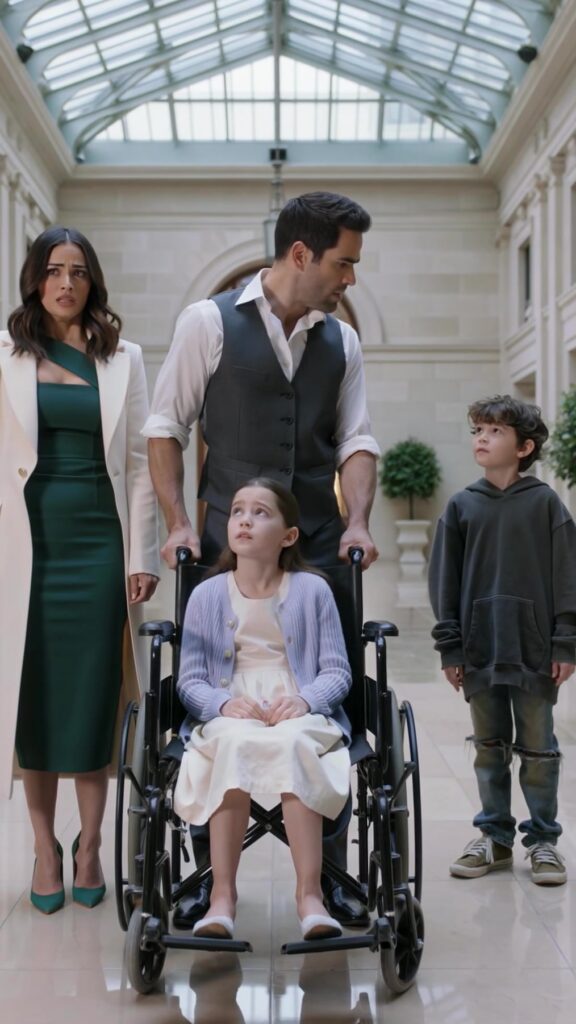
The atrium did what atriums were built to do: it forgave. Light fell from the glass ceiling in clean sheets, bleaching the corners where dust might have collected and softening the hard edges of the people who moved through it. The marble floor held reflections like promises. The potted palms stood in glossy obedience. Even the air smelled expensive—citrus and disinfectant and something floral meant to suggest health.
On mornings like this, a person could believe they had a future simply by walking toward it.
Grant Hawthorne had always walked as if he owned the air ahead of him. Today he moved carefully, one hand on the push handles of the wheelchair, the other lingering on the shoulder of the girl sitting in it as though contact could keep her tethered to him and to the world. Emery’s legs lay beneath a blanket patterned with tiny birds that looked ready to take off. Her hair was brushed smooth and pinned with a clip shaped like a star. She watched the bright floor glide by with the solemn attention of someone trying to understand why her body didn’t follow her thoughts anymore.
Vivian Hale floated beside them. She wore pale blue that made her seem made of the same light that flooded the atrium. A ring flashed on her left hand—Grant’s ring, public and perfect. She leaned in now and then, speaking softly to Emery about the fountain in the courtyard they might visit afterward, about a new book, about how brave she was. Anyone watching would have seen a man protecting a child and a woman standing close enough to become family.
It would have looked like salvation, if you didn’t know where to stand.
The boy on the far left did not belong to the scene. He was too thin for the polished world, his jacket too large, his shoes scuffed. He hovered near a column as if the building might swallow him if he stepped fully into the light. His dark hair fell into his eyes, and his hands were clenched so tight his knuckles turned chalky.
Grant noticed him only because the hospital receptionist had glanced that way with annoyance, and because Vivian’s voice had faltered for the first time all morning.
Then the boy lifted his arm and pointed. The gesture was small. The effect was not.
“She’s not really paralyzed,” he said, his voice cracking as if it had been waiting too long to be used. “Your fiancée is the reason she’s still like this.”
The words cut through the atrium’s careful quiet, and for a moment the light felt like an accusation.
Grant stopped. His hand tightened on the wheelchair handle. The pause wasn’t confusion. It was impact—like something had struck a bruise no one had been allowed to touch. The muscles around his mouth went rigid. Slowly, he turned his head toward Vivian.
“What is he talking about?” he asked, and the question sounded like it had been dragged out of him. “Is it true?”
Emery looked up at him, then at Vivian. She didn’t understand the accusation; she understood the shape it made. Fear had a geometry, and grown-ups wore it in their faces even when they tried not to. Emery’s fingers found the hem of her blanket and gripped it.
Vivian’s smile didn’t fade. It vanished. As if someone had reached into her and shut off whatever made her glow. Color left her cheeks. Her breath shortened. Her body, faithful to its own instincts, began to decide distance before her mind could form a plan.
She took a step back. Then another. Slow, deliberate, as though if she moved carefully enough she could make this moment belong to someone else.
Grant moved half a step toward her without releasing the wheelchair. His posture became the strangest kind of compromise—one leg angled after her, his hands anchored to his daughter’s chair as if he could not yet choose between pursuit and protection.
“Who are you?” Grant demanded of the boy, though his eyes stayed on Vivian. “Why would you say something like that?”
The boy did not answer right away. He didn’t fill the space with nervous explanations. That made him harder to dismiss than any shouting ever could. He simply stared, his gaze steady with the terrible calm of someone who had decided silence was no longer survivable.
“My name is Silas,” he said finally. “I used to bring deliveries to Ms. Hale. To her apartment. I saw things.” His throat worked as if swallowing glass. “I heard her on the phone. She said if your daughter got better, you’d stop needing her.”
A couple passing in the atrium slowed, sensing drama like a scent. A nurse paused near the vending machines. The world leaned in without shame.
Vivian’s lips parted. She seemed to search for a laugh, for indignation, for anything that would turn this into nonsense. What came out was a thin, shaky breath. “Grant… this is insane. He’s lying. Who is he to—”
“Don’t,” Grant said, and there was warning in it. He did not raise his voice. He didn’t have to. The warning wasn’t in volume; it was in the way the name on his badge of power—Hawthorne—suddenly meant nothing if his child was threatened.
Silas lifted his chin. “You think I want to be here?” he asked. “You think I want her looking at me like I’m ruining something pretty?” He nodded toward Emery, and his face twitched with something like apology. “I didn’t come to ruin you. I came because she’s been ruining her.”
Vivian’s hand moved to her sleeve. The motion was small, almost elegant, like smoothing a wrinkle. Something near her cuff caught the light—an abrupt sparkle where no sparkle belonged.
Grant’s gaze snapped to it.
A tiny vial, half-hidden against the pale line of Vivian’s coat, shifted as her wrist turned. The glass was the size of a thumb. The label was clinical and ordinary, but Grant had learned the language of ordinary tragedies. He knew what medication vials looked like. He knew what dosages could do. He knew how often he’d trusted someone else to handle the pills and injections and careful schedules because he’d wanted to believe love could be delegated.
His face changed from shock to something worse, something that hollowed him out so quickly it seemed the bright atrium dimmed around him even though the sun didn’t move.
“What is that?” he asked, and his voice finally shook.
Vivian’s fingers tightened around her sleeve as if she could fuse fabric and skin. “It’s nothing,” she said too fast. “It’s—vitamins. For Emery. Her doctor suggested supplements—”
“Which doctor?” Grant demanded. “Dr. Kline? Dr. Rivera? Or the one you invented because you thought no one would check?”
Emery made a small sound, more breath than word. “Daddy?” Her eyes were wide, reflecting the ceiling’s grid of glass like a cage.
Grant did not look away from Vivian. “Vivian,” he said, and her name sounded like a verdict. “Give it to me.”
For one heartbeat, Vivian stood still. Her eyes darted, mapping exits. The atrium had three doors—main entrance, emergency hallway, elevator bank. All of them shone with the same indifferent cleanliness. There was nowhere for an ugly lie to hide in a room this bright.
She backed again. The heel of her shoe whispered against marble. “Grant, you’re letting some stranger poison you against me,” she pleaded, voice softening into the tone that had soothed him through exhaustion and paperwork and nights when Emery cried from phantom pains. “You know me. You know what I’ve done for your family.”
Silas flinched at the word family as if it burned.
Grant’s hand left the wheelchair handle. It rose, palm open, not quite reaching for her yet. “I know what I thought you were,” he said. “I know what I wanted you to be. Hand it over.”
Vivian’s gaze flicked to the elevator. Her body angled.
And in that angle, in that instinct to run instead of fight for the truth, Grant felt the last piece of denial snap cleanly. He saw it all at once: the setbacks that arrived after every hopeful appointment, the sudden infections, the unexplained fatigue, Vivian insisting on being the one to give Emery her medicine when nurses were busy, Vivian’s gentle hand pushing a spoon, a syringe, a cup.
He heard, like an echo, the boy’s sentence landing somewhere already tender.
“Stop,” Grant said.
Vivian turned. Not toward him. Toward escape.
Grant lunged—not fast, but fueled by something raw enough to make the polished floor irrelevant. His fingers caught her sleeve. Fabric tore with a sharp sound that made Emery gasp. The vial slipped free and clinked against the marble, rolling in a slow circle as if time itself had been compelled to watch.
A nurse near the vending machines moved first, stepping forward with a practiced alertness. “Security,” she called out, voice loud now, the atrium’s hush finally broken. “I need security in the atrium.”
Vivian froze, eyes fixed on the vial on the floor like it was a piece of her soul that had fallen out. Then she looked at Grant, and for a fleeting moment her face did something almost human: grief, or rage, or both. “You would have left,” she whispered fiercely. “As soon as she walked again, you would have realized you didn’t need me.”
Grant’s grip tightened, not in anger now but in disbelief that love had been treated like a contract secured by injury. “So you kept her in that chair,” he said, the words tasting like metal. “You kept my daughter—” His voice broke. He swallowed hard. “You kept her suffering because you were afraid of being alone.”
Emery’s small hands pressed to the armrests. “Vivian?” she asked, as if the name could still mean storybooks and warm tea.
Vivian’s eyes slid to Emery. Something flickered there—calculation, then panic. She yanked against Grant’s hold and twisted, suddenly strong, suddenly desperate. “I didn’t mean for it to get this far,” she hissed, and that sentence, more than any denial, sealed the truth.
Security guards appeared at the atrium entrance, their radios crackling. The nurse had already scooped up the vial with a tissue and held it away from her body as if it could stain the light. Silas stood rigid, breathing in quick bursts, as though he might collapse now that the words were out.
Grant let go of Vivian’s sleeve as the guards took her arms. She struggled once, then seemed to realize there was no graceful way to exit a lie exposed under glass. Her perfect composure shattered into something ugly and ordinary. She began to sob—not with remorse, but with the sound of someone whose plan had failed.
Grant turned back to Emery. He dropped to one knee beside her chair, so their faces were level. The atrium’s brightness flooded the space between them, showing every tremor in his hands, every wetness in his eyes.
“Em,” he said softly, “I’m here.”
Her lower lip quivered. “Did she make me stay broken?”
Grant closed his eyes for a moment because the answer was unbearable and because lies, even kind ones, had no shelter left in this light. When he opened them, he forced his voice steady. “Someone hurt you,” he said. “But we’re going to fix what we can. We’re going to find the truth. And you won’t be alone for a single second.”
Across the atrium, Vivian’s pale blue coat looked suddenly cheap under the glare as she was led away. Silas remained by the column, shoulders sagging, as if he had thrown something heavy out of himself and didn’t know what to do with the empty space.
Grant looked at him then—not with gratitude yet, not fully, but with recognition of the courage it took to step into a bright room and speak an ugly truth. He nodded once, sharp and solemn.
Outside the glass ceiling, the sun kept shining as if it had never been fooled. Inside, the atrium held its reflections without judgment. And in the center of it, a father bent close to his daughter, promising her that no one would ever use her pain as a leash again.