The supermarket’s automatic doors sighed open as if the building itself were tired, and Lena stepped inside with a child on her hip and a list folded into quarters in her pocket. She didn’t belong to anyone’s idea of “effortless.” Her hair was pinned up with a plastic clip that had lost a tooth; her coat was too thin for the bite in the air. Yet she moved with the careful focus of someone balancing a tower of glass.
Milo, three years old and all elbows, had his cheek pressed to her shoulder. His small fingers clutched her collar like a lifeline. “Can I have cereal with the tiger?” he whispered, peering toward the bright aisle like it was a carnival.
“We’ll see,” Lena murmured. It was always we’ll see—words that could mean yes, could mean no, could mean only if the world didn’t demand another fee for breathing that day.
She found a cart whose wheels didn’t sing and guided it between displays. The store was clean in the way a place tries to be rich: shiny floors, overhead lights that pretended not to flicker, seasonal banners that promised abundance. Lena moved past the produce, selecting fruit that was just ripe enough to become lunch and not old enough to become waste. She chose baby food, though Milo wasn’t a baby anymore; it was cheaper than the pouches and faster than cooking when the late shift stole her evenings.
At the end of aisle five, she paused near the shelf of boxed pasta. Her hand hovered over a brand she knew, then shifted to the store label. It felt like a confession every time.
That was when the voice cut through the hum of refrigeration and distant beeps.
“Excuse me,” a woman said in crisp English, each syllable ironed flat. “You need to watch your cart.”
Lena turned. The speaker stood like a display model: tailored coat, polished nails, hair that didn’t dare fall out of place. Her perfume arrived before she did, expensive and faintly accusatory. A man—maybe a driver, maybe an assistant—hovered behind her with a basket containing imported chocolates and something wrapped in gold foil.
“I’m sorry,” Lena said automatically. Her cart wasn’t touching anything. It wasn’t even close. But apologies were cheaper than arguments.
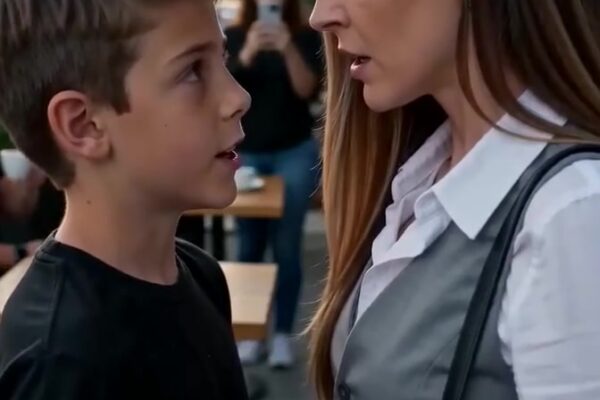
The woman’s gaze drifted downward, settling on Milo and then returning to Lena with a look that suggested she’d discovered a stain. “It’s irresponsible,” she said, louder now, “to bring a child into a store and make a mess. People like you always do.”
Lena felt heat climb her neck. She glanced around, hoping for anonymity. But eyes had already started to turn; a few shoppers slowed, curiosity blooming. Milo tightened his grip, sensing the shift in the air.
“We’re not making a mess,” Lena said softly. “We’ll be quick.”
The woman stepped closer, her heel clicking. “Quick doesn’t change the fact you can’t afford half of what’s in there. I’ve seen it. Fill the cart like it’s a fantasy, then make a scene at the register. It’s embarrassing.” She smiled as if she were offering helpful advice. “For everyone.”
Lena’s mouth opened, closed. Her heart hammered. She wanted to say she had a card. She wanted to say she had permission. She wanted to say that she had once worn shoes as fine as the woman’s, before the world had rearranged itself. Instead she whispered, “Please… we’re just shopping.”
The woman’s eyes narrowed, as if the word please were an insult. And then, with a sudden, deliberate motion, she grabbed the cart’s handle and heaved.
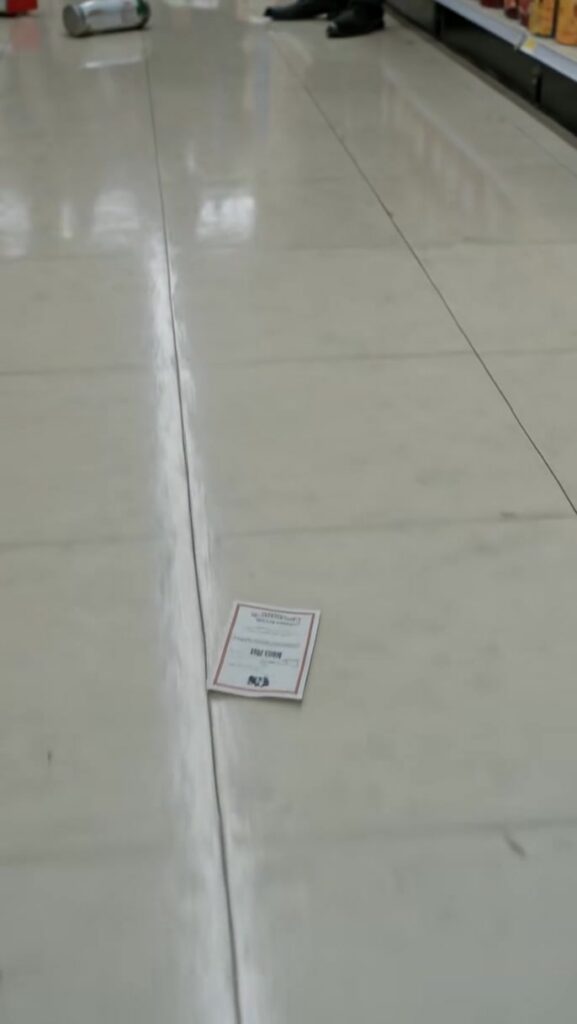
The cart went over with a metal shriek. The sound shot down the aisle like a gunshot. Milk erupted, white and violent. Apples and oranges rolled away, bumping gently into the base of shelves like startled animals. Boxes of pasta skidded, bread loaves flopped, baby food jars clinked against tile. Milo began to scream, sharp with terror.
Lena dropped to her knees in the spreading milk, hands outstretched as if she could gather everything back into order by force of will. Her palms slipped on the slick floor. “Oh God—no—please,” she choked, words tumbling out with her breath. “Please stop.”
The rich woman stood over them, chest rising and falling, one hand still on the overturned cart as if to prove she had the power to tip the world. “You can’t pay for any of this!” she shouted, loud enough to echo. “Now everyone can see what happens when people like you pretend.”
Phones appeared. A cashier leaned out. A couple at the end of the aisle froze with a jar of sauce suspended between them. Someone whispered, “Did you see that?” Another voice said, “Call a manager.”
Lena’s face burned. She tried to gather the groceries, fingers shaking so badly she couldn’t grip the cardboard. Milo cried beside her, his small shoes planted in the milk, his hands reaching for her, his panic seeping into her bones.
Then something tiny slid free from beneath a torn paper bag and skated across the floor—an ordinary rectangle of adhesive paper, fluttering like a pale leaf until it came to rest near the sneakers of a young store worker.
He was barely old enough to shave, wearing the store’s green apron and a name tag that said “JAE.” He bent, picked up the little tag, and frowned as if it were a puzzle piece that didn’t belong to this box.
The rich woman noticed and made a theatrical gesture. “Go on,” she said with a mocking smile. “Check it. Make sure she didn’t stick clearance labels on premium items. People like that always do.”
Jae hesitated, then held the tag under the scanner he’d been carrying for restocking. A soft beep sounded—nothing dramatic, just the store’s everyday language. But Jae’s face changed as if someone had pulled a curtain away from his eyes.
He looked down at the handheld screen. Looked again. His mouth parted. The noise of the aisle—Milo’s crying, the murmurs, the distant register beeps—began to thin as people noticed the shift.
“What is it?” the rich woman demanded, her confidence hitching.
Jae swallowed. He turned, eyes searching until they found the manager who’d arrived at a jog, tie askew from haste. The manager’s expression was already stern, ready to assign blame the way stores did, ready to protect the appearance of order. Then Jae lifted the tag with two fingers as if it had become fragile.
“Sir,” he whispered, but the aisle had gone so quiet the word carried. “This account… it’s linked to the founder’s private family balance.”
The manager went pale so fast it was as if the fluorescent lights had drained him. Around them, a collective intake of breath rippled through the onlookers—soft, stunned, disbelieving.
The rich woman’s smile faltered. “That’s impossible,” she snapped. “She’s—”
Lena’s hands froze over a carton of eggs. Milo’s crying quieted to hiccups, his eyes wide and wet. She pressed trembling fingers to her mouth, as if to keep something from spilling out: grief, maybe, or the truth she had kept folded like her grocery list.
The manager stepped closer, his voice suddenly respectful, almost afraid. “Ma’am,” he said, not to the rich woman but to Lena. “Are you… Lena Harrow?”
Lena flinched at the name spoken aloud in a place that smelled of detergent and sliced fruit. She hadn’t heard her maiden name in months. She nodded once, a small motion that cost her more than a confession.
The rich woman’s gaze darted to Milo, then back to Lena, as if trying to fit them into a picture frame she had already labeled. “Harrow?” she repeated, the word thinning. “As in…”
The manager’s throat bobbed. “As in Mr. Harrow, who built this chain,” he said quietly. “His daughter.” He glanced at Milo with something like dawning comprehension. “And… her son.”
The aisle held its breath. Somewhere far away, a child laughed in another part of the store, unaware of the invisible line that had just been drawn through this one.
The rich woman’s face tightened. For the first time, she looked at the milk on the floor not like a mess made by someone else, but like evidence. She opened her mouth, perhaps to apologize, perhaps to bargain, perhaps to reshape the story before it solidified in a hundred recording devices.
Lena spoke first. Her voice was hoarse, quiet, and somehow more cutting than the woman’s shout.
“Don’t,” she said.
The manager waved his hands, already signaling for staff. “Please—let us take care of this. Medical—are you hurt? We’ll—”
Lena shook her head. “My son’s frightened,” she said, pulling Milo into her lap, cradling him against her coat. She stroked his hair with milk-damp fingers and murmured nonsense comforts until his sobs softened. Then she looked up at the woman who had tipped her cart like a judge overturning a sentence.
“You threw it,” Lena said, each word steady now, as if she’d found ground beneath the slick floor. “You did it to make me small.”
The rich woman’s eyes flashed with a panic she tried to hide. “I didn’t know,” she whispered, as if ignorance could erase intent.
Lena’s laugh was soundless. “That’s the point.” She gestured to the spilled groceries. “You didn’t need to know anything about me. You only needed to believe you were entitled to punish someone you didn’t recognize.”
Jae stood rigid, still holding the tag, as if it were a key he hadn’t meant to find. The manager’s hands trembled as he spoke into his radio for security. Several shoppers shifted, their phones still raised, their faces no longer entertained but uncomfortable—witnesses drafted into a moment they couldn’t unsee.
The rich woman straightened, chin lifting in reflex. “This is ridiculous,” she tried, but the words were thin. Her gaze kept returning to the price tag in Jae’s fingers, to the invisible account it represented—an inheritance, a history, a door she hadn’t realized could swing open and strike her.
“I don’t want your fear,” Lena said. “I wanted my groceries and a quiet day.” She looked at the mess again, the milk spreading like a white stain that wouldn’t politely vanish. “And I wanted him”—she tightened her hold around Milo—“to grow up without learning that humiliation is something you can buy for the price of a good coat.”
The manager knelt, not to gather food but to meet her at eye level. “We will fix this,” he said. “We’ll replace everything. And—” He glanced toward the rich woman, whose face had turned the color of paper. “And we will handle… her.”
Lena watched as two security guards appeared at the end of the aisle. They didn’t touch the rich woman yet; they didn’t need to. The crowd’s attention had shifted like weather, turning away from Lena and toward the one who had created the storm.
Lena rose slowly, lifting Milo into her arms. She didn’t look at the cameras, didn’t look for sympathy. She looked only at her son, who blinked at her through lashes heavy with tears.
“Cereal with the tiger?” he whispered again, small and hopeful, as if trying to anchor himself back to the world.
Lena pressed her forehead to his. “Yes,” she said, and meant it. Not because she needed to prove she could afford it, not because a price tag had revealed her bloodline, but because her child had earned something gentle after being dragged through someone else’s cruelty.
Behind her, the manager was already issuing quiet orders. Jae was still staring at the tag as if it might burn him. The rich woman’s protests rose and faltered, swallowed by the sudden understanding that a store—like a world—could turn on its heel when a number on a screen changed.
But Lena walked away from aisle five without looking back, carrying Milo past the shocked faces and the puddle of milk, past the phones that had come hungry for spectacle and now captured something else: the moment shame tried to find its target and missed.
And in the silence that followed, the entire store seemed to remember that dignity had never been a matter of price.