The garden had been arranged to look like a promise kept: rows of white chairs under a high noon sun, glass vases spilling peonies and baby’s breath, a faint breeze tugging at ribbons tied to the aisle. Someone’s hands—likely a coordinator’s—had placed every detail to suggest certainty. The string quartet waited with poised bows, the officiant held a leather-bound folder, and the guests wore their best faces, bright with expectation.
Nora Bennett walked down the aisle in a dress that fit like a blessing. Her father’s arm was steady, her smile controlled, and her eyes—dark, intent—never left Ethan Hale waiting at the altar. Ethan looked as he always did in photographs: handsome in a practiced way, jaw clean-shaven, shoulders squared, a grin that knew which angles won a room. He mouthed I love you as she reached him.
The photographer’s shutter clicked. The quartet softened into silence. The officiant began, “Dearly beloved—”
Nora raised her bouquet as if to adjust her grip.
Then her hand cut across the air and struck Ethan’s cheek with a sound that did not belong among flowers. It was sharp enough to startle birds from the hedges. Ethan’s head snapped sideways; his breath hitched; a red bloom rose on his skin as quickly as if it had been painted on.
The crowd pulled a single stunned inhale. A few guests laughed reflexively, thinking it was a rehearsed joke. Then they saw Nora’s face.
It wasn’t the face of a bride in a prank. It was the face of someone who had survived the night by becoming harder than her own heartbeat.
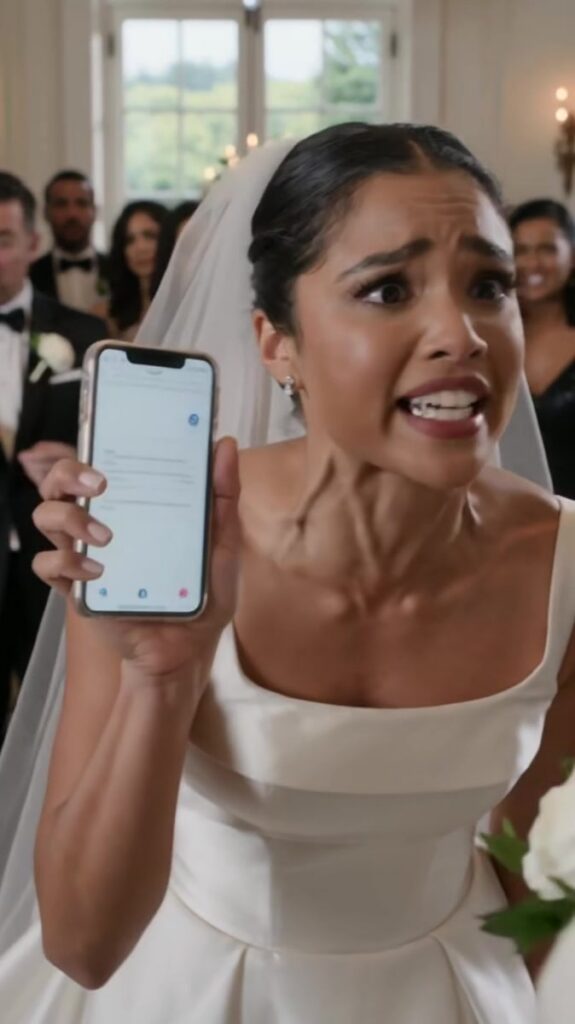
“Say her name,” Nora said, voice cutting cleanly through the garden. Her bouquet trembled in her fist like an animal trying to escape. “Don’t play dumb. Say her name out loud—right here.”
Ethan blinked, one hand pressed to his cheek. “Nora, what are you—”
“Her name,” Nora repeated, each word a nail. She reached into the folds of her skirt and produced her phone, the screen already lit. “You wrote to her after the rehearsal dinner. After you toasted me. After you kissed me goodnight.” She swallowed once, as if it hurt going down. “After you called me your future.”
The officiant stepped back, the leather folder lowering. The quartet put their bows down as if the instruments were suddenly dangerous. In the first row, Nora’s mother’s hands tightened around her clutch, knuckles whitening. Several phones rose instinctively; people did not decide to record so much as their fingers moved before their morals could catch up.
“You’re doing this in front of everyone?” Ethan hissed through his teeth, eyes darting toward the guests, toward the cameras, toward the edges of the scene as if he might find an exit concealed behind roses.
Nora’s laugh was brief and brittle. “In front of everyone is the only place you can’t lie and get away with it.” She turned the phone so he could see it, though the guests could not. “You typed, ‘I wish it were you at the altar.’ You wrote that. Last night. To her.”
The words traveled anyway, carried on the wind or on the appetite of the crowd. A shiver ran through the chairs, a ripple of murmurs. Ethan’s face drained to something paper-thin.
“Nora—listen,” he began, switching into the voice he used when he negotiated, when he charmed, when he smoothed problems until they looked like misunderstandings. “It’s not what you think.”
“It’s exactly what I think,” Nora said. Her eyes shone, but the tears did not fall. “Now say her name.”
Ethan’s throat worked. He looked, for one brief second, like a man cornered by his own mirror.
From the back, beyond the final row of chairs, a woman’s voice rose—low at first, then steady, as if she’d decided she was done being quiet in every way that mattered.
“Tell her about the baby.”
The garden seemed to stop moving. Even the breeze paused in disbelief. Heads turned as one. Somewhere, a glass clinked against a plate and rang too loudly.
Nora’s grip on her bouquet slackened. “What baby?” Her voice was smaller than before, not weaker—just stunned, like a candle suddenly deprived of air.
The woman stepped forward from the shadow of an oak tree, emerging into the sun as if crossing a line she could never uncross. She was in a plain navy dress, not wedding attire, hair pinned back without care. Her face held the exhaustion of months—sleeplessness etched into the skin beneath her eyes, a pallor that didn’t belong to the summer. In one hand she carried an envelope, and in the other she held a glossy sheet of paper that caught the light.
When she drew closer, Nora saw it: the unmistakable blur of an ultrasound image, the curved black arc of a womb, the small ghost-shape that could be a person if you believed in the future. Written along the top in clinical print was a name, a date, and a number that measured weeks in fractions of time.
Ethan’s mouth opened, then closed. He took an involuntary step backward, as if distance could rewrite ink. “She’s—she’s lying,” he said, but it came out thin, a thread of sound that snapped under its own weight.
The woman’s gaze did not leave him. “Am I?” she asked. Her voice wasn’t dramatic; it was tired, which made it more terrifying. “Do you want me to read the name printed on this? Or should I just hand it to her and let her see it herself?”
Nora’s eyes dropped to the top of the image. Her pupils widened, as if the letters were bright and burning. Her lips parted. For a moment she looked like a child about to ask a question that might split the world.
“Why is his name there?” Nora whispered. “Why is Ethan Hale listed as—” She couldn’t finish. The word father hung in the air without anyone saying it.
Ethan’s jaw worked; he looked at Nora with the desperation of a man begging for the old version of her—the one who believed the story he told. “Nora, I can explain. It was before—”
“Before what?” Nora cut in, and the calmness in her tone frightened even her. “Before you proposed? Before you picked out vows? Before you sat at my parents’ table and talked about how you wanted a family with me? Before you promised me the truth?”
The woman stopped at the aisle’s edge, close enough now that the guests could see the tremble in her fingers. She held the ultrasound out, not to Ethan but toward Nora, as if offering proof and apology in the same gesture.
“My name is Lila,” she said. “He told me he would tell you. He said he couldn’t start a marriage on a lie. He said he was just…waiting for the right moment.” Lila’s laugh was quiet and joyless. “Apparently the right moment was never.”
Nora stared at the ultrasound, then at Ethan’s reddening cheek, then at the ring poised on the pillow nearby like a glittering trap. Her bouquet slipped from her hand and landed on the grass with a soft, indecent thud.
For a heartbeat, the garden held its breath with her.
Then Nora reached out and took the ultrasound, not gently, not cruelly—simply with the precision of someone collecting evidence at the scene of a crime. She read the date again. She counted weeks in her head, her mind doing arithmetic her heart refused to accept. Her knees did not buckle. Her shoulders did not shake. Something in her seemed to lock into place, like a door finally closing.
She raised her eyes to Ethan. “Did you know,” she asked, “when you asked my father for his blessing?”
Ethan’s silence was answer enough. His gaze flicked away—toward the guests, toward the officiant, toward the sky—anywhere but the woman he’d tried to bind to him with vows.
Nora nodded once, a small movement that felt like an earthquake. She turned slightly, addressing not the crowd but the universe that had arranged roses over rot. “I wanted today to be the beginning,” she said. “But you made it an ending long before I walked down this aisle.”
She handed the ultrasound back to Lila. Their fingers brushed, and in that brief contact Nora felt the other woman’s fear—fear of being blamed, fear of being erased, fear of being trapped in the aftermath of a man’s decisions. Nora’s anger shifted shape, turning away from Lila and landing where it belonged.
Then Nora faced Ethan one last time. “Don’t follow me,” she said quietly. “Don’t touch me. Don’t call this a misunderstanding. You don’t get to turn betrayal into a conversation.”
She looked toward the officiant, who stood frozen with the folder. “I’m done,” she said.
The officiant nodded, bewildered, as if unsure whether he should offer prayer or paperwork.
Nora turned and walked back down the aisle alone. The guests parted instinctively, some with hands over mouths, others with phones still raised, their lenses hungry. Nora’s father moved as if to join her, but she lifted a hand—stop—without looking back. She needed to make this walk under her own strength, not carried by anyone, not steadied by any lie.
Behind her, Ethan called her name, one syllable cracking into the air. Nora did not turn.
At the end of the aisle, she stepped out of the circle of flowers and into the harsh open sun. The garden still smelled sweet, but now it felt like perfume sprayed over smoke. Nora kept moving until the chatter behind her became a distant roar, until all she could hear was her own breathing and the steady thud of her heart—still working, still insisting on life, even after the altar had turned into a courtroom.
Only when she reached the gravel path beyond the last hedge did she stop. She pressed a hand to her sternum, not to soothe herself but to confirm she was real. The day had not shattered her; it had revealed the crack that was already there.
And somewhere behind, under white flowers and bright daylight, the wedding that had been staged like a beginning collapsed into its truest form: a public reckoning, the moment the slap finally made sense.