The slap sounded wrong in a place built for whispers. It snapped through the cemetery like a branch breaking—sharp, intimate, undeniable—and for a heartbeat the mourners didn’t process it as violence. They registered only the motion: a gloved hand arcing, a woman’s head turning, a dark figure staggering into the flowered edge of the casket.
Under the flat, pewter sky, black umbrellas tilted as if the crowd were a single creature craning to see. A few phones rose, screens catching the glimmer of rain. The pallbearers stiffened, their shoulders tightening beneath the weight of polished wood and public expectation. The priest’s lips continued moving on instinct, prayer rolling on without his mind attached, until the words fell apart.
Verena Hale stood rigid at the head of the grave, elegant in a tailored coat that fit like armor. Her veil trembled with the force of her breath. Her mouth—usually arranged into a practiced, charitable softness—was bared in something closer to a snarl.
“You don’t get to mourn him,” she shouted, voice cracking over the fresh earth. “Not after you made him crawl through his last years.” Her gaze pinned the woman who had stumbled, the one everyone had been pretending not to notice. “You don’t get to cry over my husband.”
The other woman looked as if she’d been assembled out of damp wool and exhaustion. Her coat was too thin for the season, its seams shiny with wear. Mist clung to her hair. She pressed one hand to her cheek, already reddening beneath pale skin, and reached with the other to grip the rim of the coffin for balance. The touch made several of the wealthier mourners recoil, as if grief could be contaminated.
Someone whispered a name—Lina, maybe—then swallowed it quickly. In this town, names were currency, and the poor woman had none left to spend.
Verena stepped closer, boots sinking slightly into the mud, yet moving with the inevitability of a verdict. “You think you can show your face here,” she said, “in front of his mother, his colleagues, the people who carried him—after what you did?”
Lina’s lips parted. A sound tried to form, but it stuck behind the wall of her throat. Her eyes were red-rimmed, the kind of red that wasn’t just sorrow but sleeplessness, months of it, years. She looked past Verena to the coffin, to the spray of lilies and white roses that had been arranged to hide the finality beneath. Her fingers tightened on the polished edge, knuckles blanching.
“Say it,” Verena demanded. “Tell them why you’re here.”
The crowd held itself still. Even the wind seemed to pause, as if it had turned to listen. The priest lowered his prayer book an inch. A man at the back cleared his throat and immediately regretted it.
Lina’s hand trembled as it slid inside her coat. The movement was small, but it carried the kind of danger that makes people step back without knowing why. Two umbrellas shifted away from her as if distance could protect them. A few heads leaned in.
Verena let out a brittle laugh, the sort of laugh that tries to crush whatever it’s aimed at before it has the chance to grow teeth. “What is that,” she said, voice threaded with scorn. “A letter? A sob story?”
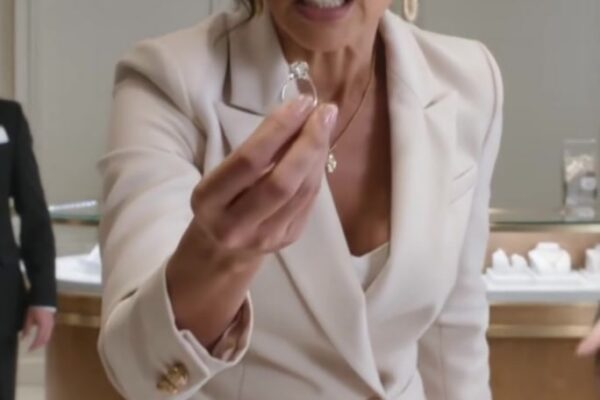
Lina withdrew her fist and opened it. A ring lay on her palm, catching the gray daylight with a muted, stubborn gleam. Not the flashy kind of jewelry that would have suited the widow’s hands, but a simple band of gold worn smooth by years of turning. Along the inner curve, faint letters curved like a secret.
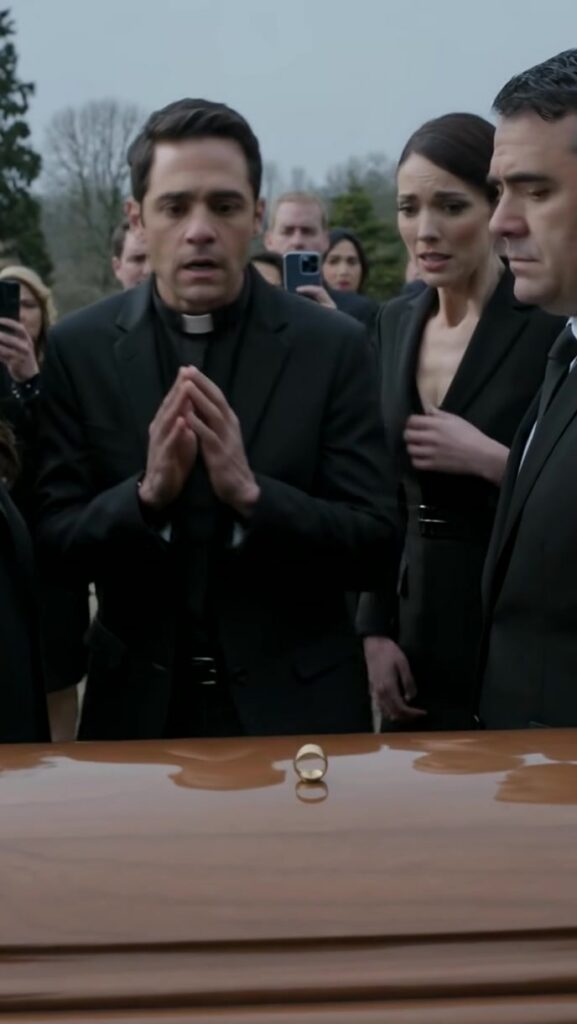
Without speaking, Lina drew her arm back and tossed it onto the coffin.
The ring hit the polished wood with a metallic click that rang louder than it should have. That single sound cut through the cemetery like a blade. The priest stopped mid-breath. The pallbearers’ muscles tightened, then froze. Verena’s expression faltered, her mouth still open as if she had been interrupted by a word she couldn’t understand.
For a long moment, nobody moved. Rain tapped the umbrella fabric. Somewhere, a crow called once and then fell silent, as if even it was startled by the tension.
The priest, Father Merrick, stepped forward, slower now, his shoes sinking into dark grass. He bent, lifted the ring, and turned it between finger and thumb. He had the careful hands of someone used to holding fragile things: chalices, infants, the wrists of the dying. When he angled the band toward the light, his face changed in stages—confusion first, then recognition, then something that looked like fear.
His lips parted, but no sound came. He swallowed. His gaze flicked from the ring to Verena, then to the coffin, as if the dead man inside could explain himself.
“That inscription,” Father Merrick finally said, voice so low it forced the crowd to lean in. “I have seen it before.” His thumb traced the inside letters, reverent and horrified at once. “This band… was placed with Elspeth Hale.”
The name moved through the mourners like a cold draft. A woman near the front made a strangled noise and covered her mouth. Elspeth: the first wife. The one whose portrait had vanished from the manor after the funeral; the one whose cause of death had been delivered as neatly as a business memo—complications, tragedy, please respect privacy.
Verena’s throat bobbed as she tried to swallow. For the first time, the widow’s poise cracked. Her eyes darted, searching for an ally, for a face that would reject Father Merrick’s words as ridiculous. But the priest stared at the ring as if it were evidence pulled from a fire.
“That’s impossible,” Verena said, but it didn’t come out as a confident denial. It sounded like a plea.
Lina stepped closer to the coffin, her fingers leaving damp prints on the polished lid. Her voice, when she finally found it, was thin with strain and sharp with purpose. “It isn’t impossible,” she said. “It’s the point.”
The crowd’s attention narrowed until there was only Lina, Verena, the priest, and the closed box between them. Even the pallbearers seemed unsure whether they were allowed to breathe.
Lina lifted her chin, exposing the mark blooming on her cheek, and looked straight at Verena. “I didn’t ruin his life,” she said. “I tried to save it.” Her eyes slid to Father Merrick, then back to the coffin. “He came to me after midnight three weeks ago, shaking so hard he couldn’t hold a glass. He said he’d done something he couldn’t undo, and he was afraid the ground would open for him.”
Verena’s hands curled into fists inside her gloves. “Stop,” she hissed, but her voice had lost its command.
“He told me about Elspeth,” Lina continued. “Not the story you sold the town. Not the pretty grief. He told me what was in her will. He told me about the safe that disappeared the day she died. He told me he couldn’t sleep because he kept hearing dirt on wood.”
Father Merrick’s face had gone ashen. “Lina,” he said, as if warning her, as if the dead should not be provoked.
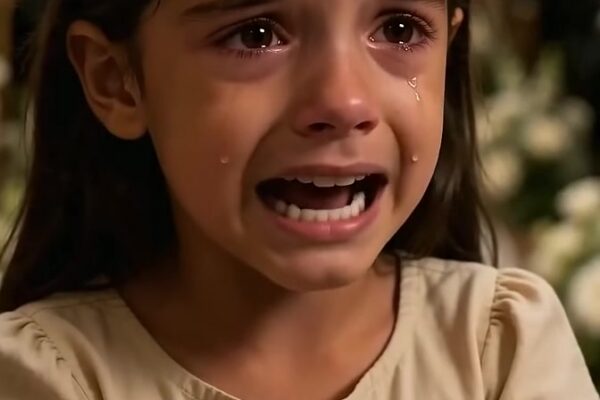
“He made me swear,” Lina said, blinking hard, tears spilling anyway, “that if anything happened to him, I would bring this ring where everyone could see it. He said it was the only thing he was sure hadn’t been destroyed.” Her voice broke on the next words, but she forced them out. “He said it was taken back out of her grave.”
A murmur swelled—disbelief, speculation, indignation—until Father Merrick raised his hand. The gesture wasn’t commanding; it was desperate.
Lina’s gaze didn’t leave the coffin. “If that ring was buried with Elspeth,” she whispered, “then someone opened her grave.” She lifted her eyes at last, pinning Verena with them. “Tell them who did.”
Verena’s face seemed to drain of color, the elegance suddenly too brittle to hold her up. Her lips moved, forming words that didn’t arrive. Around her, the mourners shifted, no longer watching a widow’s outburst but a woman cornered by a fact that had crawled out of the ground.
The rain thickened, as if the sky had decided to take sides. Father Merrick still held the ring, and his hand trembled now, not from age but from the weight of what it implied. Behind him, the grave waited open, dark and patient.
Verena stared at the gold band, at the letters inside that only the priest could read clearly, and her voice finally came—not as a scream, not as a speech, but as a small, ruptured sound. The kind a person makes when a door they thought was locked swings wide.
In that moment, the funeral ceased to be a farewell. It became an excavation.