No one noticed her at first. Not truly. In the rain, everyone became a blur—hoods drawn tight, collars up, faces lowered to hide from the wet and from one another. The alley behind the fish market was a narrow throat of brick and steam, and the men who slipped through it moved like they owned the night.
She was only a smaller shadow among them, a child’s silhouette swallowed by black water and streetlight. Her shoes made no noise; the rain did that for her. She passed the stacked crates and the half-lit loading door as if she belonged, as if the lock would recognize her by blood instead of keys.
The door opened when she pushed. No one had guarded it. No one had needed to. The place was known only by the kind of people who didn’t wander in by accident.
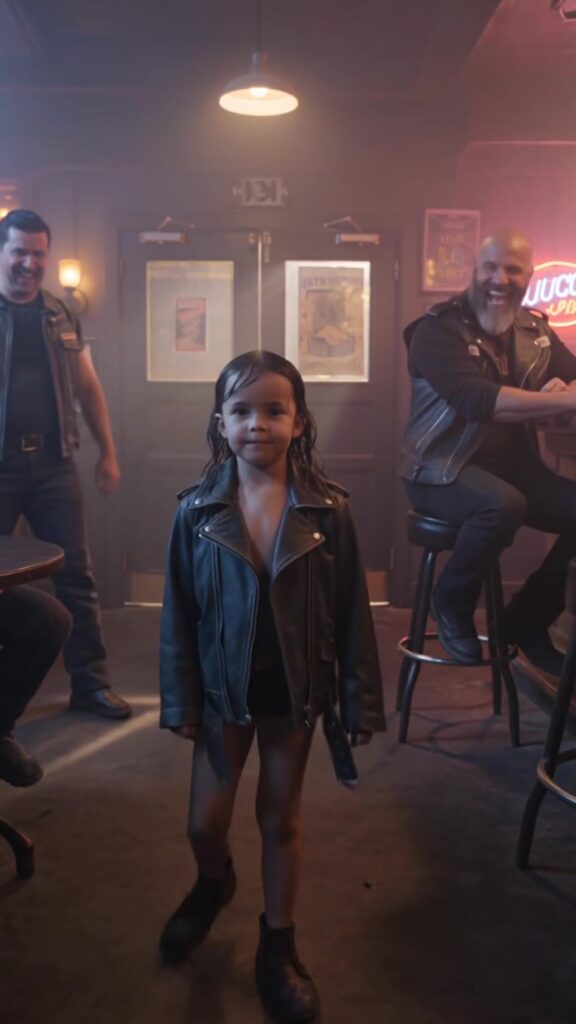
Warmth hit her first—stale, heavy with smoke and old liquor. Then the sound: laughter that didn’t reach anyone’s eyes, the clink of glasses, the lazy scrape of a chair on concrete. The room was a long rectangle, lit by a single hanging lamp above a scarred table. Men sat around it in various states of comfort, their coats steaming as if they’d brought the storm inside with them. A few looked up, saw a child, and decided she couldn’t be real.
Someone snorted. “You lose something, kid?” Another voice, crueler, made a joke she was too young to understand but old enough to hear the shape of.
She stood just inside the doorway until it swung shut behind her. The sound was sharp in the room, like a gavel. A few heads turned properly then. A man near the back—thick hands, gold tooth—rose half an inch from his chair, then sank again, amused.
“Whose is she?” asked one. “Did you bring her?”
They chuckled, passing the question like a bottle. Nobody claimed her. Nobody moved to escort her out. She was beneath threat, beneath concern, beneath the cost of attention.
She took three steps forward, shoes leaving dark marks on the floor. The lamp’s light hit her face: rain-struck hair plastered against her cheeks, skin pale from cold, eyes too steady. She was small, yes—nine years old, maybe less to the careless glance—but her posture belonged to someone who had already learned what fear could and could not do.
“From today,” she said, and her voice was quiet enough that the room leaned without meaning to, “you answer to me.”
Laughter burst as if someone had thrown a match. It rolled across the table, bumped into the walls, grew bolder. A man slapped the wood. Another wiped his eyes as though he’d been gifted a joke he’d retell for years.
Then the leader stood.
He was not the largest man in the room, but the air moved around him as if it knew better than to resist. His name in this city was Marek, though names were for paperwork and graves. He wore a coat too fine for the docks and carried himself like the owner of every door he approached. He walked toward her slowly, each step confident, as if he were giving the room time to enjoy itself before he ended the entertainment.
He stopped an arm’s length away and looked down. His expression was almost gentle—amused, patient. “Who are you, girl?” he asked. “Get out of here. That’s impossible.”
She didn’t back away. She didn’t raise her chin in defiance. She simply reached into the pocket of her soaked coat and brought out her left hand.
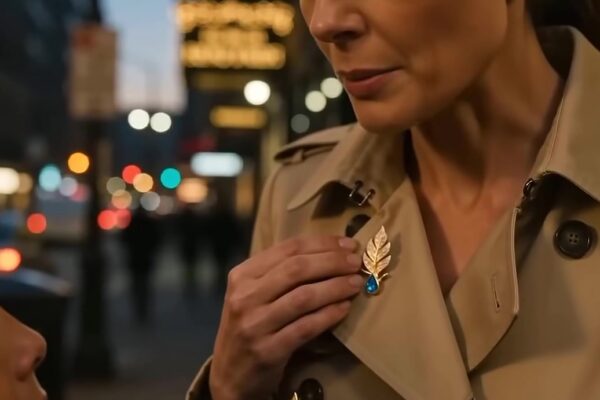
On her smallest finger sat a ring.
It wasn’t flashy. No diamond. No bright gem. It was old gold, worn smooth by years, the kind of piece that had survived wars by being tucked into bodies and bread. Its face held an engraved crest—two keys crossed beneath a crown of thorns—and in the center, dark enamel formed a mark that seemed to drink the light.
The laughter died in a single breath.
One second—noise. The next—silence so complete the rain outside sounded like applause.
Marek’s eyes fixed on the ring as if it had spoken his true name. The color drained from his face. He blinked once, hard, like a man waking from a bad dream only to find the dream standing in front of him.
Behind him chairs shifted, but no one dared stand. The gold-toothed man’s mouth hung open. A younger one—tattooed knuckles, eager cruelty—looked at Marek’s expression and swallowed his grin whole.
Marek’s lips parted. Nothing came out. Then, slowly, as though pulled by a force older than pride, he lowered himself to one knee.
The scrape of his trouser against the floor sounded like blasphemy.
Every man in the room stared, trying to understand what kind of history could bend Marek’s spine. This wasn’t power, not the loud kind they traded in—guns, threats, bribes. This was inheritance. This was an oath none of them admitted still lived inside their bones.
The girl watched him without triumph. “My name is Elara,” she said, and in that moment the room recognized a name they had buried beneath rumors. A name that used to make shipments cross oceans, make judges look away, make enemies disappear without a trace. “My mother is dead,” she added, because truth cut faster than any knife, “and my father died before I learned his face.”
Marek’s gaze flickered up to her eyes and then back to the ring, as if checking that both were real. “That ring,” he whispered, and the word came out like a confession. “It was burned. We watched it burn.”
“You watched a decoy,” Elara replied. “You watched what they wanted you to watch.”
She stepped closer to the table, and the men unconsciously made room, knees drawing back, hands lifting off weapons as though the metal suddenly belonged to someone else. Elara climbed into an empty chair at the head without asking. Her feet didn’t touch the floor. She looked even smaller seated among them, and somehow that made the tension worse, like a child holding a lit match in a room full of gas.
“I didn’t come for respect,” she said. “I came because I need help.”
Marek remained kneeling. No one told him to rise.
Elara’s fingers curled around the ring as if it anchored her. “They’re coming back,” she continued, and when she said “they,” the word seemed to carry an old chill. “Not the police. Not rivals from the docks. The ones who ended my family the first time. The ones who made you all swear you’d never say our crest again.”
A few men exchanged glances—quick, fearful, pretending not to know what they knew. Marek’s throat bobbed. “The Ash Covenant,” he said, voice strained, as though speaking it might summon smoke. “That’s a bedtime story.”
Elara leaned forward until the lamp’s light painted sharp shadows under her eyes. “I saw them,” she said. “Not as a story. In my house. In the walls.”
She pulled something else from her pocket and placed it on the table. It was a small strip of cloth, blackened at the edges as if burned, bearing the faint imprint of the same crossed keys—only this version was twisted, the crown replaced with a circle of ash.
“They left this on my mother’s tongue,” Elara said, voice steady in a way no child’s should be. “And they left a message. They said the city forgot who it belonged to. They said they’ll remind it.”
The room seemed to shrink. Every man there had built his life on forgetting—forgetting the old order, forgetting the night the fire ate the estate on the hill, forgetting the screams that had made hardened men pray.
Elara’s gaze moved from face to face, and the men who met it felt the weight of her watching, as if she were counting them—measuring who could still be useful, who would run, who would betray.
“You can laugh at me,” she said softly. “You can throw me back into the rain. But if the Ash Covenant returns, you won’t have anywhere to hide. They don’t take money. They don’t negotiate. They don’t stop until every name tied to my family is erased, including yours.”
Marek finally rose, as if granted permission by some unseen judge. His eyes were haunted now, stripped of amusement. “What do you want from us?” he asked.
Elara lifted her hand, the ring catching the light like a low, patient flame. “I want what you swore,” she said. “Not to my mother. Not to my father. To the crest. To the keys. To the city you helped steal and then tried to keep for yourselves.”
She paused, letting the words settle like dust after a collapse.
“Find them,” she said. “Before they find me again.”
Outside, the rain continued its steady drumming, unaware that inside a room of dangerous men, a child had just dragged the past out of its grave—and demanded it stand guard beside her.