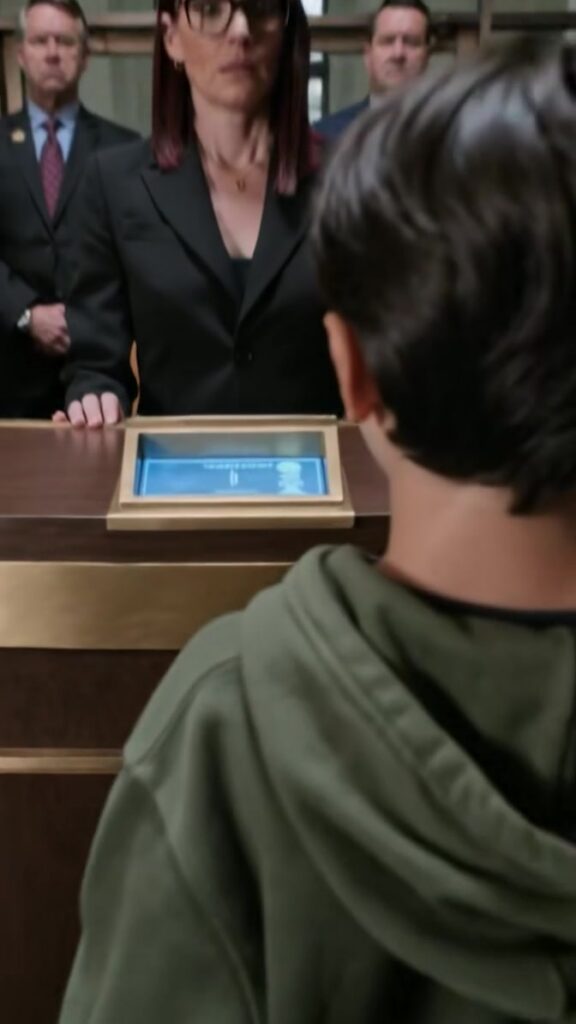
No one believed him when he stepped into the Granite & Gray Trust building with rain still clinging to his hair. He looked too small for the lobby’s marble grandeur, too young to understand the quiet threats in polished brass and guarded glances. His sneakers squeaked on the floor, and the sound traveled farther than it should have, turning heads the way a shout might.
The boy stood in front of the reception counter, hands closed around a single card as if it were warmer than the world. It wasn’t a bank card. It wasn’t a keycard. It wasn’t anything anyone recognized. Matte black, no logo, no name, no strip—just a thin seam that caught the light and, on the corner, a faint embossed mark like a crescent made by an old coin.
“Can I help you?” the clerk asked without warmth. Her nameplate read NORA KELSEY. Her smile was a practiced line.
“I need to check something,” the boy said. His voice was calm in the way of someone who had already rehearsed the words in a room where nobody listened.
Nora’s eyes slid past him, searching for an adult—any adult—who should have been responsible for the presence of a child in a place like this. There was no one. Only the revolving door spinning slowly behind him, and beyond it the gray day with its wet streets and honking impatience.
“This isn’t a museum,” she said. “Get out.”
He didn’t flinch. “I’m not leaving.”
The guard by the metal detector shifted his weight. Not because of the sentence itself, but because of the steadiness with which it was spoken. Kids bluster. They bargain. They cry. This one sounded like he had already accepted whatever would happen next.
“Where are your parents?” Nora asked, irritation sharpening her vowels.
“My mom said I had to come here,” he replied. “I only came to check what belongs to me.”
A breathless laugh slipped out of someone in line behind him. It wasn’t cruel, exactly; it was the reflex of adults faced with a child performing adulthood. Nora’s eyes narrowed as if she could compress him into an apology.
“And what,” she said, “belongs to you?”
The boy set the card gently on the counter. It didn’t clack like plastic; it landed with the mute certainty of stone. He pushed it forward with two fingers.
Nora rolled her eyes, then—because she was bored, because she wanted the little standoff over, because it took less effort to humor him than to argue—she picked up the card and turned it over in her hands.
There was nothing to scan. No barcode, no chip. Still, the card felt oddly heavy, and the crescent mark seemed to catch on her skin as if it had texture.
“This isn’t—” she began, then stopped because the computer screen flickered on its own.
The lobby’s background noise thinned. A printer halted mid-whir. The music that always played—soft piano meant to turn anxiety into compliance—stuttered into silence. Even the guard straightened as if he’d heard his name called from far away.
Nora held the card above the counter, hovering, suddenly unsure whether she had touched something she wasn’t supposed to.
“Ma’am?” the guard said, half a question.
Nora swallowed. “It’s… reacting.”
She slid the card across the desk the way you might slide an offering across an altar, and the embedded scanner—one she hadn’t used in months, hidden beneath a flap labeled INTERNAL—lit with a blue line.
The card didn’t beep. It didn’t make any sound at all. The screen simply changed, as if the system recognized a presence rather than a number.
Then Nora’s face drained of color.
On the monitor, in a neat corporate font, an account summary populated itself: entity name blank, status active. Below it, columns of assets unfolded like an endless list.
Nora blinked hard. “That can’t be happening…”
“What is it?” someone whispered behind the boy.
Nora’s fingers trembled above the keyboard. “The numbers on the screen—”
She leaned in, then back again, as if distance would make it more reasonable. “They aren’t real.”
Yet they were there: figures with too many zeros, values that dwarfed the bank’s own reserves. The system had stopped converting into dollars, switching instead to raw units as if currency itself had become inadequate. The sum line read like a mistake you would erase before anyone saw, except the computer didn’t allow edits. It simply displayed.
The guard stepped closer, and Nora—who had dismissed the boy with a word—found herself lowering her voice as if the air had become expensive. “He owns everything,” she said, the words tasting wrong in her mouth.
A silence settled, complete and heavy. People in line stopped pretending not to listen. A man in a tailored coat lowered his phone. The security camera above the desk rotated by a fraction, as though to watch more carefully.
The boy didn’t move. Didn’t smile. Didn’t ask if it was a joke or if there had been an error. He looked at the screen with the exhausted familiarity of someone confirming a bruise.
Nora’s gaze snapped from the monitor to the boy. “Who gave you this?”
He answered without hesitation. “My mom.”
Nora’s throat worked. “Your mother’s name?”
His eyes flickered to the revolving door, to the rain beyond it, as if he could see her there for one more second if he tried hard enough. “Evelyn Hart.”
The name had a strange effect. Nora stiffened. The guard’s hand lifted from his belt and then dropped. In the lobby’s far corner, an older man who had been reading a tablet looked up sharply, his face tightening like a fist.
Evelyn Hart. A name that had vanished from news articles years ago, buried beneath corporate mergers and the calm language of ‘restructuring.’ A name associated with whispers in boardrooms: founder, dissident, ghost.
Nora lowered her voice. “Evelyn Hart is—”
“Dead,” the boy supplied softly.
The word landed with finality. Nora’s eyes glossed, not with sympathy, but with the dawning realization that she was standing at the edge of something she could not file, not deny, not fix with policy.
He added, “She told me something else.”
Nora waited, caught between impatience and fear. “What did she tell you?”
The boy’s fingers curled against the counter’s edge. “She said the first time they scan it, it will show what they stole.”
Nora glanced at the screen again. A red banner had appeared, silently, like a wound opening: DISCREPANCY DETECTED. Then a list began to scroll—companies, properties, patents, trusts, foundations—each item paired with a date and an authorization signature that repeated in different handwriting styles, as if many hands had borrowed the same name.
“She said the second time,” the boy continued, “it will show what they feared.”
Nora’s mouth went dry. “There is no second time. We don’t—”
The boy leaned forward. His reflection rippled in the glossy counter, doubled by the bright screen. He looked at the monitor as if speaking to it would make it tell the truth faster.
And suddenly—
it changed.
The account summary vanished. The numbers collapsed into a single, pulsing line of text that wasn’t a balance at all. It was a sentence, written in the same corporate font but carrying none of its false calm.
BENEFICIARY CONFIRMED.
Then another line appeared beneath it:
EXECUTIVE ACCESS OVERRIDE: ACTIVE.
A chime rang out—a tone so low it felt more like pressure than sound. Locks clicked somewhere in the building’s hidden spine. The elevator at the far end of the lobby lit up without anyone touching it, its floor indicator racing downward as if it were emptying itself for a guest.
People stepped back instinctively. Nora did too, bumping her chair. The guard raised a hand, not in threat, but in caution, as though the boy might be dangerous in the way lightning is dangerous—unintentional, absolute.
On the screen, names filled the space where balances had been. Not the boy’s. Not his mother’s.
The board. The executives. The trustees. Each name appeared with a status beside it, one by one.
PENDING REVIEW.
HOLD PLACED.
ASSETS FROZEN.
ACCESS REVOKED.
Nora stared, her breath shallow. The older man in the corner stood abruptly, his chair scraping like a scream across the marble. His face had gone rigid, eyes fixed on the monitor as if it were a mirror finally showing him his own reflection.
The boy watched the cascade without surprise. A sadness lived in his stillness, the kind that doesn’t come from losing a game but from learning what adults do to win them.
Nora whispered, barely able to form the words. “This… this is impossible.”
He turned his head slightly, and for the first time his composure cracked enough to reveal the child inside it. Not fear—something older. Resolve, borrowed from a woman who had known she wouldn’t live to enforce her own truth.
“My mom said you’d say that,” he murmured. “She said you’d call it a glitch or a prank. She said you’d try to throw me out before you looked.”
Nora’s eyes burned. “What do you want?”
He lifted his hand and pointed—not at the screen, not at the guard, not at Nora, but at the elevator whose doors had just opened like a mouth.
“I want,” he said, “to see what’s in the basement.”
Nora’s lips parted. The building’s lower levels were not on the public directory. They were spoken of only in training manuals with pages missing, in security briefings held behind glass doors. Vaults. Archives. Contracts. The kind of history corporations preferred to lock away.
The boy stepped away from the counter, the black card now resting in Nora’s palm like a weight she could not set down. He walked toward the elevator with the steady pace of someone following a map drawn by a dying hand.
Behind him, the lobby remained frozen—people held in place by a revelation they hadn’t asked for but could not unsee. Nora watched his small back recede, watched the rainwater darken the marble in footprints that looked like punctuation marks.
Just before he reached the elevator, he paused and looked back at her.
“You told me to get out,” he said quietly. “But this is mine.”
Then he stepped inside.
The doors slid shut with a soft, final whisper, and the indicator above them blinked—no floor number, no letter, only a single character that none of them remembered seeing before.
∞