The sky over Grayridge Cemetery looked rinsed clean, as if someone had scrubbed the color away with a rough cloth. Ethan Caldwell stood at the iron gate with a paper-wrapped bundle of lilies pressed to his chest, listening to the hinge whine like an old throat clearing. He had rehearsed this visit in his head—one last time before he went back to work, before the world demanded he pretend it was possible to keep living.
Three months since the crash. Three months since the closed casket. Three months since the part of him that used to laugh at small things had gone silent. Normal, he told himself. This was supposed to be normal: come, kneel, talk to the marble, leave flowers, go home to an empty house that still smelled faintly of her shampoo.
He followed the gravel path, shoes crunching softly, passing stones that carried entire lives in hyphens and dates. The wind was thin and cold. At the far row, under a maple with bare branches like fingers, was her marker—ANNA CALDWELL. BELOVED. The word BELOVED felt like a dare.
Ethan crouched, set the lilies down, and brushed a few dead leaves off the granite. “Hi,” he murmured, because it was what he always said first, as if she could be startled awake by politeness. His breath fogged and vanished. He told her about the neighbor’s new puppy. About the leak in the kitchen that he still hadn’t fixed. About how the house creaked differently at night now that it only held one heartbeat.
Silence answered, dense and heavy, the kind that made his ribs ache. He reached into his coat pocket, thumbed the edge of the small velvet box he’d brought—the one that held her wedding ring. He had promised himself he would leave it here today, stop carrying it like a talisman, stop punishing his hand with the imprint of its circle. His palm closed around the box, and he lowered his head.
“Goodbye,” he whispered, and the word tasted like metal.
“She can’t hear you.”
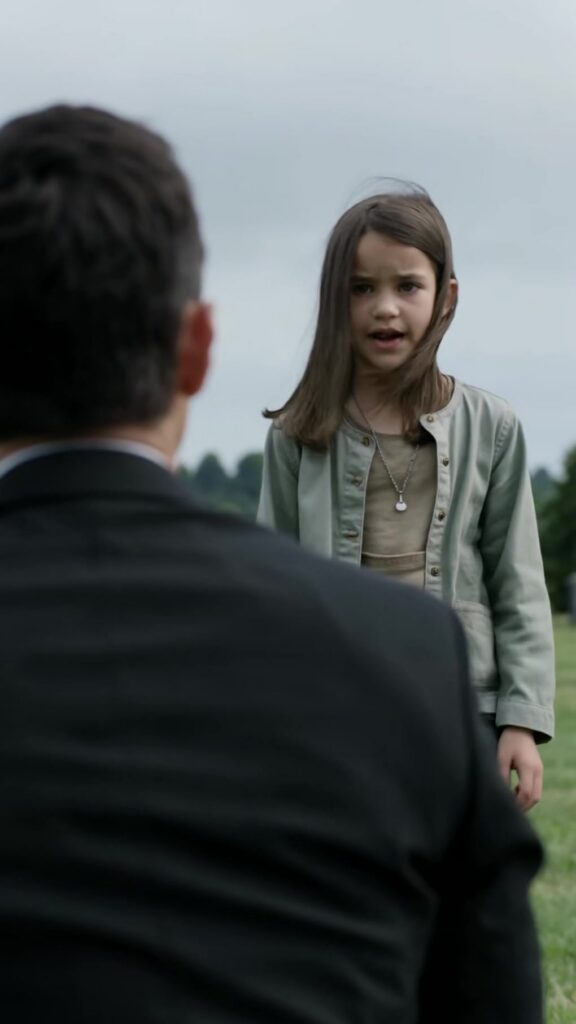
The voice was behind him—young, quiet, steady. Not a caretaker calling hours. Not another mourner. Ethan’s body went rigid before his mind could catch up. He turned quickly, expecting to see an intrusive stranger with a phone, or an apologetic teenager cutting through rows. Instead, a girl stood several paces away at the edge of the path.
She looked about seventeen, maybe eighteen, with dark hair pulled into a low knot and a plain gray coat buttoned to her throat. She held herself as if she were made of careful angles. Her eyes fixed on Ethan with an expression that wasn’t pity, wasn’t curiosity—more like evaluation, like she was making sure he existed.
“Excuse me?” Ethan said, his voice rough from not being used.
The girl stepped closer, her shoes soundless on the gravel. “Your wife isn’t dead,” she said. Her tone carried no flourish, no drama. Just a statement placed between them like a stone.
Ethan’s throat tightened. Anger tried to rise, but it tangled with something else—hope, sick and instinctive. “Don’t,” he said. “That’s not funny.”
“I’m not laughing,” she replied. Her hands moved, and for the first time he noticed she’d been holding something small. She opened her palm.
A necklace lay coiled there, the chain thin and gold, the pendant a tiny oval locket etched with a vine pattern. Ethan recognized it the way the body recognizes fire. Anna never took it off; she’d worn it on their wedding day, on hikes, at the sink washing dishes. It had rested against her collarbone like it belonged to her skin.
It had also been placed in the casket, because he had insisted. Because it had felt like a final kindness to bury her with the thing she loved.
“Where did you get that?” Ethan asked, and his voice came out too loud, cracking the cemetery’s fragile hush.
The girl watched his face as if cataloging every twitch. “From her,” she said. “From Anna.”
Ethan’s hands began to tremble. The lilies on the stone seemed suddenly unreal, a stage prop. “That’s impossible.”
“The crash wasn’t an accident,” the girl said. “It was a collection.”
“A what?” Ethan’s mind stuttered over the word, unable to fit it into his life. “Who are you?”
She hesitated, then reached into her coat pocket and pulled out a folded, creased photograph. She held it out. Ethan stared at the glossy rectangle and felt his stomach drop. The image showed Anna in a hospital bed, hair damp with sweat, her face gaunt but unmistakably alive. A digital clock on the wall read 2:13. Her eyes were open, unfocused, looking past the camera as if she were trapped behind glass.
“I’m Lark,” the girl said. “I live in the places people don’t check. I take things out before they disappear.” She nodded toward the necklace. “That was one of the things.”
Ethan’s fingers closed around the photograph. It was real—the cheap, slightly blurred kind you got from old printers. “When was this taken?” he demanded.
“Two nights after her funeral,” Lark replied. “They keep them sedated, move them through basements and service elevators. Different names. Different paperwork. Dead people are easy to transport.”
Ethan’s head spun. Three months of grief, and now this girl was calmly peeling it open like a scab. “Who are they?” he asked, though part of him already feared he knew: the faceless machinery that made tragedies neat, that turned chaos into closed cases.
“People who trade in bodies,” Lark said. “People who profit from your certainty.”
His knees weakened, and he grabbed the edge of the stone for balance. “Why are you telling me?”
Lark’s gaze flicked to the headstone, then back to him. “Because I’m tired,” she said simply. “And because your wife kept saying your name when she thought no one was listening.”
Ethan tried to swallow. “If she’s alive… where is she?”
“Not here,” Lark answered. “But you need to look at the grave.”
He frowned, heart thudding. He had been looking at it. He had memorized the grain in the granite, the moss at the base, the way the earth had settled into a gentle dip around the edges. He forced his eyes down anyway, and the cemetery seemed to tilt.
Something was wrong with the soil.
The ground at the foot of the marker wasn’t smooth the way it had been for weeks. It had been disturbed recently—subtle, like someone had pressed a palm into flour and tried to erase the print. A shallow seam ran along the edge where the grass met the dirt, too straight to be natural. Ethan leaned closer and saw a thin scatter of fresh clay, darker than the surrounding earth, still moist beneath the dry surface.
His lungs forgot how to work. “No,” he whispered, the word breaking. “No, no—”
Lark crouched and pointed. “They came back,” she said. “After everyone stopped visiting. After the grief got quiet.”
Ethan’s hands went numb. The velvet box slipped from his fingers and fell into the grass with a soft thud. He stared at the disturbed ground and imagined the lid of the casket lifting, imagined emptiness where Anna should have been, imagined the necklace missing because someone’s gloved hand had taken it like a receipt.
He looked at Lark, rage and terror burning together. “You’re saying she was never in there,” he said, barely able to form words. “Or she was, and then—”
“I don’t know which is worse,” Lark said. “But I know this: the only reason you still have a marker to talk to is because you stopped asking questions.”
Ethan’s vision blurred. He wanted to dig with his bare hands, to rip up the grass, to force the earth to explain itself. But his body wouldn’t move. All he could do was stare at the grave that had held his mourning like a container, now cracked open.
Lark placed the necklace gently atop the stone, as if returning it to its rightful place. The pendant caught a sliver of gray light and winked. “If you want her,” she said, “you have to become the kind of person who doesn’t accept official answers.”
Ethan’s mouth tasted like dirt. He looked down at the name carved in granite—ANNA—and it no longer felt like a memorial. It felt like a warning. The cemetery was quiet, but the silence had changed. It wasn’t peaceful now. It was watchful.
He picked up the velvet box, stood slowly, and met Lark’s unwavering eyes. “Tell me what you know,” he said. “All of it.”
Lark nodded once, sharp and decisive, as if some internal clock had reached a mark. “Not here,” she whispered. “They listen in places like this.”
And as Ethan followed her away from the grave, the wind shifted through the bare maple branches, stirring the lilies against the stone, making them rustle like paper in a file drawer being opened.
Behind them, the disturbed soil lay waiting—an unsealed sentence at the end of his former life.