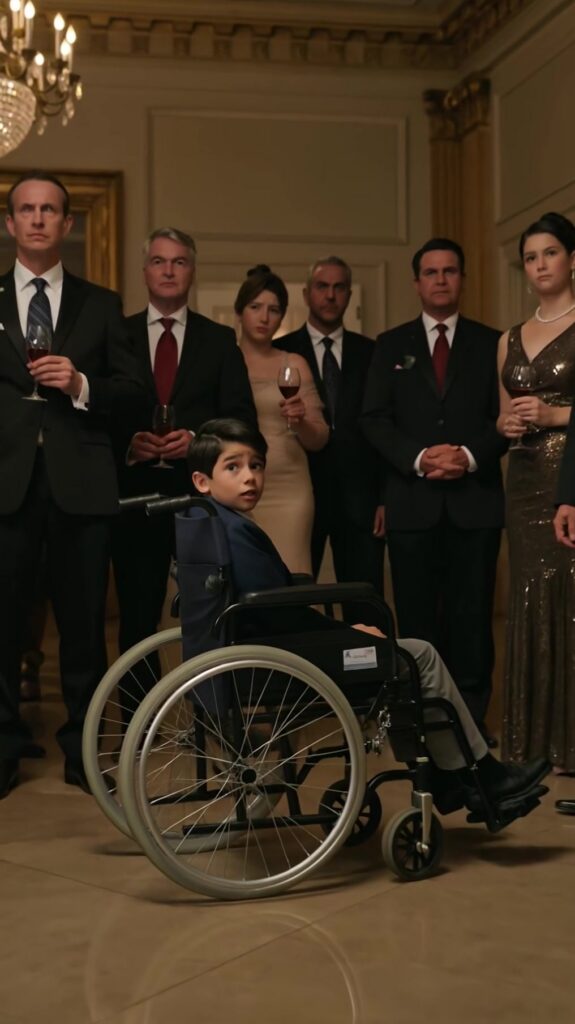
The quartet never paused. Not when the chandeliers trembled with laughter, not when crystal clinked and silk brushed against silk, not even when the rain began to tick at the tall windows like impatient fingernails. Vivaldi flowed through the ballroom of Harrow House the way perfume did—expensive, persistent, and meant to cover something sharper underneath.
It was an anniversary gala for the Harrow Foundation, an evening for donors and photographs and careful sentences. The staff moved like shadows. The guests moved like they owned gravity itself. At the far end of the room, beneath an arch of orchids that looked freshly cut from someone else’s garden, sat Rowan Harrow in his wheelchair, angled slightly away from the crowd as if he were a decorative piece that required a flattering view.
He watched the room as though it were an aquarium: mouths opening and closing, eyes glittering, fingers holding their stems of champagne with the same careful tension. Every so often his gaze snagged on his mother.
Elara Harrow stood near the dais in a gown the color of midnight ink, her posture so perfect it seemed practiced in solitude. She had the calm of someone who believed the world was a puzzle she had already solved. When she smiled, people relaxed, as if her approval were shelter.
Rowan knew that smile. It was the one she wore when she won.
The violin climbed into a bright, agile phrase, and the doors at the back of the ballroom opened.
The girl who walked in did not belong to the frame of the evening. She wore no sequins, no carefully chosen heels, no borrowed sparkle. She had on a simple dark dress and flat shoes, her hair pinned back with the kind of impatience that makes practicality look like defiance. She wasn’t tall, and she couldn’t have been more than sixteen, but she stepped into the light as if it were hers.
No invitation. No hesitation.
Conversation didn’t stop, not really. In a place like that, people didn’t allow surprise to show its teeth. But a hush spread in the way heat does when the furnace turns on: subtle, unavoidable. Heads turned with the smallest movements. Eyes slid toward her and away again, pretending discretion.
The girl’s gaze cut straight through the room, over shoulders and catered smiles, and landed on Rowan’s wheelchair. She began walking.
A man in a tailored suit moved as if to intercept, then thought better of it when her expression didn’t offer a place to argue. She moved with a purpose that made obstacles rearrange themselves.
Near the orchids, Elara noticed. Her smile did not change at first, but something inside it tightened. She stepped forward into the girl’s path with the kind of grace that looked like kindness from a distance.
“You’re lost,” Elara said, her voice shaped to be heard only by those nearby. “This is a private event.”
The girl didn’t slow. “I came for him.”
The words were wrong for her face, too calm, too seasoned. The donors near Elara went still, sensing a crack in the glass and leaning closer to see if it would shatter.
Elara’s eyes flicked over the girl’s dress, her shoes, the lack of any recognizable emblem of status. “You shouldn’t be here.”
“I wasn’t asking.”
The quartet played on, the notes continuing their elegant climb, but the room shifted anyway. It wasn’t chaos. It was weight. The sensation of a large object passing overhead, blocking out a familiar light.
Rowan felt it in his chest first, that old ache that arrived whenever someone spoke as if his life belonged to their agenda. He opened his mouth to say something—anything—when another voice, rougher than he expected, cut through the air.
“…Wait.”
It wasn’t loud. It didn’t need to be. The girl stopped instantly, as if the word had been a hand on her shoulder. Every eye, every fraction of attention, turned toward Rowan.
He hated that. The spotlight. The pity. The careful calculation of what had happened to him and how much it must have cost. But this time the attention felt different, sharpened by the girl’s stillness.
Elara’s composure held, but a thin fracture appeared at its edge. “Rowan,” she said, the warning wrapped in his name.
He ignored her and stared at the girl. Something about her—something uninvited—made his breath catch. Not her clothes, not her posture. Her eyes. They were the color of river stones, flat and ancient, as if they’d seen too many winters to belong to a teenager.
He searched his memory and found, impossibly, a summer he wasn’t supposed to have.
Rain on hot pavement. A hospital garden. A voice telling him to listen—not to the doctors, not to the machines, but to the place inside him where sound turned into feeling.
Elara moved again, placing herself between them. “You don’t know her,” she said, too quickly.
The girl’s gaze did not shift to Elara. It stayed on Rowan as if nothing else in the room had mass. “He does.”
Silence fell, real silence, the kind that doesn’t belong among catered platters and polite applause. Even the quartet seemed to play from far away, as if the music had retreated to the corners out of respect.
Rowan leaned forward. The movement was small, but it made the chair creak. “It’s you,” he whispered, and the words tasted like disbelief.
The girl finally smiled, but it wasn’t triumph. It was relief sharp enough to hurt. “You remember,” she said softly.
Elara’s chin lifted. “Rowan, don’t indulge—”
“Her name is Mara,” Rowan said, each syllable dragging itself up from somewhere buried. “You told me she was… you told me she was a hallucination.” He looked at his mother, and the old fear in him shifted, finding a new shape. “You told me I was confused.”
Elara’s eyes flashed. “You were medicated. You were vulnerable. You created stories to cope.”
“No,” Mara said. The word fell like a stone into a pond, and the ripples reached every corner of the ballroom. “You made sure I disappeared.”
People pretended not to listen. They always did. But their bodies betrayed them, turning subtly toward the confrontation as if drawn by gravity.
Mara stepped closer to Rowan, close enough that he could smell rain on her skin, close enough that the air between them felt charged. She extended her hand, palm up, fingers steady.
“Stand up,” she said.
A few guests made involuntary sounds—tiny exhalations, the soft choking shock of people who had never been told no by the laws of physics. Elara’s breath went shallow, and for the first time that night her elegance slipped, revealing something frantic beneath.
“This is cruel,” Elara hissed. “He can’t—”
Rowan stared at Mara’s hand. It was ordinary. No glowing, no miracle threaded through the skin. Just a hand offered with absolute certainty, like a bridge built across an abyss.
His own hand lay limp on the armrest, familiar as defeat. Years of therapy. Years of being congratulated for progress that never became freedom. He swallowed, and a memory surfaced—Mara leaning close in that hospital garden, her lips near his ear as the rain began.
Now she leaned in again, her voice only for him.
“They taught you to obey the pain,” she whispered. “I’m here to teach you to disobey.”
Something in Rowan’s chest shuddered, not hope exactly, but anger—clean, bright anger at every night he had lain awake listening to music from downstairs while he stared at his own legs like they were foreign objects. Anger at every time his mother had said, with soft eyes, that some things were simply impossible.
His fingers twitched.
It was barely visible, the smallest rebellion, but it was real. He felt it like a spark under the skin.
Elara took a step forward, her control finally cracking into something like fear. “Rowan.”
Rowan didn’t look at her. He reached—slowly, shaking, as if his own body were a locked door and he had lost the key. His fingertips brushed Mara’s palm.
The contact was warm. Human. Not imagined.
The quartet continued, obediently unaware or professionally indifferent, their music threading through the tightening air. But in Rowan’s mind, the melody changed. It became the sound of a gate unlatching.
Mara’s grip closed around his hand, firm but not forcing. “Again,” she murmured, as if they had done this a thousand times.
Rowan drew a breath so deep it hurt. He commanded his foot to move the way he once had without thinking, back when motion was as natural as laughter.
His leg answered with a tremor.
Somewhere in the room, a glass slipped from someone’s fingers and shattered, the sound sharp and bright. No one moved to clean it up. No one could. All eyes were on the boy who wasn’t supposed to change and the girl who hadn’t asked permission.
Elara’s voice came out thin. “Stop. You don’t understand what you’re doing.”
Mara didn’t glance back. “I understand exactly.”
Rowan tightened his grip on her hand. The music didn’t stop. It swept on, elegant and relentless, as if daring the world to remain the same. And in the middle of Harrow House, beneath chandeliers and orchids and a thousand watching faces, Rowan began to rise—slowly, impossibly—toward whatever came next.