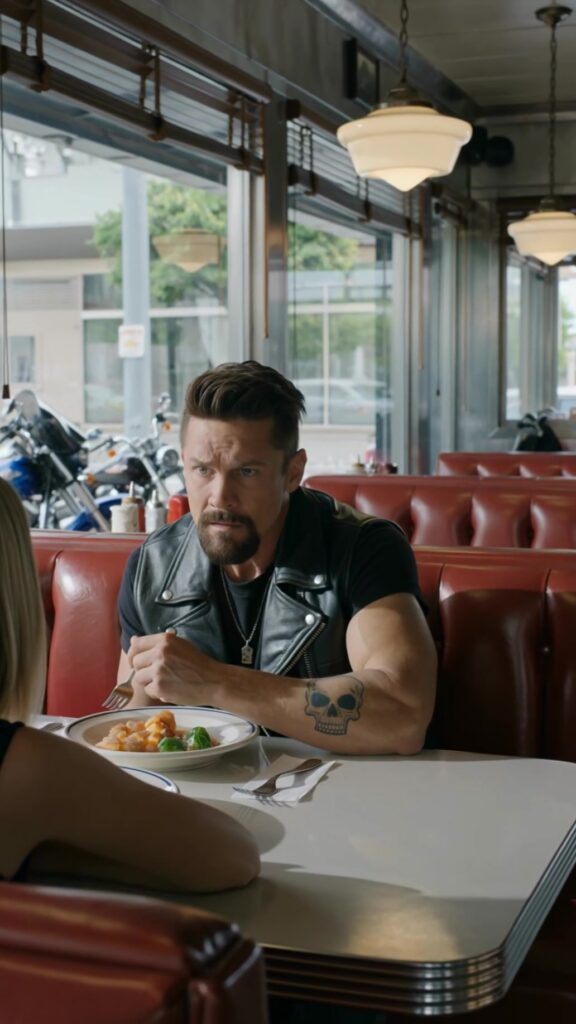
The place called itself Route 9 Family Diner, but nobody in fifty miles called it family. It was a strip of fluorescent light in the wet night, a smear of chrome and coffee steam where truckers drifted through like weather and locals ate their grudges with fried eggs. Forks scraped, a jukebox wheezed out old country songs, and the fryers hissed like snakes. The noise had its own gravity, pulling stories down into the booth cushions and trapping them there.
Cal Briggs liked it that way. Noise meant cover. The kind of cover a man needed when he’d spent a lifetime making sure certain names stayed buried.
His bike sat outside, black and road-scarred, beading rain on the tank. He sat alone at the counter, his back to the wall out of habit, hands wrapped around a mug that tasted like burned beans and second chances. A waitress with tired eyes refilled it without asking. Cal nodded, polite enough to pass, invisible enough to survive.
He’d been in a dozen diners like this. Same menu. Same linoleum. Same look people got when they saw his leather jacket and decided to measure the distance to the door. He could’ve left after the first cup, but he’d been riding too long, and the night had teeth.
Then the noise shifted—not louder, not quieter, just rearranged, as if the room had made space for something it didn’t understand.
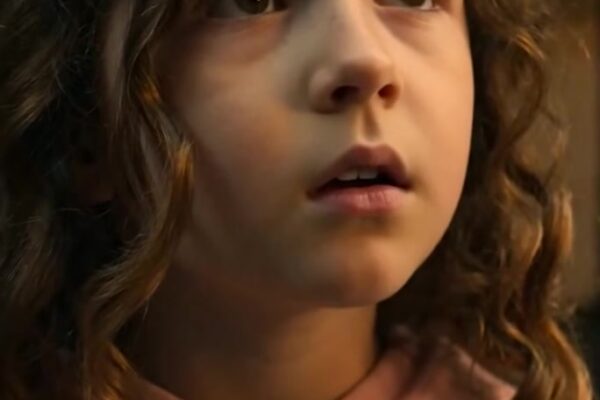
At the last booth, half hidden behind a plastic ficus, a girl sat alone. No fries. No phone. No fidgeting. Not a glance toward the window. She was maybe sixteen, hair pulled back as if hands had done it in a hurry and never returned to fix it. She stared at the tabletop like it had written her instructions.
People didn’t sit like that in a diner. People did something—chewed, talked, scrolled, watched the door. This girl simply existed, still as a held breath.
Cal told himself to ignore her. He told himself it was none of his business, that stillness could be grief or drugs or defiance and he didn’t want to know. But he looked anyway. It was a reflex older than his scars. He’d spent too long reading rooms for danger, and danger sometimes wore silence.
Her gaze lifted, slow and precise, and locked onto him.
Not his face. His arm.
Cal’s jacket sleeve had ridden up as he reached for the sugar. On the inside of his forearm, just above the wrist, a small mark showed—dark ink, softened by time. A circle and a line through it, simple as a child’s drawing, but his skin remembered the needle. A symbol you didn’t get by accident.
The girl slid out of the booth. Not hurried. Not hesitant. Each step measured, like someone counting to keep from shaking. When she stopped at the counter beside him, the diner’s chatter dimmed in Cal’s ears, the way it did when a storm chose a tree.
She didn’t ask if the seat was taken. She didn’t smile. She leaned just enough to see the mark more clearly.
“My father had that,” she said.
Cal’s first instinct was to laugh it off. Plenty of men had tattoos, plenty of daughters carried stories. A harmless coincidence was the easiest kind. He didn’t turn fully to her, kept his shoulders casual, his tone flat. “Lots of people have lots of things.”
But her voice didn’t fit the words. It wasn’t teenage bravado. It was something older, steadier—like someone reading from a page that couldn’t be rewritten.
“He told me,” she continued, “to never trust anyone who doesn’t.”
Cal’s fingers tightened on his mug. Heat bit his skin. The symbol wasn’t some trend. It belonged to a network that had died, on paper and in fire, years ago. A network he’d helped end. The air around him suddenly felt too thin.
He turned his head and finally looked at her. Her eyes were pale, not pretty, not cold—just sharp. Too sharp for a kid who should’ve been worried about finals and curfews. On the bridge of her nose, a faint bruise was turning yellow, like time was trying to erase it.
“Where’d you hear that?” Cal asked, careful.
She tilted her head, studying him the way people study locked doors. “From him.”
Cal swallowed. The coffee tasted like rust. “What’s his name?” The question left his mouth before he’d decided to ask it. The diner noise bled back for a moment—someone laughing too loud, a plate breaking—and then faded again, as if the room leaned in.
She didn’t hesitate. No searching her memory, no uncertainty. “Daniel Carter.”
The name hit Cal like a fist to the throat.
Not because it was famous. Because it wasn’t supposed to exist. Daniel Carter had been a ghost even when he breathed, a man with too many passports and too few friends. Daniel Carter had been reported dead in a warehouse fire eight years ago, a fire Cal could still smell in his sleep. Daniel Carter had been the one who taught Cal how to disappear—and the one who taught him the price of staying.
Cal stared at the girl until the edges of her face blurred. For a second, he heard only the tinny hiss of the fryer, like flames whispering secrets.
“That’s not a name you say out loud,” Cal murmured.
“I don’t have anyone else to say it to,” she replied. Her composure cracked just enough to show the raw thing underneath. “They told me he never had a daughter. They told me he never existed. But he taught me that symbol. He said it meant you belonged to the only people who would tell the truth when the truth was dangerous.”
Cal’s pulse beat hard at his jaw. “Who’s they?”
Her hands, clenched at her sides, trembled once. “The men who came after him. The ones who came after me.” She looked toward the window. Rain streaked the glass. Beyond it, headlights passed and vanished. “He said if I ever got cornered, I should find someone who still carries the mark. Someone who would recognize the old rules.”
Cal’s mind ran through old corridors: passwords, dead drops, safe houses that were now probably condos. He remembered Daniel’s voice, patient and ruthless. He remembered the last time they spoke, in that warehouse, Daniel pressing a key into Cal’s palm and telling him to run. Cal had run. Daniel had stayed behind, wearing a calm that looked like surrender.
“Daniel Carter is dead,” Cal said, because saying it was easier than believing anything else.
The girl’s eyes didn’t flinch. “Then why did he call last week?”
Cal’s breath stopped. “What?”
She reached into her jacket pocket and pulled out a folded paper napkin, the kind the diner used. On it, in careful block letters, was a sequence of numbers—coordinates, or a code, or both. Underneath, two words: TURN THE KEY.
Cal’s stomach turned. The phrase wasn’t poetic. It was operational. It was the kind of instruction that opened doors that were meant to stay closed.
Outside, an engine idled too long in the parking lot. A low rumble under the rain. Cal didn’t look; he didn’t need to. His body recognized the timing, the way predators wait until the moment attention shifts.
He slid off the stool, slow, so the movement didn’t announce itself. “What’s your name?” he asked, voice barely above the clatter of plates.
She hesitated for the first time. “Mara.”
Cal nodded once, like the name had weight. He reached for his jacket sleeve and tugged it down, hiding the mark. Then he did something he hadn’t done in years: he took a risk without calculating every exit.
“Mara,” he said, keeping his eyes on the reflective chrome of the coffee machine so he could see the room behind him, “you’re going to walk to the restroom like you need to wash your hands. Don’t run. Don’t look at the door. I’m going to pay the check. When I tap the counter twice, you go out the back. There’s an alley and a delivery gate. My bike’s too visible, so we’ll take the truck.”
“Whose truck?”
Cal’s smile was brief and humorless. “Whichever one starts.”
Mara’s lips parted as if to argue, then closed. She turned and moved away, her stillness replaced by purpose. Cal watched the window reflection: two men entered, rain on their shoulders, faces blank in the way blank faces are trained. Their eyes scanned. Not hungry. Hunting.
Cal set a twenty on the counter. The waitress opened her mouth to speak, and he shook his head, just once, a silent plea not to become part of the story. He tapped the counter twice—soft, like a coin dropping.
As he moved toward the back hall, Cal felt the past rising, not as memory but as machinery. Daniel’s name was no longer buried. It was a flare in the dark, and Mara was the hand that had lit it.
In the narrow corridor by the kitchen, the diner’s noise fell away completely. Cal’s heart pounded like a warning drum. He thought of the key Daniel had pressed into his palm years ago—a small brass thing he’d kept hidden in a hollowed-out handlebar grip, because some pieces of the past refused to die.
Turn the key, the napkin demanded.
Cal pushed through the back door into the rain-slick alley. Somewhere behind him, a chair scraped hard against the floor, and a voice rose, sharp with recognition.
Cal didn’t look back. He only lifted his sleeve long enough to glimpse the faded symbol, to remind himself of the oath inked into skin: truth when truth was dangerous.
Then he ran into the night, toward the truck, toward Mara, toward a name that should have stayed silent—and toward whatever waited on the other side of the key.