The diner was full of noise—plates, voices, laughter—braided together into the kind of racket that made you forget your own thoughts. Grease hissed on the griddle. A jukebox fought to be heard over the lunchtime crowd. In the corner booth, a baby fussed while a tired man tapped a spoon against his coffee cup like he was counting down the seconds of his life.
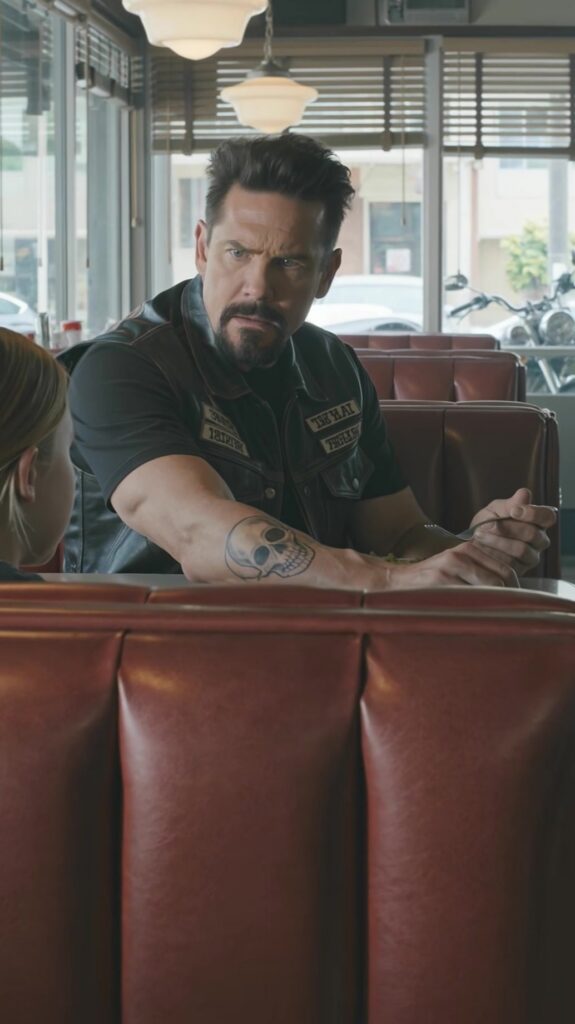
At the counter, with his back half to the room, Miles Rourke sat like a boulder in a river. People flowed around him and didn’t look too closely. That was the trick: you stayed big, quiet, and boring. The leather jacket helped. The scar at his jaw helped. The steel ring on his right thumb helped most of all—a dull band stamped with a small split lightning bolt, the sort of thing nobody would notice unless they’d been trained to look.
He had his helmet on the stool beside him, his coffee black, his plate untouched. He wasn’t hungry. Hunger meant feeling, and feeling made you sloppy. He was waiting for his contact to slip a paper under the sugar caddy, the same as every other meeting in every other town that had a diner like this. Sunlight cut through the window and laid a blade across the counter, bright enough to show the trembling of his hand if anyone cared to watch.
Then the room changed.
It wasn’t a sound—nothing dramatic like glass shattering or a scream. It was a small shift, the way a crowd subtly tilts toward the entrance when the temperature drops. The laughter didn’t stop, but it turned brittle. The clatter of plates became too sharp. Even the jukebox sounded off-key, as if the song had taken a wrong turn.
Miles didn’t turn at first. Years had taught him that the fastest way to be seen was to act like you were looking. Still, the hair at his nape lifted. Something had entered the room that didn’t belong, and his skin recognized it before his eyes did.
The bell above the door hadn’t rung. Or maybe it had and everyone’s ears had been busy with their own lives. Nobody seemed to notice the girl standing just inside the entrance, the way you don’t notice a shadow until it crosses your feet.
She was small—maybe fifteen, maybe older, hard to tell with her thin frame and stillness. Her dark hair fell straight and plain, no shine, no charm. She wore a gray hoodie in weather too warm for it. Her hands hung at her sides, empty. She didn’t scan the room for a table. She didn’t glance at the pie case. She didn’t fidget with a phone. She looked as if she’d been placed there, and the world had forgotten to tell her to breathe.
Except she was staring at Miles.
He felt it like a hand closing around his throat. The old instincts snapped awake: measure exits, measure distances, judge intent. The front door behind her. The side hall by the restrooms. The kitchen swing doors. The windows. Too many eyes in here if something went wrong. Too many innocent people, too many angles, too many chances for a mistake that couldn’t be undone.
Miles shifted his thumb over the ring, a slow rub that looked like nothing. If the girl was a distraction, it was a good one. If she was a message, it was a cruel one.
She took a step. Then another. Not hurried, not afraid, not curious. Just inevitable. Her gaze never broke.
Miles tried to hold onto ordinary. He let out a small breath that could have been a laugh. “Kid,” he muttered, low enough for only the counter to hear, “you’re in the wrong place.”
She stopped beside his stool, close enough that he could smell rain on her clothes though the sky outside was clean blue. Her eyes were a startling gray, like stormwater. She lifted one hand and pointed—not at his face, not at the helmet, but at the ring on his thumb.
“My father had one like that,” she said.
The sentence landed wrong. Not because of what she’d said, but how she’d said it. No tremor, no bravado. Like reciting something that had been stitched into her.
Miles let out a soft chuckle, a practiced sound that had gotten him out of trouble more times than he could count. “A lot of people have rings,” he said. “You want a milkshake or something?”
Her eyes didn’t flick to the menu. They didn’t flick anywhere. They held him as if he were the only solid object in the room.
“He told me,” she continued, “never trust anyone who doesn’t have it.”
The diner noise swelled and then dulled again, like waves against a breakwater. Miles’s jaw tightened. That line wasn’t random. It was a passphrase, one he hadn’t heard spoken aloud in twelve years, not since he’d watched a barn burn to the ground with three men inside it and sworn he’d never say their words again.
“What did you say?” Miles asked, and his voice wasn’t casual anymore.
The waitress came close with a coffeepot, hesitated, and moved on as if she’d forgotten what she was doing. That was how it always happened when trouble was real: the world sensed it and tried to pretend it hadn’t.
The girl stepped closer, so close her shadow cut into the sunlight on the counter. “He said you would pretend not to remember,” she said. “He said you would look for a joke because that’s easier than fear.”
Miles’s fingers closed around his coffee glass. The warmth of it did nothing. “What’s your name?”
“Doesn’t matter.” Her voice stayed level. “He didn’t give me a name that would survive.”
Miles’s heart made a hard, stupid punch against his ribs. He found himself watching her hands for a weapon, but they remained empty, open, the way a child’s hands are when they’re asking to be believed.
“Who is ‘he’?” Miles asked, though he already knew the shape of the answer and hated himself for knowing.
She didn’t smile. She didn’t soften. She simply said the name.
“Daniel Carter.”
The glass in Miles’s hand slipped just enough to click against the counter. A tiny sound, lost in the diner’s roar, but it might as well have been a gunshot in his skull. Daniel Carter wasn’t supposed to be a man anyone could name. Daniel Carter was a ghost filed away in sealed records and ash. Daniel Carter was the reason Miles Rourke had stopped being Miles Rourke.
“That’s not possible,” Miles whispered.
“He said you’d say that too,” the girl replied. “He said you’d call him dead because it’s safer.”
Miles forced his eyes away from hers long enough to glance toward the booths. No one was watching. No one was listening. The world was doing what it always did—pretending danger belonged to other people.
He lowered his voice. “Where is he?”
For the first time, something flickered in her expression—not fear, not sadness, but a thin, sharp urgency, like a blade turning in a sheath. “He’s not coming,” she said. “Not in the way you want.”
Miles’s thumb scraped the ring again, feeling the stamped lightning bolt like a scar. “Then why are you here?”
She finally shifted her gaze, just a fraction, to the window where his motorcycle sat angled toward the road. A black machine waiting like a promise. “Because he left me a map,” she said, “and a warning. He said if I ever found you, it meant the people who erased him were done being quiet.”
Miles’s stomach went cold. The organization that had trained him, used him, and tried to bury Daniel hadn’t been called by any name you could put in a newspaper. They were just “the Bureau” to the men who worked in darkness. A thousand faces, no fingerprints. They didn’t leave daughters behind. They didn’t allow witnesses. Unless the witness was bait.
“What do you want from me?” Miles asked, and he hated how much he already cared about the answer.
The girl reached into her hoodie pocket. Miles’s muscles tightened, ready to move, to break, to run. She pulled out a folded piece of paper, creased until it looked like it had lived in her hand. She placed it on the counter between them like an offering.
“He said to give you this,” she said. “And to tell you one more thing.”
Miles didn’t touch the paper. Not yet. He watched her face, searching for the lie. “What?”
Her voice dropped even lower, the words nearly swallowed by the diner’s cheerful chaos. “He said the ring isn’t just a sign,” she murmured. “It’s a lock. And you’re the only one still alive who can open what he hid.”
Miles stared at the folded paper, at the small, ordinary thing that might as well have been an indictment. He thought of Daniel laughing in a different diner in a different life. He thought of smoke and screams and the promise he’d made to never go back.
Outside, a truck rumbled past. The bell above the door finally gave a faint jingle as someone left, and sunlight shifted across the counter like a slow, turning blade.
Miles lifted his eyes. “If you’re lying,” he said, “you picked the worst man to try.”
The girl’s stare didn’t flinch. “I’m not lying,” she said. “I’m late.”
“Late for what?”
She nodded toward the parking lot, where a sedan had just pulled in—plain, clean, forgettable. Two men stepped out at the same time, wearing the kind of neutral clothing that made them invisible until it was too late. One of them glanced at the diner’s windows as if counting faces.
The girl looked back at Miles. “Late for them,” she said.
Miles’s fingers closed over the folded paper at last. His ring felt suddenly heavy, like a shackle and a key at once. He slid off the stool, keeping his body between the girl and the window, and for the first time in years he let himself feel the old, familiar, terrible certainty.
Daniel Carter wasn’t supposed to exist anymore.
But neither was Miles Rourke.
And yet here they were—alive in a room full of noise—when the silence finally arrived.