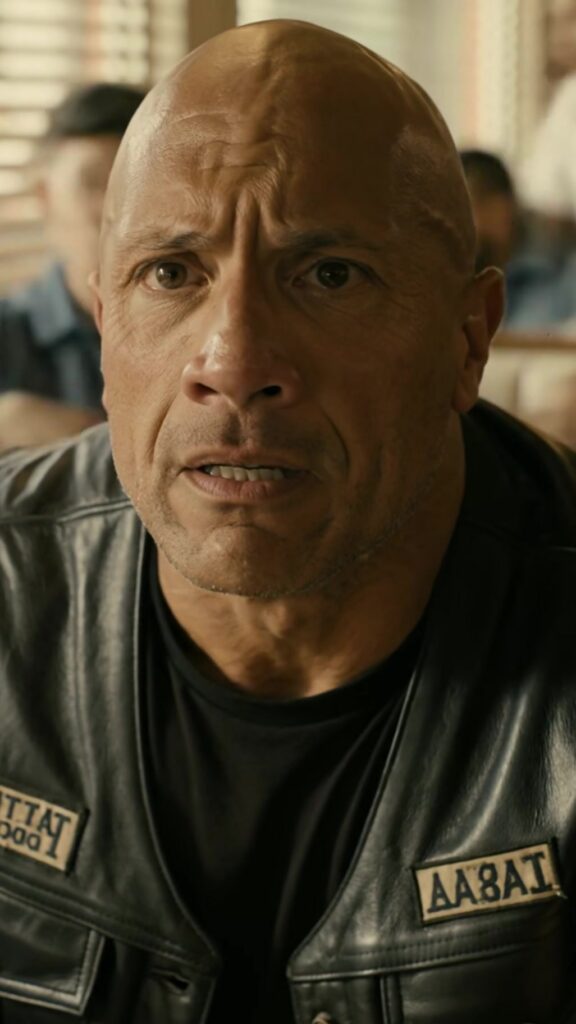
The diner called itself the Iron Lantern, but no one in three counties used the name. It was just the Lantern—the place where the coffee was black as motor oil and the booths held secrets the way road grit held to chrome. On Saturday nights it felt like a living thing: breath in the hiss of the grill, pulse in the jukebox that never quite played the same song twice, bones in the stool legs that scraped when men shifted their weight.
Outside, bikes lined the curb like resting animals, still hot enough to tick as they cooled. Inside, the regulars spoke in low currents. Nobody laughed too loud. Nobody stared too long. The Lantern had rules that weren’t written, and they were enforced by a man everyone called King.
King sat with his back to the wall at the long table by the window, where the neon OPEN sign reflected in his glass like a wound that wouldn’t close. His hair was shot through with gray, pulled back tight. His vest looked like it had been sewn on him. The patch on his shoulder—an old club insignia—was faded, but his reputation wasn’t. When King blinked, the room seemed to blink with him.
That was how the place stayed predictable. That was how it stayed safe—for the people who belonged there.
Until the door slammed hard enough to make the bell strike once, sharp and wrong. A sound like a warning shot.
The waitress, Marla, had her mouth open to scold whoever couldn’t handle a handle, but her words fell away. Everyone had already turned.
A little girl stood in the doorway, framed by the rain that had started without anyone noticing. She was maybe eight. Too thin for her coat. Too pale around the lips. Water ran off her bangs in straight lines like she’d been crying with her whole body.
She didn’t look around like lost kids did. She didn’t hesitate like runaways. Her gaze fixed in one direction, steady as a headlight.
King’s table.
Chairs stopped creaking. Forks paused midair. Even the jukebox seemed to lower its volume, as if it knew it was about to be blamed for what happened next.
She started walking. Each step was small but deliberate, heel-to-toe, like she’d practiced the distance in her head. She passed men whose knuckles were scarred, whose eyes had learned to measure danger before it spoke. Some of them shifted, as if to block her path on instinct. Then they didn’t. Something in her face made them hold still.
Marla whispered, “Honey… you okay?” but the girl didn’t break stride.
She stopped at King’s table, so close her coat brushed the edge of his plate. There was a line of gravy on his fork. A piece of cornbread he hadn’t touched. King didn’t move to make room. He didn’t need to; people usually backed away from him without being told.
The girl lifted her hand and pointed—not at his face, not at his knife, but at the ink on his forearm where his sleeve was pushed up. A tattoo, old and dark: a lantern with a broken glass globe, flames drawn like claws.
Her voice came out soft, but it carried in the silence like a match struck in a gas station.
“My dad had that.”
King’s eyes narrowed, not in anger at first, but in calculation. He glanced at her shoes—muddy, cheap. He glanced at the door—still open, rain slicing in. He didn’t ask her name. He didn’t ask why she’d come. He asked the question that mattered.
“Where’d you see it?”
Her throat bobbed as she swallowed. “On him. He used to trace it when he couldn’t sleep.”
A man two seats down, Tank, let out a breath like he’d been punched. Another biker, Jace, turned his head away and stared at his hands as if they’d begun to tremble without permission.
King’s voice stayed controlled, but something in it chipped. “What’s your father’s name?”
The girl’s eyes shone, but she didn’t cry. Not yet. She looked at King like she was trying to memorize him, or accuse him, or both.
“Daniel Hayes.”
A glass slipped from someone’s fingers and broke on the tile. The crash should have been loud. It wasn’t loud enough. Nobody looked down. Nobody moved to sweep it. King sat perfectly still, as if any movement might trigger a trap.
“That’s not possible,” he said, and the words sounded like he’d dragged them up from deep water. “We buried Danny.”
“No,” the girl replied. The certainty in her small voice made the hair on Marla’s arms lift. “You didn’t.”
King’s jaw worked once. “Kid, you don’t know what you’re saying.”
She reached into her coat pocket and pulled out a crumpled envelope that had been folded and unfolded until the paper went soft at the seams. She held it with both hands. It wasn’t addressed. It didn’t need to be.
“He told me to come here,” she said. “If anything happened. He said there was only one person who would understand what he meant when he said the Lantern broke.”
King’s gaze dropped to the envelope as if it were a weapon. “Where’d you get that?”
“He gave it to me.”
“When?”
“Before he didn’t come home.” Her composure finally cracked at the edge. Her breath hitched, and her eyes flooded, but she kept them open. “Mom said he left. But he didn’t leave. He promised me.”
King’s hand hovered over the envelope, then stopped. He didn’t take it. He didn’t want to touch it in front of witnesses. In front of men who still believed he was carved out of steel.
“Open it,” the girl said, voice trembling now, “or I will.”
Something passed over King’s face—fear, and then anger, not at her but at a memory. Tank half stood. Jace grabbed his arm and pulled him back down, shaking his head hard.
King finally reached out and took the envelope with two fingers, as if it might burn. He unfolded the paper inside. The room leaned in without moving.
The letter was short. King read it once. Then again, slower. His lips pressed together so tight the skin around them whitened.
Marla watched his eyes, saw them go distant the way they did when men returned from places they didn’t talk about.
“He said,” the girl whispered, “that you’d remember what you did after.”
King looked up. The diner’s neon reflected on the wet shine of his eyes, and for a moment the legend in the booth looked like just another man who’d outlived his own choices.
“Where is he?” King asked, and the question came out raw.
The girl wiped her face with the sleeve of her coat and shook her head. “I don’t know. I only know someone came to our house. A man with a ring shaped like a wolf. He talked to Mom in the kitchen. And after he left, she burned Dad’s pictures.” She swallowed. “And she told me never to say the name Daniel Hayes again.”
That did it. The name of the ring—unspoken but understood—hung over the table like a noose. The wolves were not club folklore. They were business. They were men who didn’t ride together because they didn’t need anyone watching their backs.
King pushed back from the booth so quickly the table rattled. The sound snapped the spell, but it didn’t ease the tension; it only proved it had been real. He stared at the girl, and his voice went low enough that only the nearest could hear.
“Danny’s not dead,” he said, more to himself than to anyone else. “He’s hidden. Or he’s held.”
The girl nodded once, like she’d been waiting for him to admit it. Then she said the final thing, the thing that turned the room from suspense into dread.
“He said if you read that letter and still did nothing, then you were never his brother.”
King’s eyes flicked to his men. To Tank, to Jace, to the faces that had followed him through bar fights and funerals and snowbound rides. They looked back with something unfamiliar: not loyalty, not bravado—something like pleading.
Because they had all heard the same rumor years ago. That Danny Hayes had turned on the club to stop a deal with the wolves. That King had chosen the club over the man who’d saved his life.
King folded the letter with slow, shaking hands. He placed it in his vest like he was putting away a blade.
“What’s your name?” he asked the girl.
“Lila,” she said. “Lila Hayes.”
King stood. His chair scraped back, loud as thunder. In the Lantern, it was the kind of sound that meant things were about to break.
He reached down, and after a pause—after a visible battle with himself—he held out his hand. Not a threat. Not a test. An offer.
“Then you’re coming with me,” he said. “And I swear on that ink you pointed at… we’re going to find out who decided your father could be erased.”
Lila took his hand. Her fingers were cold. King’s grip tightened just enough to make a promise.
Outside, thunder rolled over the highway. The lights in the diner flickered once, as if the building itself flinched. And as King led the little girl toward the door, the men at the table rose—one by one—like hardened stone turning, at last, into something that could move.
In the dark glass of the window, Marla saw their reflections shift: not bikers in a diner anymore, but a crew headed into a storm they’d pretended wasn’t coming.
The bell rang as the door swung open, and the night swallowed them whole.