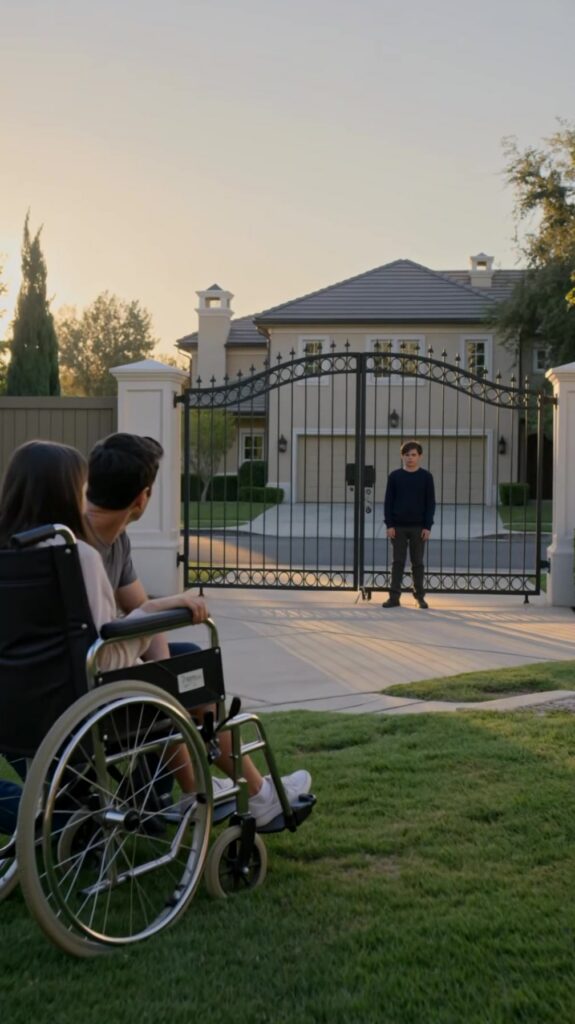
“DAD—I CAN’T FEEL MY LEGS!”
The words tore through the morning like a siren. The backyard had been ordinary seconds before—watering can tipped in the herb bed, the neighbor’s dog barking at nothing, a thin breeze pushing the clothesline into a slow sway. Then her voice cracked the air, and everything that had been soft turned sharp. A pair of sparrows exploded from the maple, wings snapping. The quiet that followed didn’t feel peaceful. It felt incorrect, like the world had missed a beat and couldn’t recover.
Mark dropped the watering can so hard the metal clanged against the stone path. Water spilled into the gravel, darkening it in a spreading stain. He crossed the yard in three strides and fell to his knees beside the wheelchair. His daughter’s hands were clenched around the armrests so tightly her knuckles blanched. Her face had gone a frightening shade of pale, freckles floating on it like scattered ash.
“Hey—hey, Lily, look at me.” His voice tried to sound like the man who fixed broken taps and opened jars and carried her up stairs when she couldn’t manage. It came out thin instead. “Tell me what you feel. Anything. Tingling? Pressure?”
She shook her head hard enough to rattle the straps of her summer dress. Tears collected along her lower lashes and didn’t fall, as if her body was holding those back too. “Nothing. It was… it was there, like always, and then it’s gone. Like my legs aren’t even… attached.” She glanced down at her knees as though expecting to see empty space.
Mark’s hands hovered over her shins, not touching, afraid that the wrong touch would prove something. He remembered the hospital’s fluorescent hallway, the verdict from the surgeon delivered with gentle firmness: spinal swelling, uncertain recovery, time would tell. He remembered the driver who’d run the stop sign and the blur of metal and noise. He remembered signing forms without reading them, because the only sentence he could see was my daughter may never walk again.
“I know,” he whispered, not because he knew—because he couldn’t bear to say he didn’t. “I’m here. We’ll call Dr. Patel. We’ll go in right now. You’re safe, Lily. You’re safe.” He tried to hold control in both hands like a fragile bowl, but it shook.
Then a voice came from behind the fence gate. “I can help her.”
It was calm in a way that set Mark’s nerves on fire. Not the cautious calm of a neighbor offering a spare tire. Not the practiced calm of a doctor. It was calm like certainty. Like someone naming the weather.
Mark spun. A boy stood just beyond the gate, half in shadow, half in sunlight. He looked about Lily’s age—maybe fourteen—but his posture was too still, too deliberate, as if he’d rehearsed how to stand in someone else’s grief. His hair was dark and uncombed, his eyes watchful. He held nothing in his hands. That somehow made it worse.
“Stay back,” Mark said. The words came out sharp, protective, final. His body leaned over Lily, instinctively blocking. “This is private.”
The boy didn’t flinch. Didn’t apologize. He simply took one step forward until the gate squeaked on its hinges. “She’s not supposed to be like this,” he said, like he was stating a fact someone had gotten wrong on paper.
Mark felt the temperature shift. The sun still shone, but it seemed suddenly far away. “What do you mean?”
Lily’s eyes moved between them, wide and searching. She swallowed, and when she spoke her voice was so small it seemed to come from somewhere deeper than her throat. “How do you know anything about me?”
The boy’s gaze softened when it landed on her, but there was no pity in it. Only recognition. “Because I was there.”
Shock hit Mark like a shove. His mind ran through every possibility—reporter, scammer, the driver’s kid with a guilt confession, some online creep who’d followed Lily’s story. He rose from his knees, towering over the boy by sheer urgency. “Where?” he demanded, voice dropping low, dangerous. “Where were you?”
The boy lifted his hand slowly, as if he expected the air itself to resist. He didn’t point at the street. He pointed at Lily.
“In the car,” he said. “Not… sitting. Not like that. I mean—” His expression tightened, the first crack in his calm. “I was in the moment. When it happened.”
Mark’s heart began to pound with a hard, steady thud, the way it used to before big storms. “Are you telling me you were in the other vehicle?”
“No.” The boy shook his head once. “I was on the median. By the stop sign. I saw the truck coming. I saw you turn. And I—” He swallowed as if words were stones. “I tried to stop it.”
Mark barked a laugh that had no humor in it. “You tried to stop a truck?”
The boy’s eyes flicked toward Lily’s legs, then back to Mark. “I didn’t stop it. I just… redirected it. I thought I could change what would break. I thought I could choose something smaller.”
The sentence was nonsense, but it hit Mark in a place that remembered the impossible. The day after the accident, when Lily had been unconscious and Mark had sat beside her bed with his forehead pressed to the sheets, he’d sworn into the fabric that he’d trade anything. He’d said it out loud: Take my legs instead. He had meant it with a ferocity that frightened him.
“She was supposed to die,” the boy said softly. “That’s what the impact should have done. The angle. The speed. I didn’t want that. So I pushed the crash sideways. I thought… a spinal injury was better than a funeral.”
Lily’s breath caught. She looked at Mark like she was asking permission to believe or permission to scream. “Dad,” she whispered, and the syllable held her childhood and her terror together. “Is that… could that be true?”
Mark didn’t know what to do with the sudden, absurd idea that there had been a choice at all. He stared at the boy’s empty hands and tried to see the lever, the miracle, the hidden mechanism. All he saw was a kid who looked haunted by a decision he’d made without being asked.
“Who are you?” Mark asked, the anger in him shifting into something ragged and desperate. “Why are you here?”
The boy’s face tightened again, and his calm finally faltered. “Because it’s unraveling.” He glanced at Lily’s legs, then at the sky as if checking for a signal. “What I did wasn’t stable. I didn’t have permission. I stole a different outcome, and now it’s trying to correct itself.”
Mark’s mouth went dry. “Correct itself how?”
“The numbness,” the boy said. “It’ll climb. Today it’s her legs. Tomorrow it could be her hands. Her lungs.” He met Lily’s eyes with a steadiness that felt like an apology. “I can hold it. Maybe fix it. But I need to touch the place where it split.”
Lily’s fingers trembled on the armrests. “Where?” she asked, voice barely there, but it mattered more than anything.
The boy looked past them, toward the street that curved away from the house, toward the stop sign two blocks down. “Back where it happened,” he said. “Before the moment locks in. Before it decides what it really wants.”
Mark felt the yard tilt, the day suddenly too bright, too fragile. He thought of every warning he’d given Lily about strangers, every lesson about safety, and how all of them fell apart when your child’s body began to vanish from the inside out. He thought of the accident’s randomness, the cruel coin flip of physics. He thought of the boy’s impossible words and the cold weight of the alternative.
“If you’re lying,” Mark said, voice shaking, “if you’re playing some sick game—”
“I’m not,” the boy interrupted, quiet but absolute. “I don’t get to be forgiven. I’m not asking for that. I’m just telling you the truth: she was never meant to be in that wheelchair. And if you don’t come with me now, she won’t stay in it either.”
The last line hung in the air like a blade. Lily stared at her father with terror and hope braided together so tightly it was hard to tell them apart. Mark looked at his daughter—at the fierce set of her jaw, at the way she tried to be brave even when her body betrayed her—and felt the world narrowing to a single decision.
He reached for the wheelchair handles. His hands finally stopped hovering. They gripped. “Okay,” he said, not because he believed, but because he couldn’t afford not to try. “Show us.”
The boy stepped aside and opened the gate as if he’d been waiting for those exact words. The hinges groaned, a sound like warning. Mark pushed Lily forward, the wheels crunching over gravel. Behind them, the spilled water in the path began to dry in the sudden heat, leaving no mark—as if even the morning itself was trying to erase what had happened.
And as they rolled toward the street, toward the stop sign, toward the moment that had shattered their lives, Mark realized with a sick, dawning clarity that some truths didn’t arrive gently. Some came like an impact—rewriting everything at once.