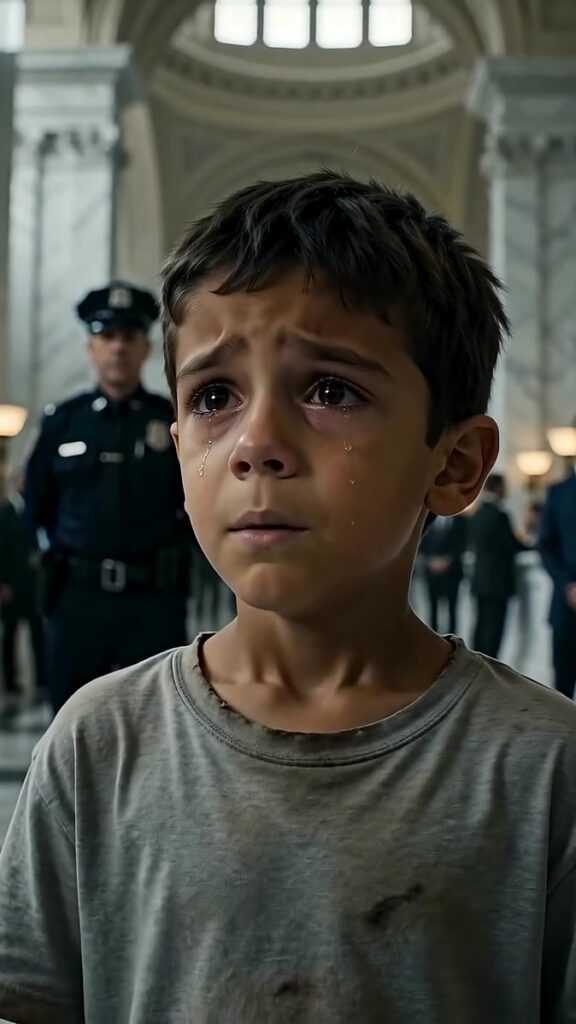
The building rose from the avenue like a pale monument, too clean for the city around it. Its marble steps were worn only at the edges, as if the world had tried to touch it and been turned away. Inside, the air smelled faintly of stone dust and expensive perfume. Light fell from a glass ceiling in a cold, vertical pour that made everyone’s shadow look sharper than it should.
People moved as though they had rehearsed it: men in dark coats slicing through the lobby with eyes forward, women with rigid handbags held close like shields, voices softened by carpet runners and the expectation of being overheard. Even the clocks seemed quiet—hands gliding with the indifference of money.
In the center of that order stood a boy who did not match any part of it.
He was small, the kind of small that made the vastness around him feel intentional. His T-shirt had lost its color to too many washes and too few choices. His shoes were scuffed at the toes where he dragged them when he didn’t want to be brave. He held a brown envelope to his chest, both arms around it, as if it might jump away.
He had practiced what he needed to say on the walk here. He had mouthed the words at red lights, tested them under his breath when the bus lurched. Each time, the phrase sounded simpler than the thing behind it. The thing behind it was his grandmother’s empty chair and the way the house now echoed.
When his turn came at the counter, he set a black bank card down on the marble with care, like laying a delicate object on ice. He stood on his toes to see over the ledge and aimed his voice up at the teller.
“Hi,” he said, because his grandmother had taught him that greetings matter. “I need to check the balance.”
The teller looked young enough to have been in school not long ago, but his tie sat perfect and his hair was cut with a precision that implied other people did the messy work for him. He glanced at the card, then at the boy’s shirt, then at the envelope held tight like a secret.
The teller’s expression didn’t have to change much to become unkind. A slight narrowing, a small curl at the edge of his mouth, and suddenly the boy felt as if he’d tracked mud across a sacred floor.
“You can’t be here,” the teller said. His tone was clipped, louder than necessary. “Leave the counter.”
The boy swallowed. His throat felt like paper. “I’m supposed to—”
“If you don’t walk away, I’m calling security.”
A shift rippled behind him: a pause in a line, the faint scrape of someone adjusting their stance. A uniformed officer near the entryway turned his head, his attention caught by the word security the way a dog’s attention is caught by a whistle.
The boy’s hands tightened on the envelope until the paper creased. He didn’t run. He couldn’t. Running felt like agreeing.
He nudged the card a little closer, pushing it across the marble as though distance alone had been the problem. “Please,” he said, his voice smaller now. “I just need to know what’s in there.”
The teller snatched the card up. “Where did you get this?” he demanded, and his voice rose on purpose, so that it would become everyone’s business. “This isn’t yours.”
Heat flooded the boy’s face and then drained away, leaving him cold. His eyes stung. He blinked hard, refusing to let the tears spill in front of all those polished strangers.
“It is mine,” he said, and the sentence came out with a wobble. “My grandmother left it.”
The word grandmother carried the weight of a funeral program folded too many times. It wasn’t a claim. It was a bruise.
The teller rolled his eyes, performing impatience for the line behind the boy. He turned to his computer, fingers moving fast, careless. The officer stepped closer, not aggressive yet, but alert. A woman with a gold watch shifted her handbag to her other arm, her lips tightening as if she’d bitten something sharp.
The teller’s hands kept moving. He typed, paused, clicked, typed again. He looked bored with the entire transaction, bored with the boy, bored with grief.
Then he stopped.
The change was so abrupt it seemed to pull the sound out of the room. His fingers hovered above the keys as if he’d suddenly forgotten what a keyboard was. He leaned in toward the screen, eyes narrowing, then widening. He clicked again, hard, as if the computer had insulted him. He read. He swallowed. He read again.
The smirk slipped away from his face like a mask being removed. Color drained from his cheeks. His mouth opened a fraction, then closed as if he’d bitten his own tongue.
The boy shifted his weight from one foot to the other, trying to keep his voice steady. “Can you tell me?” he asked softly. “Please.”
The teller didn’t answer. He stared at the screen as though it were a window into something he wasn’t meant to see. His hand, still holding the card, began to tremble. The officer arrived at the counter now, his presence a solid block of authority beside the boy’s slight frame.
“Problem?” the officer asked, calm but firm.
The teller looked at him, then looked back at the boy, and something like fear—real fear—flashed in his eyes. He lowered his voice, but the room was quiet enough that quiet carried.
“This account,” the teller whispered, “is under a protected estate.”
The officer frowned. “Meaning?”
The teller’s throat bobbed. “Meaning it’s tied to a trust. Meaning there are restrictions and… oversight. Meaning…” He glanced around as if the marble columns might be listening. “Meaning the balance is… substantial.”
The boy’s brow furrowed. He didn’t understand the words. Protected sounded like a blanket, estate sounded like a house too big for his grandmother. Trust sounded like something you did with people you loved, not something that lived behind a counter.
He clutched the envelope tighter. Inside it was a letter in his grandmother’s looping handwriting, the kind she used when she wrote his name on birthday cards. He hadn’t opened it yet. He had promised her, in the hospital, that he’d do it the right way. That he’d go to the bank first, because she said the bank would explain.
The teller’s hands moved again, but now they moved carefully, as if every keystroke could trigger an alarm. His eyes darted to the officer, then back to the screen. He swallowed and spoke with an effort that made his voice thin.
“There’s also a note,” he said. “It’s… it’s attached to the account. For the beneficiary.”
The boy’s mouth went dry. “Benef… what?”
“You,” the teller said, and the word landed like an object set down in front of him. “It means you.”
He slid the black card back across the marble, but he did it with two fingers now, gently, as if returning something dangerous. His earlier cruelty looked suddenly foolish, like a man laughing at a storm because he hadn’t realized it was coming for him.
The officer watched the teller closely. “How much?” he asked, still measured, though the question carried a new weight.
The teller hesitated. In the hesitation, the entire lobby held its breath. He finally turned the monitor slightly—not enough for the line to see, but enough for the officer to read.
The officer’s eyes flicked across the numbers. His jaw tightened. For a second, the practiced neutrality of his face faltered into something else: surprise, then recognition, as if he’d heard a story like this before but never expected to meet it.
The boy stared between them, confused, frightened by their expressions more than by any figure he could not comprehend.
“Is it… bad?” he asked, because at eight years old, big emotions usually meant bad things.
The teller’s voice broke slightly when he answered. “No,” he said. “It’s not bad.” He cleared his throat and sat straighter, as if posture could undo his earlier words. “It’s… it’s more than most people will ever see.”
The boy’s eyes filled anyway, not with relief exactly, but with a sudden ache for the person who should have been here to translate it all. “I don’t want most people,” he whispered. “I just want her.”
The officer’s gaze softened. He crouched slightly so he was closer to the boy’s height. “What’s in the envelope?” he asked.
The boy looked down at it, the brown paper worn at the corners from his grip. “A letter,” he said. “She told me not to open it until I got here.”
“Do you want to open it now?” the officer asked.
The boy hesitated, then nodded. His fingers trembled as he worked the flap. The paper tore a little. He pulled out a single sheet and unfolded it carefully, the way you unfold something that might change your life.
He couldn’t read all the words; some of them were too grown-up, too long. But his grandmother had left spaces for simple sentences, for him. At the bottom, in larger writing, there was a line he could manage.
His lips moved as he sounded it out, and when he spoke it aloud, his voice echoed against the marble like a small bell.
“If anyone makes you feel small,” he read, blinking through tears, “tell them you come from me.”
The teller flinched as if struck. The officer stood slowly, turning his attention to the teller with a steadiness that promised consequences.
The boy held the letter to his chest now instead of the envelope. He looked around the grand, unreal bank—the polished floors, the tall windows, the cold light—and for the first time since he’d stepped inside, he didn’t feel like an intruder.
He felt like a message that had finally arrived.
The teller cleared his throat. “I’m going to bring my manager,” he said, and the humility in his voice came too late to be clean, but it came all the same.
The officer placed a hand gently between the boy and the crowd, a quiet shield. “You’ll be treated properly,” he said.
The boy nodded, eyes still wet, letter crinkled under his fingers. Somewhere high above, sunlight shifted across the glass ceiling, and the marble brightened—just a little—as if the building had been waiting to be reminded that grandeur meant nothing without dignity.