The room was glowing with warm gold light, the kind that flattered every face and turned every glass into a small sunrise. It drifted from hidden sconces, from a chandelier so heavy it looked capable of breaking its own chain, and from the polished panels of a safe that dominated the far wall like an altar. Someone had chosen the light carefully. It made greed look like elegance.
They stood in clusters around the vault—men with cuff links that flashed when they laughed, women with satin sleeves that brushed crystal flutes. Champagne hissed and spilled in cheerful little accidents. There were private jokes and public smiles, each one a performance for the others. The safe drew them in: an enormous thing, gold-faced, embroidered with scrollwork and a crest that belonged to a family name whispered in certain clubs.
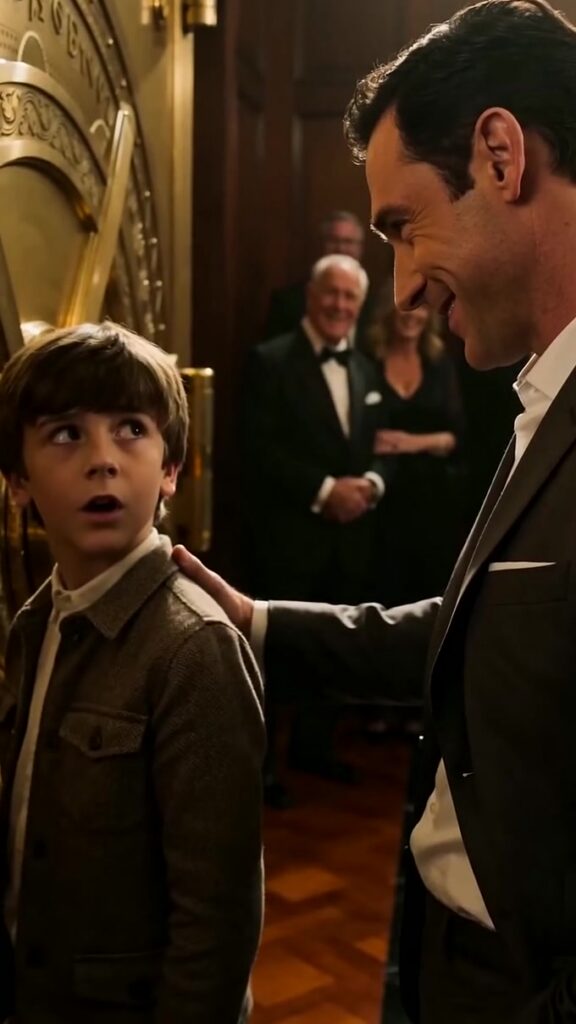
And in front of it, as if he’d been placed there by mistake, stood a boy in a brown tweed jacket. He couldn’t have been more than nine. His hair was combed too neatly, his hands held too still at his sides, his shoes too plain for the rugs. Everything about him suggested someone had dressed him for a photograph and forgotten to tell him to pretend.
A man in a dark suit drifted close and set a hand on the boy’s shoulder, a proprietary touch delivered with the ease of someone used to owning rooms. His smile was calibrated for applause. “I’ll give you ten thousand dollars if you open it,” he said loudly enough to let the offer bloom in the air.
A soft wave of laughter moved through the guests. An older woman lifted her glass to hide her grin. Someone near the back made a show of shaking his head—what a charming scene, what a clever party trick. The boy didn’t flinch at the number. He didn’t glance at the crowd to gauge how he was supposed to react.
He stared at the safe.
Not as if it were an obstacle. Not as if it were an opportunity. As if it were an old wound that had healed wrong and could still ache when the weather changed.
The man leaned down, the scent of cologne and expensive confidence mixing with the boy’s faint smell of rain and wool. “What’s wrong?” he murmured with practiced amusement. “Too hard?”
The boy lowered his gaze for a second, a small breath in, a small breath out, like he was bracing himself against something unseen. When he looked back up, his face was calm in a way that felt misplaced on a child. It chilled the warmth of the room without dimming a single lamp.
“Are you sure?” he asked.
The laughter didn’t stop immediately—it thinned first, then broke apart into isolated chuckles that died when they heard themselves. The man’s smile stayed for another heartbeat, then wavered at the edges.
“What did you say?” he asked, still loud, though the volume now sounded like armor.
The boy took one step toward the safe. It was not a dramatic stride, not a march; it was the kind of step taken by someone returning to a place they knew too well. The conversations around them faltered. Glasses paused midair. Without an announcement, the room arranged itself into silence.
The boy raised his hand toward the gold panel. His fingers hovered an inch from the surface, stopping with such certainty it was as though he could feel the mechanism through the metal. The safe gleamed back at him, reflecting a smaller version of his face, all seriousness and shadow.
“I asked if you’re sure,” he said again.
No one laughed now. The man swallowed, and it was only noticeable because the room had become so quiet that tiny human sounds turned loud. In that silence, something else became audible: a faint, steady ticking, almost like a clock. It had been there all along, buried beneath music and chatter. Now it sounded like patience.
The boy’s voice lowered. “Because once it opens…” He didn’t finish the sentence. He didn’t need to. The words hung in the gold light like a threat that could be interpreted in many ways.
The man’s expression shifted in increments. First irritation, then confusion, then the first thin line of fear. The older woman lowered her glass. Another guest took half a step back, as if distance might help if something spilled out of that safe that couldn’t be put back.
The boy turned his head and looked directly at the man. For the first time all evening, the man looked as if he’d been caught doing something he had assumed no one could understand.
“My father said you’d beg me never to touch this,” the boy whispered.
The words struck like cold water. A few guests glanced at each other, searching for context, but the ones closest to the inner circle went rigid, as if a name had been spoken without being spoken. The man’s hand slipped off the boy’s shoulder. His fingers curled, then opened again, a reflex he couldn’t control.
“Your father,” the man repeated, forcing lightness into his tone. “Is that so? And where is your father, then?”
The boy didn’t answer the question. He placed his fingertips against the lock plate. It was warm from the room’s heat, but beneath that warmth he sensed the chill of the steel spine. He tilted his head slightly, listening—not to the room, but to the safe itself. The ticking grew sharper in his mind, aligning with his breath.
Somewhere inside the massive door, a tiny metallic click sounded, precise as a pin dropping.
The man’s face drained. He tried to laugh and couldn’t. “Stop,” he said, and the word came out too quick, too raw. He reached toward the boy and hesitated, as if the child were suddenly something that might burn.
The guests leaned in despite themselves. Their wealth, their laughter, their champagne—none of it mattered against that single click. The safe had always been a symbol to admire. Now it became what it truly was: a mouth.
“It’s just a lock,” someone said weakly, but no one agreed aloud.
The boy pressed, not harder, but with a subtle shift—like finding the precise point where a secret yields. Another click. The crest on the door seemed to watch the room. The air tightened. The golden glow became oppressive, as if the light itself had been used to hide what would look monstrous in shadow.
“Listen to me,” the man said, and his voice had changed completely. There was no audience now, no performance. Only urgency. “Whatever he told you—whatever you think is in there—it doesn’t matter. You don’t understand. This was settled. That was the agreement.”
The boy’s eyes flicked over the man’s face, not with a child’s confusion but with a judge’s attention. “You made agreements with my father,” he said softly. “And you broke them.”
He slid two fingers along the seam where door met frame. He found a hairline irregularity, a place where gold ornamentation disguised a release. His hand moved with quiet familiarity, as if he’d practiced in dreams. The ticking in his head stopped.
The safe responded with a sound like a long exhale—deep metal shifting, bolts retracting. A low, heavy clunk reverberated through the floorboards and up the guests’ legs. Several people involuntarily stepped back, their laughter finally, fully gone.
“Don’t,” the man said. It was not a command anymore. It was a plea.
The boy kept his palm on the door, feeling the weight ready to swing. He glanced once at the crowd that had been so delighted to watch him fail. Their faces had changed. Their eyes reflected the gold light like coins held too close to a flame.
“He didn’t leave me money,” the boy said, and the words were calm enough to be mistaken for mercy. “He left me a key.”
The safe door shifted, opening a fraction of an inch. A thread of air slipped out—cool, dry, ancient. It carried a scent that didn’t belong at a party: paper sealed for years, iron, and something faintly medicinal, like a hospital corridor.
The man made a strangled sound, half name, half warning. His knees bent, as if his body had decided without him that it might need to kneel.
The boy pulled.
The golden door opened wider, the hinges complaining softly. Inside was darkness at first, a void refusing the room’s warm light. Then the interior revealed itself in layers: a velvet-lined compartment, stacks of folders bound with twine, a slim wooden box with a brass latch, and behind it all, bolted to the back wall, a small glass vial that caught the light and turned it hard.
On the top folder, in a hand that looked like it had written signatures worth millions, was the boy’s surname—followed by a date. Below it, a list of names. Several guests went pale as they recognized themselves.
“No,” the man whispered. He stepped forward, then stopped again, trapped between desperation and the certainty that touching any of it would make it worse.
The boy’s fingers hovered over the wooden box. His voice stayed steady, but something in it finally sounded like the strain of carrying a weight too large for small shoulders. “He said you’d build rooms like this,” he murmured, “fill them with light, and call it safety.”
He looked up. “He said you’d laugh.”
The chandelier shimmered above them. Champagne bubbles rose and burst in forgotten glasses. Somewhere, far away, music continued as if the house didn’t know what was happening in its heart.
The boy opened the wooden box.
Inside lay a recorder the size of a cigarette case, and beneath it, a single photograph: his father, bruised and smiling faintly, holding up two fingers in a gesture that could have meant victory or goodbye. Taped to the back was a note, written in the same hand as the folders. The boy didn’t read it aloud. He didn’t have to.
The man’s mouth trembled. His eyes glistened with a fear that had nothing to do with money. “Please,” he said again, to the boy, to the room, to the past. “You don’t know what you’re doing.”
The boy slid the recorder into his pocket and placed the photograph carefully back in its place, as if returning a blade to its sheath. He rested his hand on the edge of the open safe and let the gold light wash over him. His face was still too serious for a child, but now everyone understood why.
“I know exactly what I’m doing,” he said.
And at last, the room—glowing, elegant, full of borrowed laughter—felt like it belonged to no one at all.